As an ever-expanding open-access festival, FRINGE WORLD is something of a crapshoot, heavily dominated by cookie-cutter burlesque and comedy acts, with many artists struggling to get an audience or cover costs. Nonetheless there’s gold to be found, and a few genuinely original works manage to cut through.
FRINGE WORLD reviews – quick links
Broken Wheel
★★★
Broken Wheel is a new play by Perth-based emerging independent artists Indi Ellison and Nathan Di Giovanni, who met while doing the Advanced Diploma of Performance at WAAPA.
It’s a tender and delicate work for four actors about parenting patterns repeating themselves from one generation to the next, and Ellison and Di Giovanni are to be applauded for their courage in entrusting it to the hurly burly of FRINGE WORLD.
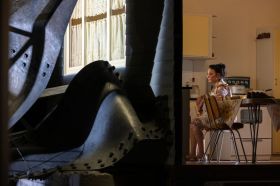
Perhaps wisely, Broken Wheel was staged in the small black box theatre space at DADAA in Fremantle, a disability arts venue in a peaceful and somewhat out-of-the-way location at a safe distance from the festival’s main hub in Northbridge.
The play was a series of dialogue scenes between a single mother and teenage daughter (Gabrielle Wilson and Alannah Caramelli), and another single mother and her teenage son (Andrea Fernandez and Daniel Pais).
The interconnection between the two couples was gradually revealed. A voiceover by a small child (uncredited but possibly the most affecting performance in the show) also opened the play with a slightly bowdlerised version of Philip Larkin’s famous poem This Be the Verse (‘They fuck you up, your mum and dad’) and reappeared very effectively in the final scene. Otherwise, writing and staging were essentially naturalistic and minimal.
The only item of set was a bed scattered with clothes and toys, and the only non-naturalistic ‘device’ was that some scenes involved both couples onstage speaking identical and simultaneous or overlapping lines of dialogue (much like Andrew Bovell’s Speaking In Tongues, which my friend and colleague Humphrey Bower directed for Black Swan State Theatre Company in Perth last year).
Unlike Bovell, however, Ellison and Di Giovanni are still-emerging playwrights, and the play was somewhat formulaic in terms of its characters, dialogue and basic conceit. Perhaps intentionally, there was little sense of where or when the play is set, and few contextualising details – work, school, social class, extended family or other relationships – to help the actors flesh things out; the fact that all four actors were fairly close in age made their task even more difficult.
There were also missed opportunities for humour in terms of intergenerational misunderstandings, and for dramatic irony in the use of simultaneous dialogue. A certain lack of emotional bandwidth was reflected by the minimalism of the set and lighting (perhaps inevitable given the FRINGE context and shared venue) along with the amount of unused floorspace around the central bed that was the sole focus for much of the action.
Notwithstanding these reservations, the play left me ruminating about questions of agency and responsibility. Are we doomed to repeat the past in our relationships, especially between parent and child? Or can we break the cycle?
The play tentatively suggests that we can but doesn’t give much sense of how this might be possible, other than by offering a somewhat simplistic notion of forgiveness, and a somewhat schematic sense that this might be easier for one generation than another, or even (more problematically) between a mother and son than a mother and daughter.
Written by Madelaine Nunn and directed by Lucy Clements, sitting, screaming is a new work for a solo performer (Helena Cielak) that debuted at The Old Fitz in Sydney in 2024 and also had a short season at The Blue Room as part of the venue’s curated season of Summer Nights for FRINGE WORLD.
Like Broken Wheel, another FRINGE WORLD production about teenagers’ relationships with adults, sitting, screaming also had the advantage of having had runs on the board and a swag of rave reviews, but was a much more nuanced show in terms of its writing, direction, design and central performance.
Broken Wheel played at DADAA, Perth from 29 January to 2 February as part of FRINGE WORLD.
sitting, screaming
★★★★
Written by Madelaine Nunn and directed by Lucy Clements, sitting, screaming is a new work for a solo performer (Helena Cielak) that debuted at The Old Fitz in Sydney in 2024 and also had a short season at The Blue Room as part of the venue’s curated season of Summer Nights for FRINGE WORLD.
Like Broken Wheel, sitting, screaming also had the advantage of having had runs on the board and a swag of rave reviews, but was a much more nuanced show in terms of its writing, direction, design and central performance.
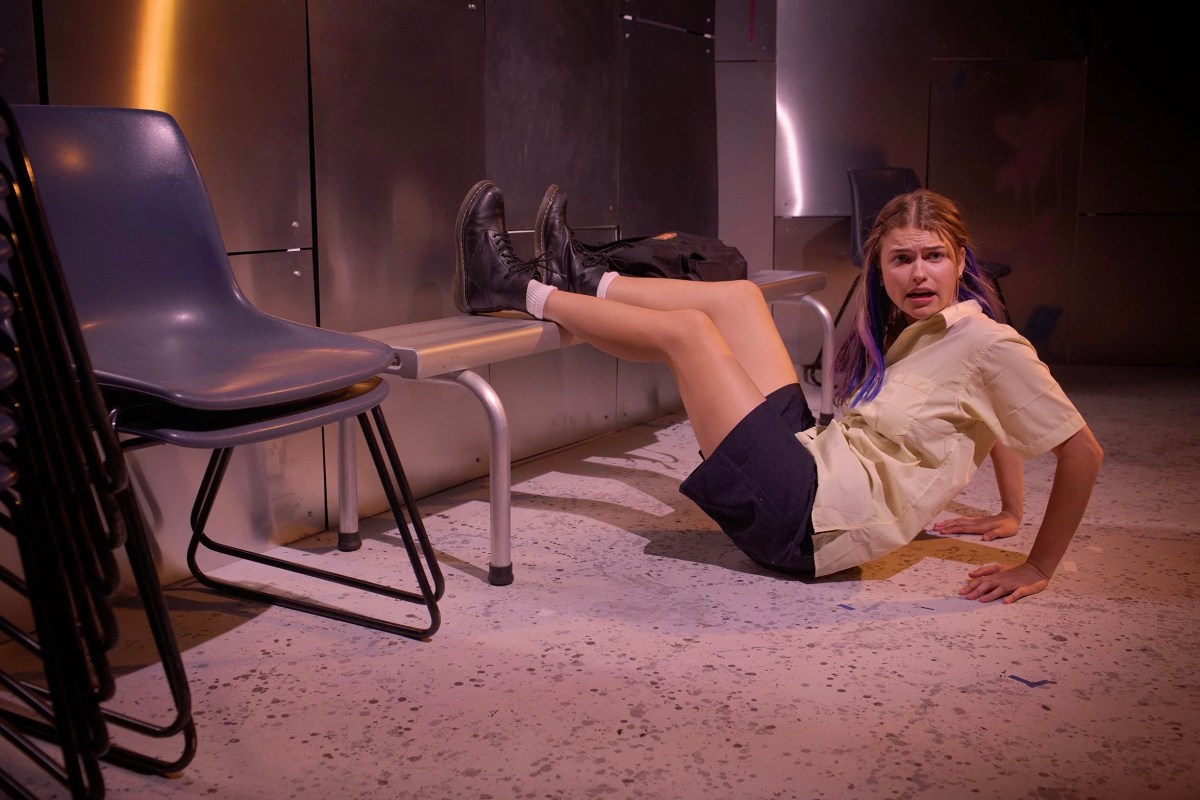
The play was shortlisted for the Rodney Seaborn Playwright’s Award, which encourages the development of plays with ‘positive values’, and longlisted for the Griffin Award, and one can see why.
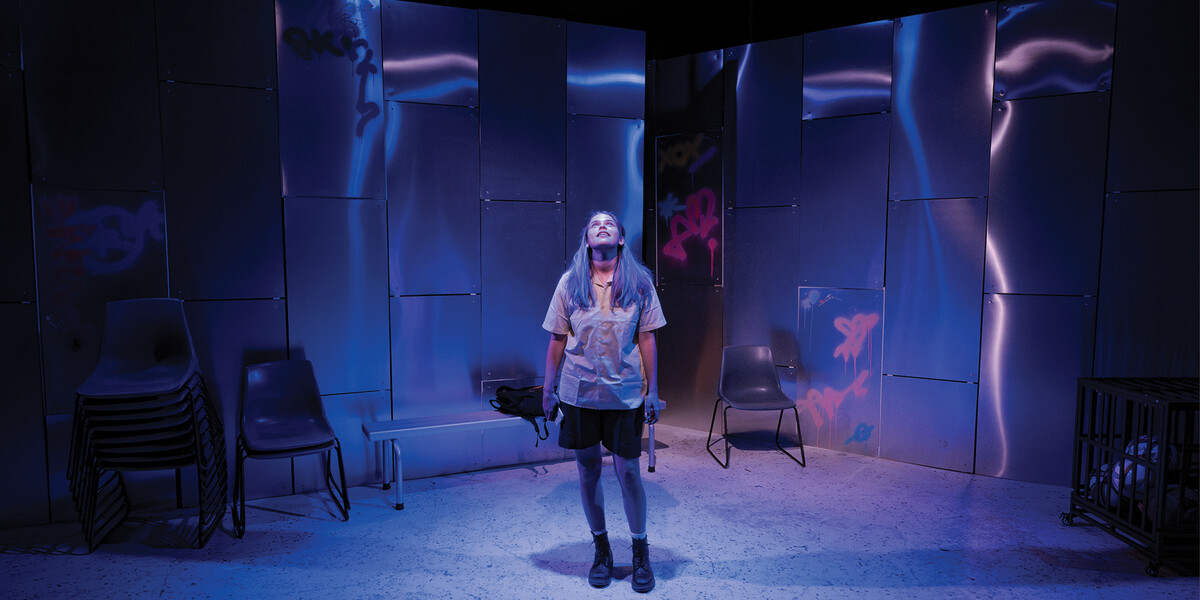
Sam (Helena Cielak) is a schoolgirl in her mid-teens dealing with a father who’s been diagnosed with prostate cancer, a full-time working mother under pressure, an annoying brother, and complicated relationships with friends and teachers – including Mr David, who initially seems like a knight in shining armour, but turns out to be something more sinister.
Clements’s writing is on-voice in terms of character and idiom, and there’s plenty of wit along with occasional glimpses of compassion to leaven the increasingly dark story.
The Blue Room is an ideal venue: located within the festival hub in Northbridge, but with its own tradition (and established audience) for staging diverse and innovative work by emerging and established artists.
It also has experienced staff, a great bar and overall ambience; the Main Space in particular is not just a black box (like DADAA) but has its own distinctive interior architecture that effectively frames even the most minimal FRINGE WORLD show.
Nunn’s direction and Hailley Hunt’s set have the right amount of theatricality without drawing too much attention to themselves, however Sam Cheng’s sound design and Luna Ng’s lighting punctuated the story a little too heavy-handedly for my taste.
Cielak’s performance occasionally fell into the same trap, but for the most part she was emotionally truthful, deeply engaging and managed to walk a fine line between being an annoying teenager and an intelligent and sensitive young woman crying out for help and desperately but clumsily seeking love.