There’s an insistent brilliance to the Craig Baldwin-directed English that reveals itself not with theatrical flourish but through restraint and emotional accumulation.
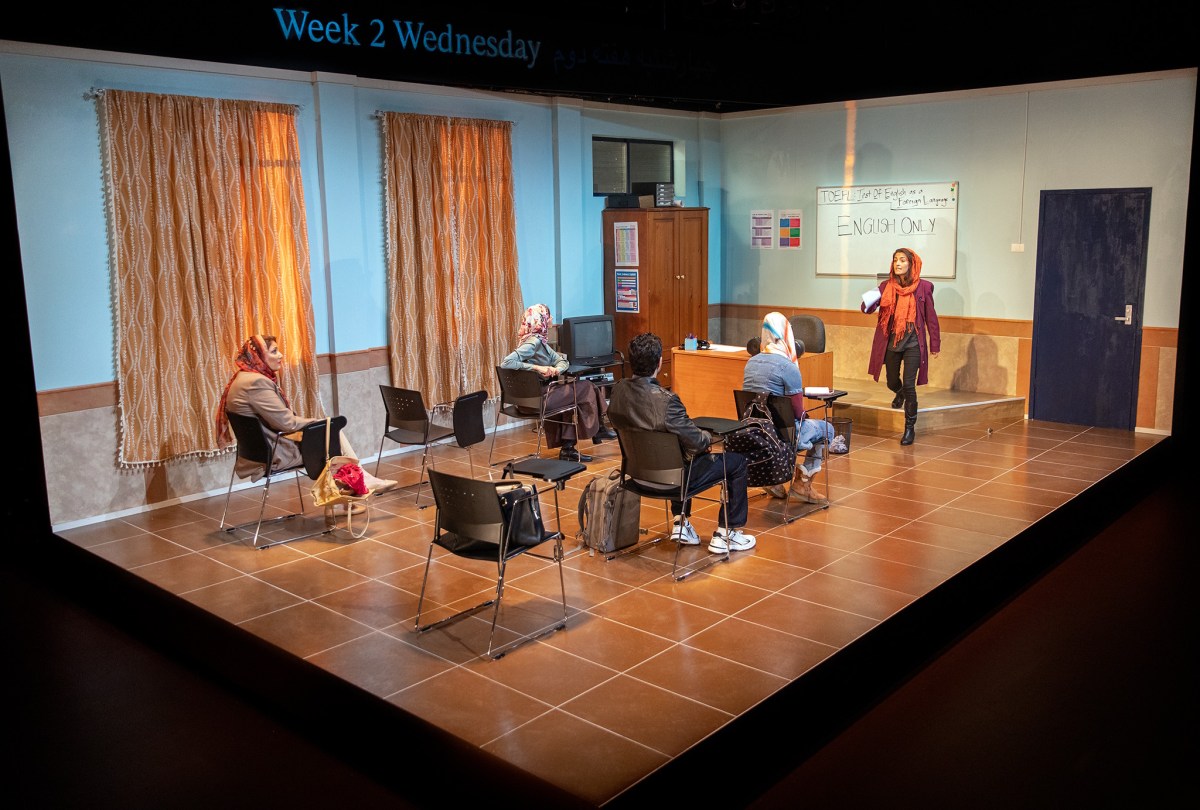
Written by Iranian-American Sanaz Toossi, the Sydney premiere of this Pulitzer Prize-winning work unfolds in a classroom in the Iranian city of Karaj, where four adult students prepare for their TOEFL (Test of English as a Foreign Language) exam under the watchful eye of their teacher, Marjan (Nicole Chamoun).
What sounds like a modest premise quickly deepens into something far more resonant: a meditation on identity, displacement and the subtle aggressions of assimilation.
English review – quick links
Precision performances
Baldwin, the first Australian to graduate from the prestigious drama program at the Juilliard School in New York City, understands the play’s power lies as much in what is withheld as what is spoken. The classroom setting becomes a kind of pressure chamber, where language is both a tool and a barrier. Each character’s relationship to the English language reveals fissures in their sense of self.
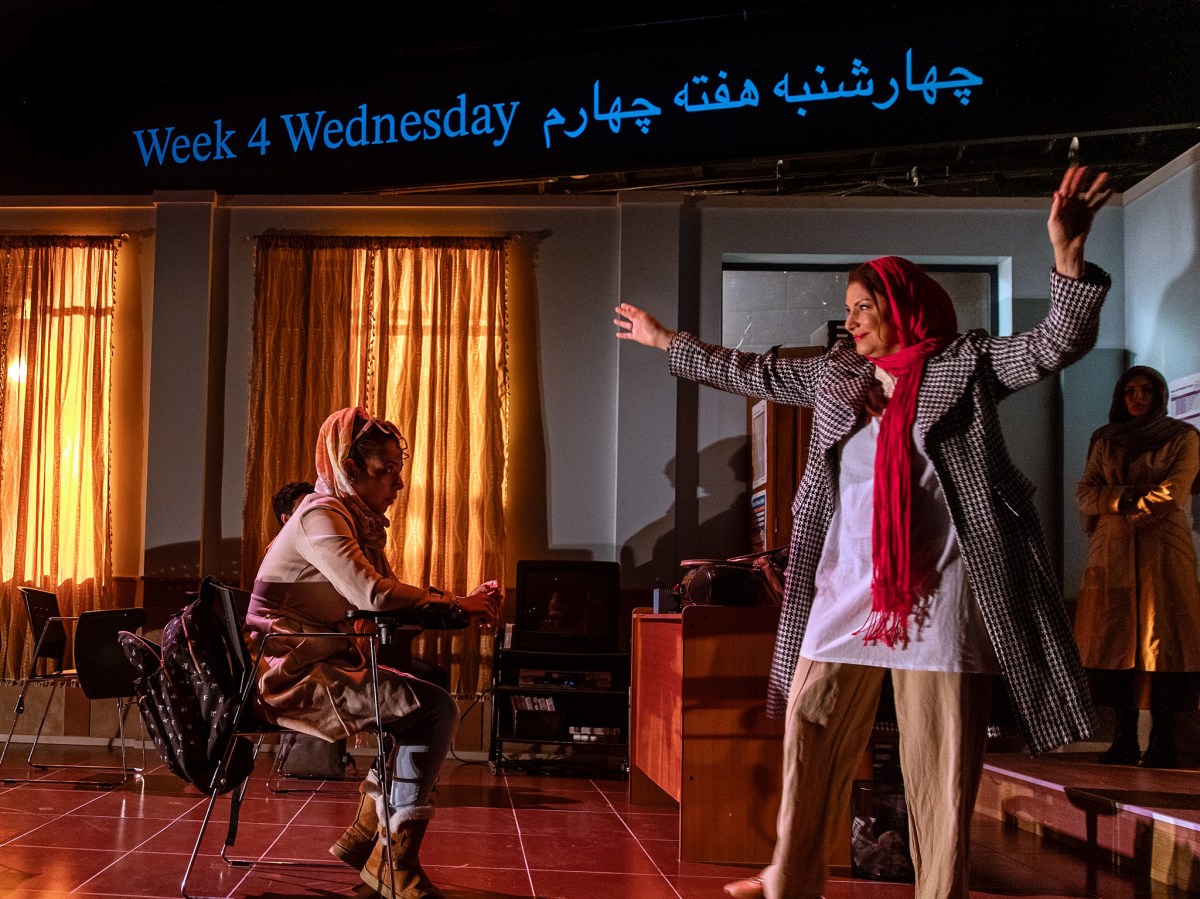
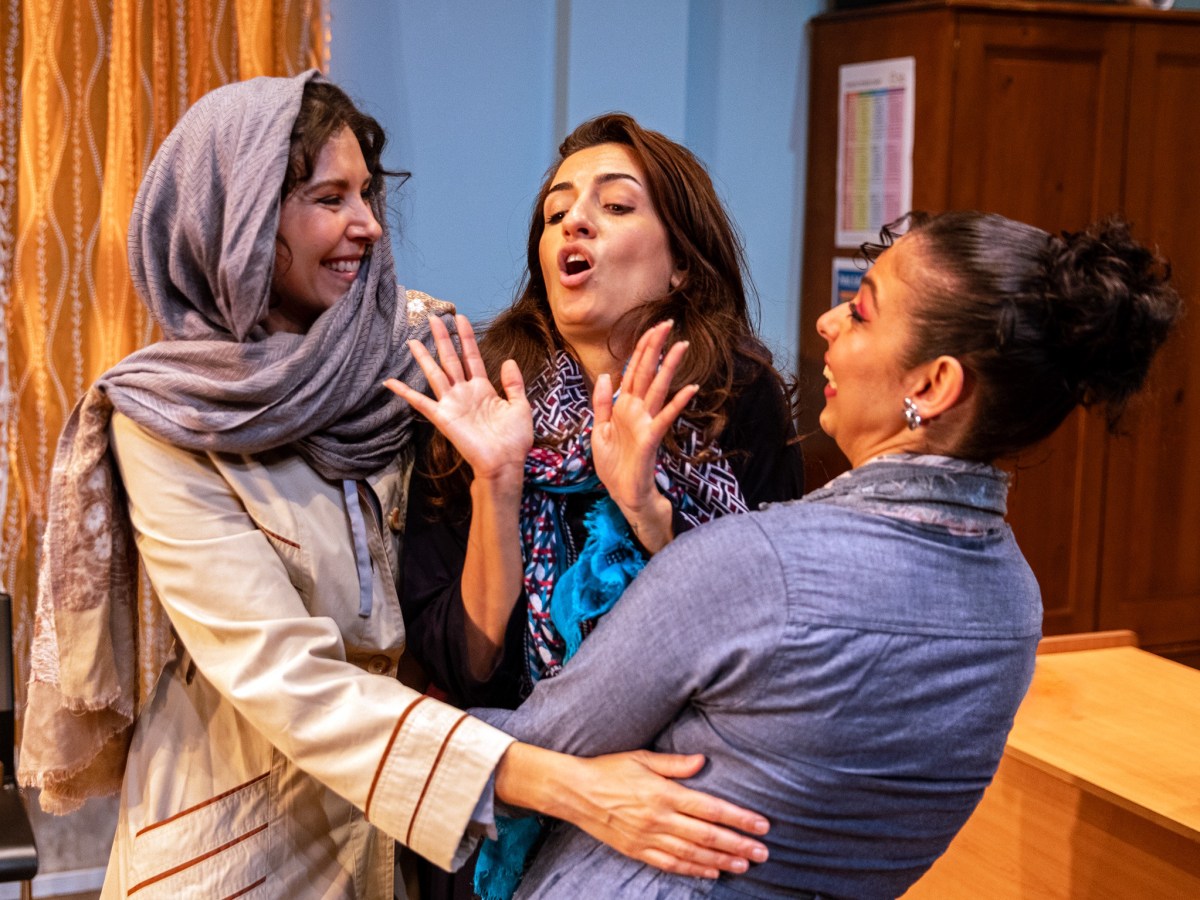
The ensemble cast here is uniformly strong, delivering performances that are finely calibrated rather than showy. Joining the teacher are the four students: the proud and defiant Elham (Setareh Naghoni), an aspiring medical student frustrated at having to learn a language that feels at odds with her identity; the young and optimistic Goli (Minerva Khodabande), who ‘likes how she sounds’ in English; Omid (Pedram Biazar), whose near-native English fluency makes his presence in the class a point of curiosity and suspicion; and Roya (Neveen Hanna), whose desperation to learn English so she can communicate with her Canadian-Iranian granddaughter is poignant and heartbreaking.
Each actor successfully navigates the balance between humour and pathos in Toossi’s script – the broken English, the comical misunderstandings – and their performances never tip too far into caricature. The characters are played with an empathy that resists easy categorisation.
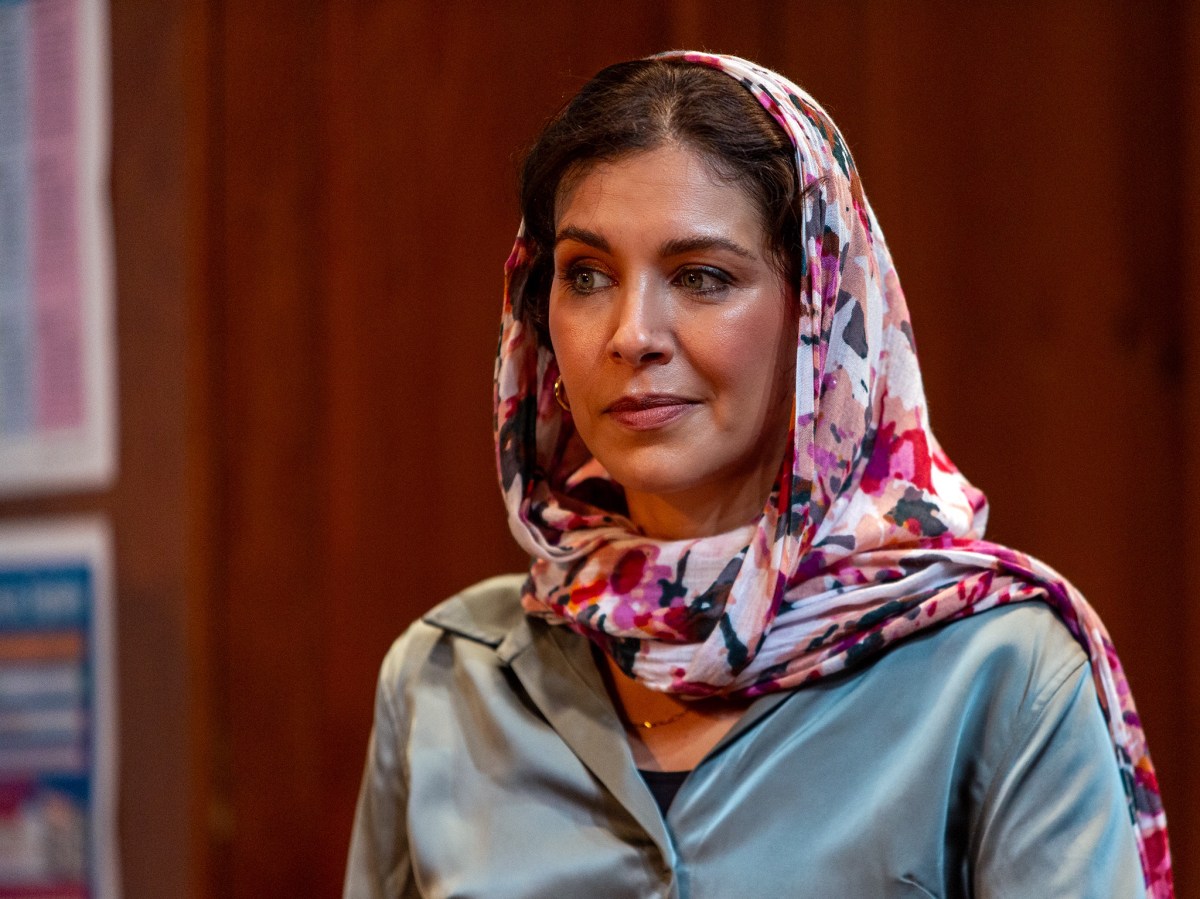
If there’s a star here, it is arguably Chamoun. The story revolves around her portrayal of the teacher, whose insistence on ‘English only’ becomes both a professional mandate and a personal shield. There is a tension in this role that speaks volumes: authority masking vulnerability, and fluency concealing compromise.
Chamoun’s performance anchors this production of English, allowing the surrounding characters to orbit with distinct yet interconnected trajectories.
The politics of language
While Toossi’s script is deceptively simple, beneath its surface lies a sophisticated interrogation of linguistic imperialism. English, here, is not merely a second language – it is a gatekeeper, a currency and a form of erasure. The play asks what is lost when we abandon our mother tongue in pursuit of opportunity, and who gets to decide which language holds value?
The production interrogates these questions without didacticism. Instead, it allows them to emerge organically through character interactions. A mispronounced word becomes a moment of shame; a fluent sentence is a small victory tinged with loss. There is humour, often wry and self-aware, but always undercut by a deeper melancholy.
Design elements are appropriately understated. The classroom set (designed by Soham Apte) is functional, almost austere, reinforcing the sense of confinement. Lighting (by Spencer Herd) shifts subtly but effectively, tracing emotional transitions rather than dictating them. The discipline in the staging mirrors the discipline imposed on the characters themselves.
A quietly devastating triumph
What ultimately makes English so affecting is its refusal to offer easy resolutions. There are no grand epiphanies, and no happy endings wrapped in neat little bows. Instead, the play accumulates emotional weight through small, precise moments – a hesitation before speaking, a glance that lingers too long, a joke that lands just slightly off.
In an era where productions strive to be obvious in immediacy and spectacle, English feels almost radical. It invites us to listen closely, to consider the ways in which language shapes not only how we communicate but who we are allowed to be.
It’s an exceedingly relevant play in a world where the politics of national identity, culture and belonging are big issues of the day. The current geopolitical machinations – which we’re all too aware of each time we fill the car with petrol, buy some groceries or turn on the news – only serve to heighten its relevance.