Echoes Through Time was the first instalment in Sanctum Series, a program of concerts at St Mary’s Cathedral as part of Perth Festival. The series presumably reflects Perth Festival Artistic Director Anna Reece’s laudable desire (as expressed in the festival brochure) to ‘unlock spaces and transform them into sites of surprise and delight’.
Unfortunately the visual, spatial and especially acoustic shortcomings of the venue, at least for orchestral or chamber music, were cruelly exposed.
Echoes Through Time review – quick links
Wrong space, wrong program
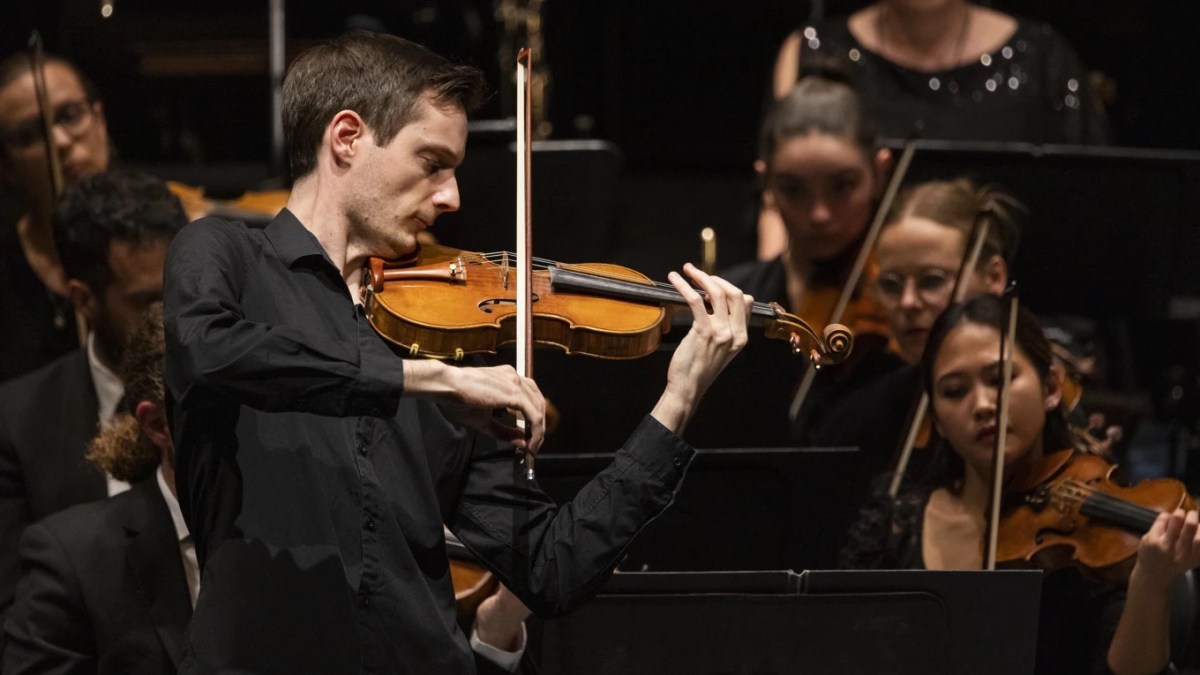
A program featuring 15 West Australian Symphony Orchestra string players – augmented in the second half by bells, a choirboy treble, and finally a second string section located in the rear sanctum of the cathedral – was a recipe for disaster.
The ensuing wash of sound rendered the music mostly incoherent and occasionally inaudible, and must have been a nightmare for the musicians, who (despite a certain inevitable cautiousness in their playing) acquitted themselves as best they could.
The Echoes Through Time program itself seemed similarly incoherent, consisting of a grab bag of European and Australian works across five centuries. Only a few – Arvo Pärt’s Cantus In Memoriam Benjamin Britten, Britten’s Corpus Christi Carol and perhaps the Vaughan Williams – could be described as having any connection with the venue or each other.
The rest – Australian composer Melody Eötvös’s Meraki, Polish 20th century composer Wojciech Kilar’s Orawa and (most incongruously of all) excerpts from Purcell’s The Fairy Queen – were more theatrical or folk-inspired than ecclesiastical or religious.
Perhaps one could say that a certain ‘sonorousness’ characterised most of the works (though one would be struggling to apply this to the Purcell) and that this quality may have been intended to match that of the venue. If so, it was a fatal miscalculation, as the latter totally cancelled out the former, which in most cases would have been better served in an acoustic environment like that of Perth Concert Hall.
Cavernous acoustics delivered the wrong kind of echoes
The Echoes Through Time concert began with an understandably somewhat timid rendition of Eötvös’s Meraki, a playful work with motifs and timbres evoking the composer’s Hungarian heritage. This was followed by a seemingly random selection of dances from The Fairy Queen, in which Purcell’s delightful rhythms and modulations were utterly ruined by the cavernous acoustic.
After this debacle, Kilar’s neo-minimalist Orawa came as something of a relief. Its repetitive unison phrases and rhythms drawn from Polish folk music were amplified but not unduly distorted by the acoustics, and the musicians were able to play with more confidence and vigour as a result.
After interval, Pärt’s Cantus In Memoriam Benjamin Britten was the most successful item on the program, the acoustic complementing the layered and essentially static nature of the work. The Corpus Christi Carol, on the other hand, was another disaster, not least because the ‘world premiere’ arrangement of what is originally a choral work (later arranged by Britten for solo treble voice and piano) here featured a string orchestra (grossly sentimentalising Britten’s austere textures and harmonies) and a solo treble choirboy, who would have been swamped by a string orchestra even in a concert hall (and even with a preternaturally loud choirboy).
Finally came Vaughan Williams’s glorious Fantasia, the inherent sonority of which was obscured rather than amplified by the acoustics, as was the almost inaudible solo violin, while the placement of a second orchestra in the sanctum at the rear of the cathedral made it similarly inaudible (at least from the nave where most of the Echoes Through Time audience were seated).
Programming work in unconventional venues is a fine thing as long as it suits or responds to the site. Otherwise at best it’s a gimmick; at worst, one that’s likely to blow up in one’s face.