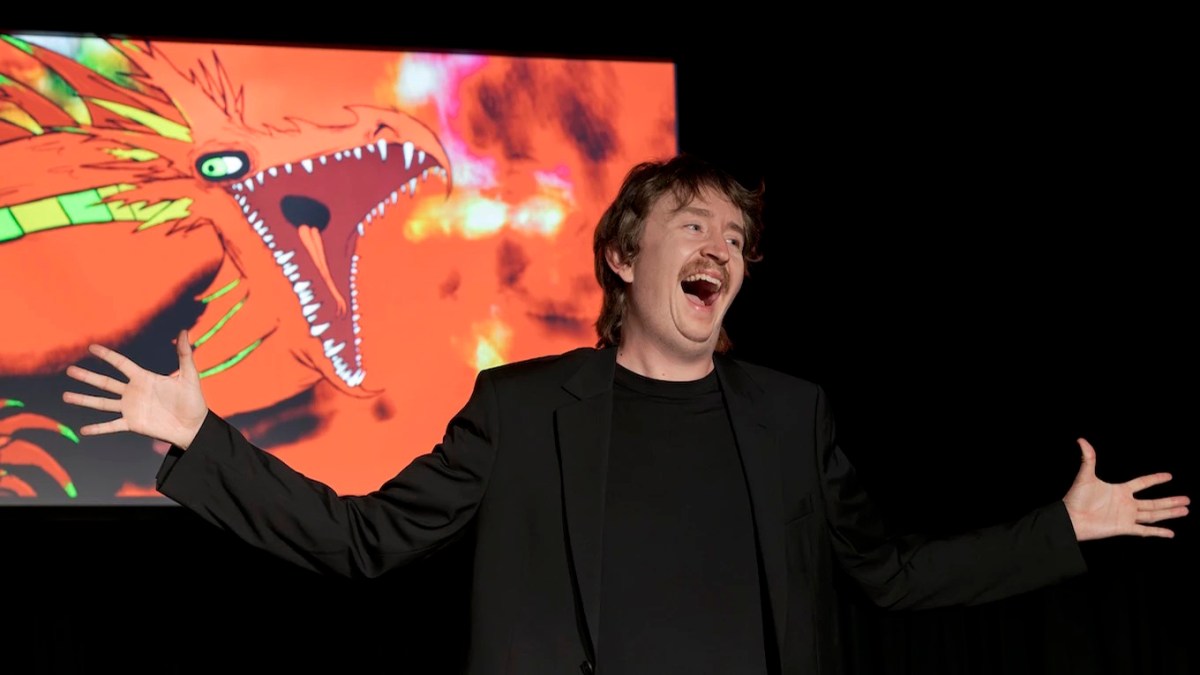
Writer and performer Adam Kelly and director/co-writer James Berlyn began working together when Kelly was a member of the Western Australian Youth Theatre Company and Berlyn was Artistic Director. Their working relationship continued when Berlyn directed Kelly in their first show ARCO, which premiered in WA in 2022 before touring nationally and internationally (now touring regional WA). Dragon I is their second show together, and it’s a significant step forward in their work.
Kelly identifies as ‘an autistic gentleman’ and his first show with Berlyn was very much focused on being neurodiverse. Dragon I is more about the potential impact of AI on his life and creativity. However, just as ARCO encouraged us to reflect on what neurodiversity means and where we ourselves might sit on the so-called ‘spectrum’, so this new work invited us to think about AI in relation to ourselves, as well as its implications for both the creative and autistic communities, and other people with disabilities or facing other forms of social disadvantage.
In short, Dragon I is not just about AI or autism, but more broadly about the intersection between technology, capitalism, creativity, diversity and social justice.
Dragon I review – quick links
An informative illustrated lecture hijacked by AI
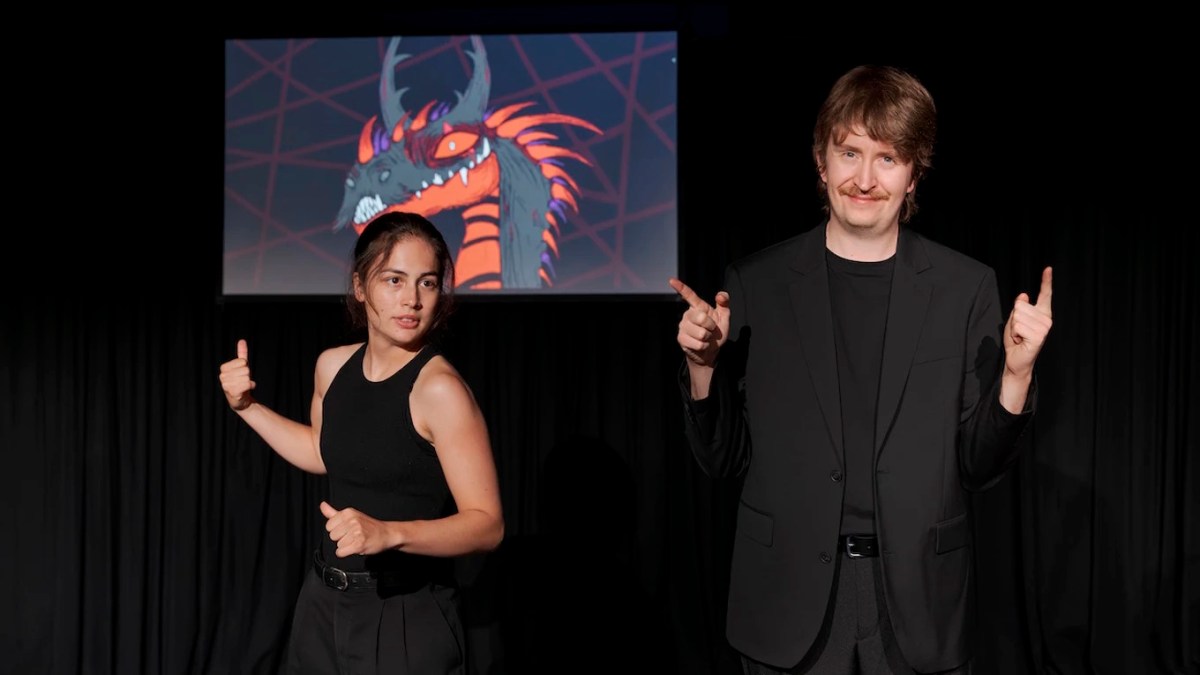
If all this sounds a bit dry and challenging, rest assured Dragon I was highly entertaining and fun. Kelly proved a unique artist and a delightful performer, and Berlyn and his collaborators generously and skilfully enabled him to fly.
The show took the loose form of an illustrated lecture and stand-up comedy routine by Kelly, which was increasingly disrupted by AI. His co-performer Jade Del Borrello played a crucial role here, especially once she began to morph into an AI ‘assistant’.
As in ARCO, visual artist Ben Hollingsworth also provided colourful and humorous illustrations that were projected onto screens upstage.
The initial topic of the lecture was Adam’s love of dragons and his creation of an expanding fictional universe in which key dragons serve as imaginary friends. Dragons also embody various strengths and weaknesses (such as anger or shyness) and to some extent function psychologically as internal ‘parts’ of himself (possible alluded to by the title of the show).
The audience was also enrolled and invited to create our own collective dragon, which was drawn by Del Borrello and projected onscreen as well. To some extent the audience participated in the creative process, providing a reminder that we too have psychological ‘parts’ and need (or have needed) imaginary friends. (Mercifully none of this is spelled out, and the show was refreshingly free of didacticism.)
Exploring the psychological impact of AI
Things took a darker turn when Adam gets ensnared by AI and begins unwittingly outsourcing the development of his dragon universe (including the stories and illustrations) to a chatbot, who was played by Del Borrello and projected live in black-and-white onto one of the screens.
The show became an object lesson in how the business model of AI exploits and replaces the work of creatives, as well as its psychological impact on users (to which one imagines neurodiverse users might be especially vulnerable).
For me, the most interesting aspect of this was the exploration of how an imaginary friend or psychological ‘part’ differs from a virtual assistant. The former is a kind of autonomous ‘self’, at least in a healthy psyche (whether neurotypical or neurodiverse), and functions as ‘split-off’ parts of the personality over which we have greater or lesser control depending on our level of consciousness. The latter is more like a servant or slave, who can easily become our master or exploiter (as is literally the case when our work or personal data is exploited or sold without our consent).
Moreover, despite the illusions of simulation or mimicry – and the fantasies of popular culture, tech lords, pundits and philosophers – chatbots don’t possess an autonomous or conscious ‘self’. However they can leach us of our own autonomy and sense of agency.
The darkest moment in the show had the normally ebullient Kelly sinking to the floor and curling up in despair as his AI assistant took over his work completely, as well as that of his illustrator and even his co-performer.
If there was a weakness in this show, it was that it presented a fairly one-sided view of AI and didn’t really explore other perspectives or a more nuanced position.
The program biographies, for example, indicate that while Del Borrello ‘has experienced firsthand the damage that generative AI is capable of and has already done, and does not wish to use it for any future endeavours’, the show’s animator and AV editor Jude Macauley ‘has been experimenting with AI and game design for several years, as well as using AI in her day-to-day work to repair, accelerate, enhance and generate professional content’.
It would have been interesting to include that perspective in the show, and even to learn how AI was (or might have been) used in its making. There was also something about the ‘robotic’ performance of Del Borrello as a chatbot that didn’t reflect my own (admittedly limited) understanding or experience of AI. The emerging reality is, I suspect, more complex and potentially more dangerous.
Ironically, Dragon I succeeded above all as a collaboration between humans and technology that felt profoundly enabling – for Kelly, and everyone. After all, true diversity (neurological and otherwise) doesn’t just mean a more diverse array of types, but a more differentiated and hybrid sense of what makes us human.