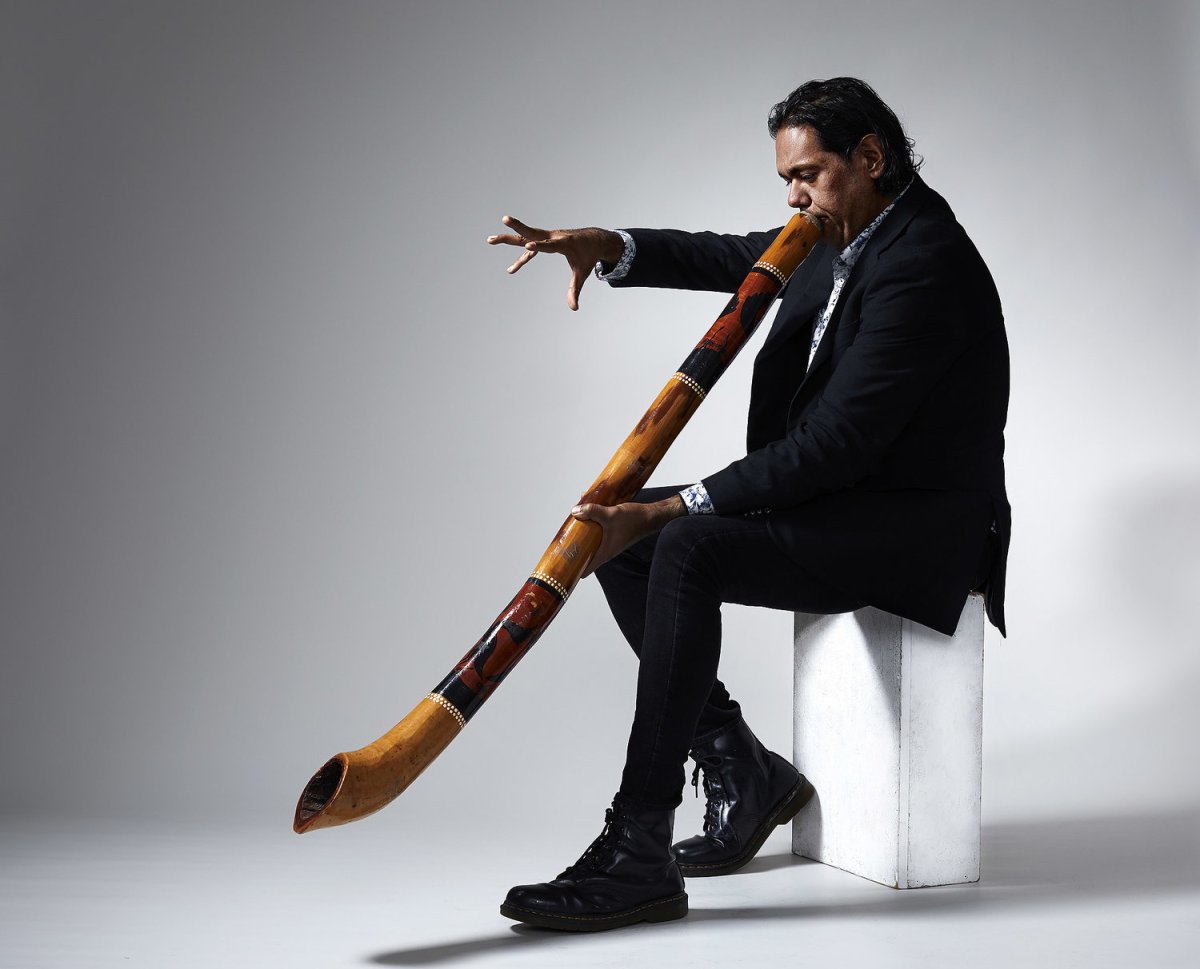
The Brodsky String Quartet have been at the forefront of chamber music in the UK since their formation in 1972. Two of the original members – Ian Belton (violin) and Jacqueline Thomas (cello) – are still with the quartet, while violist Paul Cassidy has been with them since 1982 and violinist Krysia Osostowicz joined them as leader in 2021.
Somewhat like the Kronos Quartet in the US, the Brodskys have a reputation for commissioning and playing new and cross-genre music (such as their collaborations with Elvis Costello, Sting and Björk) as well as works from the traditional repertoire, and like Australian Chamber Orchestra, they’ve made a habit of playing standing up since 1992. (Even Thomas either sits on a podium so her head is the same height as the others, or stands with a stool under one foot so she can rest the cello against her knee.)
It’s fair to say that like those ensembles they’ve been pioneers in bringing classical music (and particularly chamber music) into the contemporary world. Saturday night’s concert with Kalkadunga composer and musician, virtuoso yidaki/digeridoo player and singer William Barton at Adelaide Festival was thus grist for their mill.
Brodsky with William Barton review – quick links
Little collaboration in this cross-cultural project
Barton is an incredible artist and has forged his own path in intercultural collaboration between First Nations and Western Classical traditions. However, for me the concert didn’t quite cohere or coalesce as effectively as last year’s cross-cultural collaborations between West African, Javanese and Vietnamese musicians and the Australian String Quartet under the curatorship of Kronos leader David Harrington as part of Adelaide Festival 2025.
Part of the problem was the program itself, which alternated between contemporary Australian works involving Barton (and in one case composed by him) and works from the Western canon for string quartet alone, where Barton was absent from the stage.
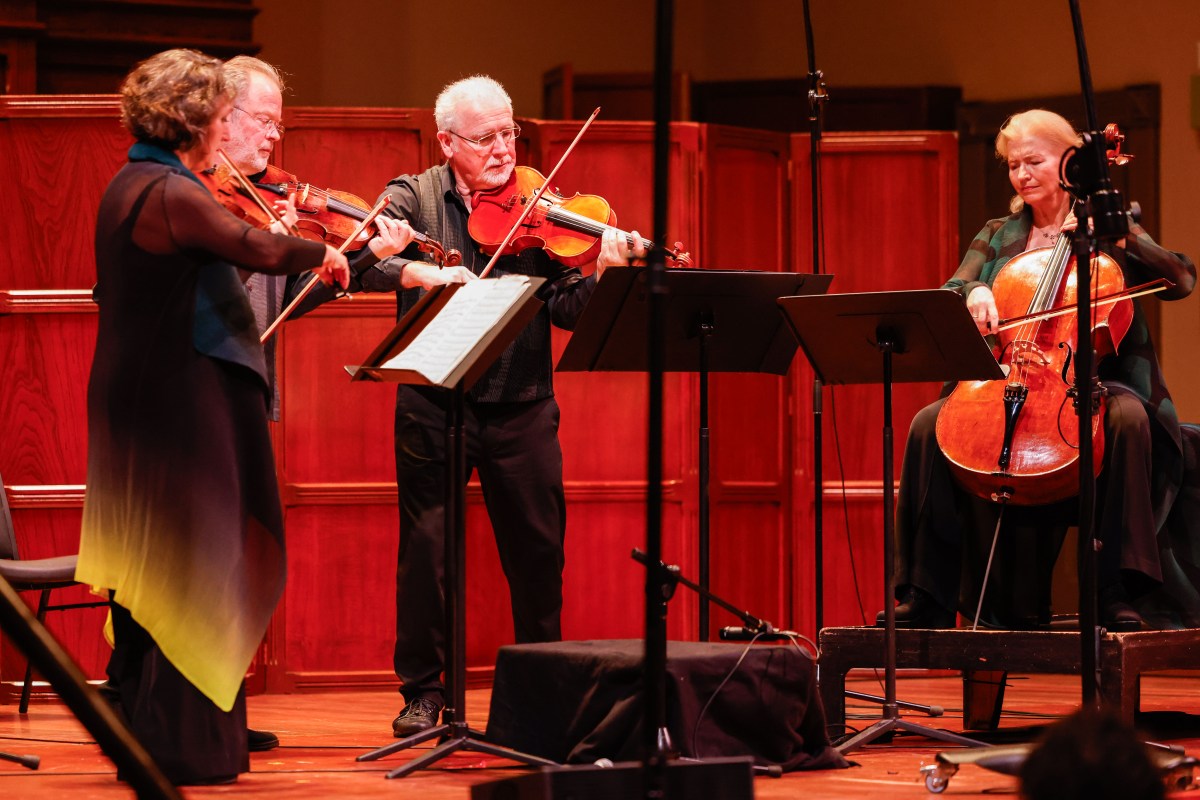
The night began with a Welcome to Country (including some powerful yidaki playing) was followed by a brief offstage yidaki soundscape from Barton; then the quartet entered without Barton and played one of Purcell’s glorious and intricate Fantasias (in D minor, Z.739), which to my ears seemed utterly disconnected from what we’d just heard.
This was followed by two contemporary Australian works for quartet and yidaki – Sculthorpe’s String Quartet No.11 Jabiru Dreaming and Robert Davidson’s Minjerribah – that were both evocative of Country. The essentially modal nature of these works easily lent itself to the monotonal qualities of the yidaki.
Barton then left the stage again while the Brodskys played Janacek’s dramatic Kreutzer Sonata quartet: another work that, like the Purcell, seemed unrelated to anything we’d heard so far (and for my taste here given a rather tame rendition).
The Brodskys no match for the charismatic William Barton
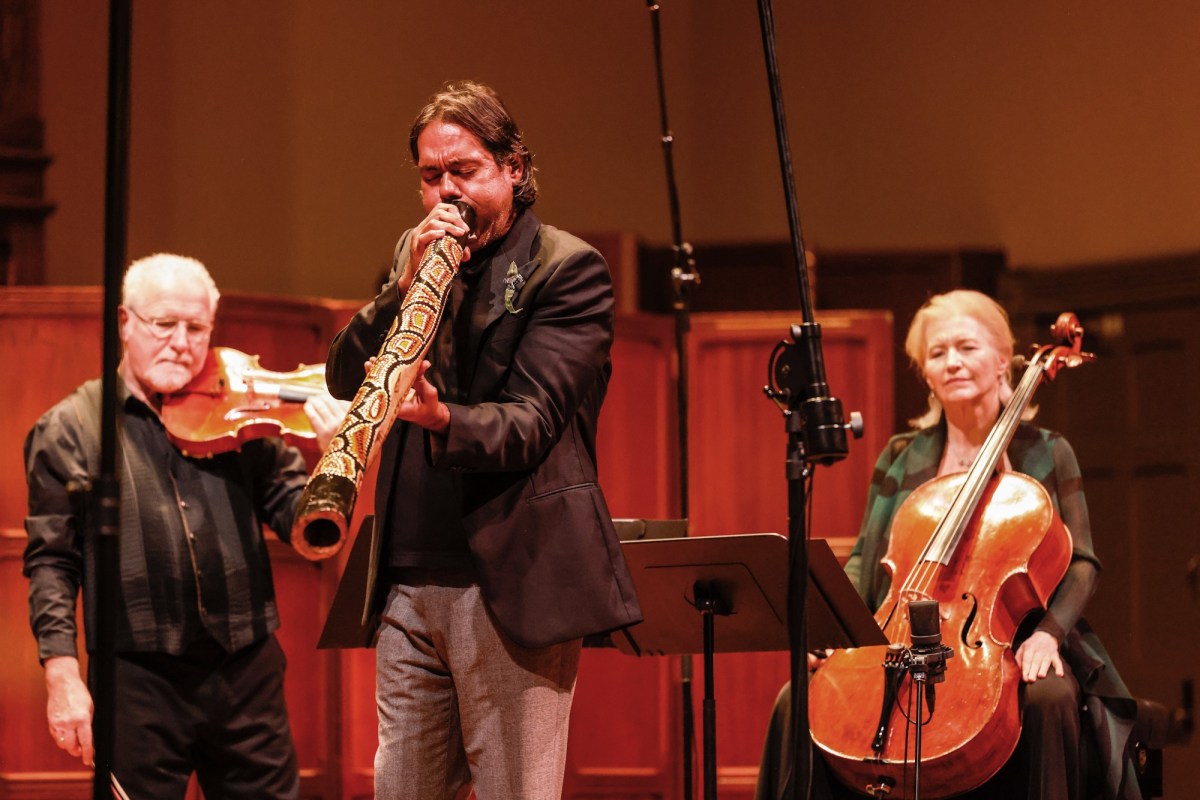
After interval things initially looked more promising as the Brodksys and Barton walked on together and strolled around the stage playing an arrangement of the Danse from Stravinsky’s Three Pieces for String Quartet, which despite its title has nothing inherently ‘string-quartet-like’ about it, the repetitive modular folk-derived rhythmic cells that make up each part lending themselves to this kind of treatment.
This was followed by two more evocative local contemporary works: Australian composer Andrew Ford’s haunting String Quartet No.7 Eden Ablaze (commemorating the Black Summer bushfires of 2019 and 2020) and New Zealand composer Salina Fisher’s String Quartet Torino (which mimics the sounds of the pūtōrino, a traditional Maori wind instrument).
ArtsHub: ATD’s Faraway review – a techno-primitive delight at Adelaide Festival 2026
Next came an arrangement for string quartet and voice by the Brodskys’ violist Paul Cassidy of the Irish folk song She Moved Through The Fair, recently and memorably sung by Sinead O’Connor. Unfortunately Cassidy’s somewhat weak voice wasn’t up to the task and suffered in comparison with O’Connor – and for that matter Barton, who immediately afterwards entered through the audience singing the introduction to his own work for voice, yidaki and string quartet, Square Circles Beneath the Red Desert Sand (another work deeply resonant of Country, in this case his own, around Mount Isa and Kalkadunga in northwest Queensland).
Barton is a highly charismatic performer, and the Brodskys were simply no match for him. More seriously however there was a mismatch between the contemporary local and older European works on the program. Unlike last year’s Chamber Landscapes program at Adelaide Festival 2025, there was no real sense of mutually transformative cross-cultural synergy or fusion between the musicians – this felt more like exotic flower-arranging than genuine diversity.