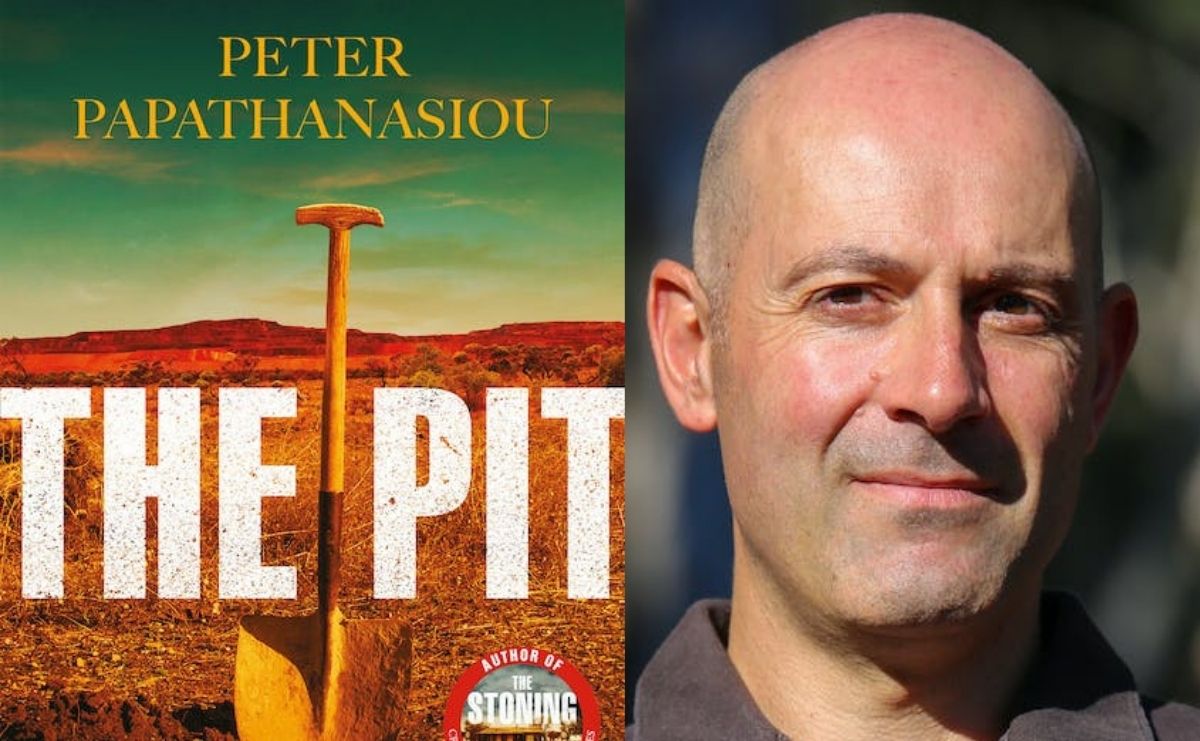
Peter Papathanasiou’s The Pit is his third novel, following The Invisible and The Stoning. Neither are essential reading in order to enjoy The Pit, a book that presents the reader with two intertwined stories. There is the present day tale, told in the third person, which sees self-confessed murderer Bob embarking on an odyssey with two other men. And then there is a story set in the past – a story of Bob as a much younger man and narrated by Bob himself.
Younger Bob’s story takes place in a powerfully evoked Pilbara region (Yindjibarndi Country) in the 70s. Bob works at a mine and Papathanasiou serves up a convincing taste of the industry at the time, as well as conveying how Indigenous rights were considered in that environment back then (if not also now):
‘Flamin’ coons reckon they own the joint,’ said the crewman.
‘Too right,’ Stretch said through clenched teeth.
‘Christ, it’s not like they were even doin’ anythin’ with it. It was just sittin’ there. What’s next, they gonna claim rights over my backyard?’
Meanwhile, Bob’s present day odyssey sees him journey from Melbourne to the far north of Western Australia. This adventure is instigated and led by him to seek redemption for a murder he committed a long time ago, by locating the corpse of his victim. His companions on this trip are a young Indigenous senior constable known as Sparrow, and Luke – a white man in his early 30s with some severe physical disabilities.
It is difficult to imagine a more unlikely trio. This would not matter – and indeed may have actually lent greater appeal to the plot – if these characters’ actions were remotely credible. But they are not. It is hard to believe that a young police officer would seek leave of absence and risk his career to go on a long trip with a complete stranger, who is also a self-confessed murderer. It only strains credulity further that Sparrow is persuaded to take this journey with a wheelchair-bound young man, whose specific needs are obviously unsuited to a lengthy trip to the outback by car.
Finally, the two stories converge and the reason for the odyssey becomes clear although the ending is a little pat and trite.
In spite of that there is much here to savour, especially for those readers who appreciate vivid depictions of brutality, corruption, personal conflict, misogyny, homophobia and racism; a novel doesn’t earn its noir classification for being a pleasant and light-hearted romp. The colourful people the three men encounter on their journey, particularly a tough female adventurer known as Mouse, add to the fascination.
This is, after all, a lively story that takes place in a distinctively Australian setting unfamiliar to most Australians. The protagonists may not feel entirely real, but the world they inhabit is portrayed with glowing intensity: as you read, you can see the red earth, smell the dust, feel the heat, sense the isolation. The sense of the immense distances the characters traverse is palpable.
The switch from first person narration in the past timeline to third person in the present is also an interesting and unusual approach. It risks appearing gimmicky or could simply have been distracting, but instead successfully adds a fresh dimension to the character of Bob, providing the reader with not just an outside perspective on him, but also some insights into how Bob sees himself.
Read: Caring as an artist
Papathanasiou’s use of vernacular in the dialogue, however, is less successful:
‘Jesus Christ. Where the hell have you been?’
Stretch said nothing, kept his head low.
‘Hey. I’m torkin’ to you, ya big streak of piss.’
He paused and looked at me with cold, clear eyes. ‘Good to see you too,’ he said, and continued walking.
I followed him, my heart beating faster. ‘I’ve been waitin’ for bloody hours.’
‘What are you, my wife or somethin’?’
‘I’m your partner.’
‘Some partner. Look, back orff, orright?’
It is occasionally punchy – ‘streak of piss’ is pure Aussie poetry – but the frequent dropped ‘gs’ and the reliance on phonetic spelling is arguably more grating than authentic.
Read: Book review: The Modern, Anna Kate Blair
The Pit has been heavily marketed as Australian outback noir. If you define noir stories as those that feature crime, unsentimental and unusual characters, violence and sex, The Pit slots into this category exceptionally well. For many readers, that may well be enough to overcome its limitations; if outback noir is to your taste, this book may well be for you.
The Pit, Peter Papathanasiou
Publisher: Hachette
ISBN: 9781529424485
RRP: $32.99
Publication: 25 July 2023