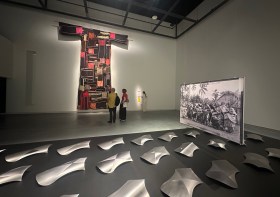
The 25th Biennale of Sydney is, once again, a testament to the idea of scale. A sprawling international showcase, it’s ambitious in both the spread of the exhibition and the size of the art itself.
In the first instalment of ArtsHub’s review, Gina Fairley interrogated the biennale’s city galleries, considering some of the issues around curating across multiple venues. In this second instalment, the focus is on the exhibition segments presented at the Penrith Regional Gallery and Campbelltown Arts Centre in Western Sydney.
While the city venues have clearly been designed for visitors to enjoy in tandem, forming broader narratives across venues, the Penrith and Campbelltown parts of the biennale, by virtue of their distance from the city, have conversely been curated as whole exhibitions in and of themselves.
Biennale of Sydney Western Sydney venues – quick links
Western Sydney is the heart of the showcase
The exhibition’s move toward Western Sydney is unsurprising considering the this biennale’s artistic focus on diaspora and reformed community. The theme, Rememory, is concerned with revisiting, reconstructing, and reclaiming histories that have been erased or repressed – an interest that is expressly relevant for a region with a strong migrant population.
There are accessibility concerns – both PRG and CAC are 15 to 20 minute walks from their nearest train station, and around a 45-minute drive out of the CBD – but artistic director Hoor Al-Qasimi was clearly conscious of making these two locations true destinations worth the effort. Pop-up installations are also scattered across Parramatta and Granville.
ArtsHub: Biennale of Sydney CBD venues review – a world, and an organisation, in decline
The Penrith and Campbelltown presentations, put together with precision and respect for their local and artist communities, are promising signs for the future of the biennale. While some might frame the move to Western Sydney as an imperialist offering to ‘less cultured’ communities, I’d say, as a proud Western Sydneysider, it is a generous invitation to enjoy the vibrant melting pot which feeds so much of Australia’s culture.
The homely Penrith Regional Gallery
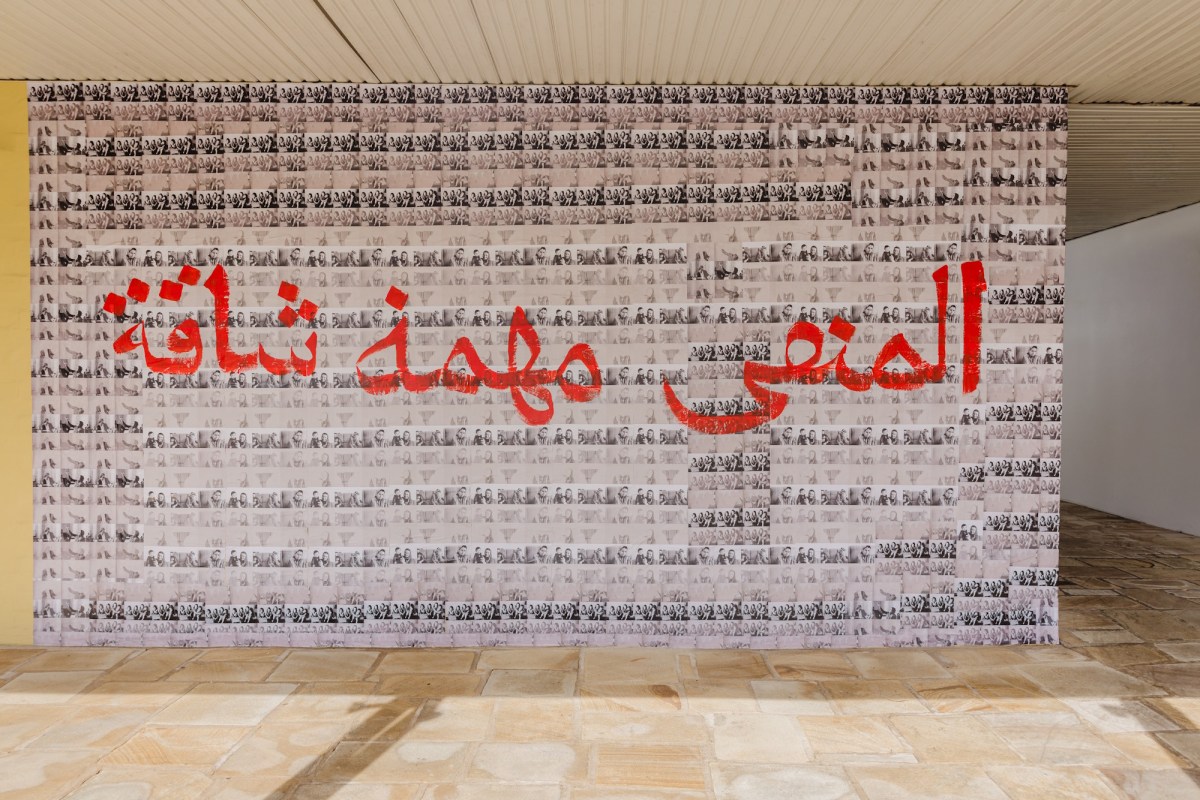
PRG, a first-time biennale venue, has the vibe of an earthy and approachable domestic space, and that cosiness is also reflected in the works on offer here. Nil Yalter’s Exile is a Hard Job (1975-ongoing) wraps around the entry walls. (The striking collage is also presented at CAC.) The Turkish artist, who is based in France, has hand-painted the words of the work’s title across black and white photographs of Turkish workers, grounding the exhibition’s curatorial concerns in a history of struggle.
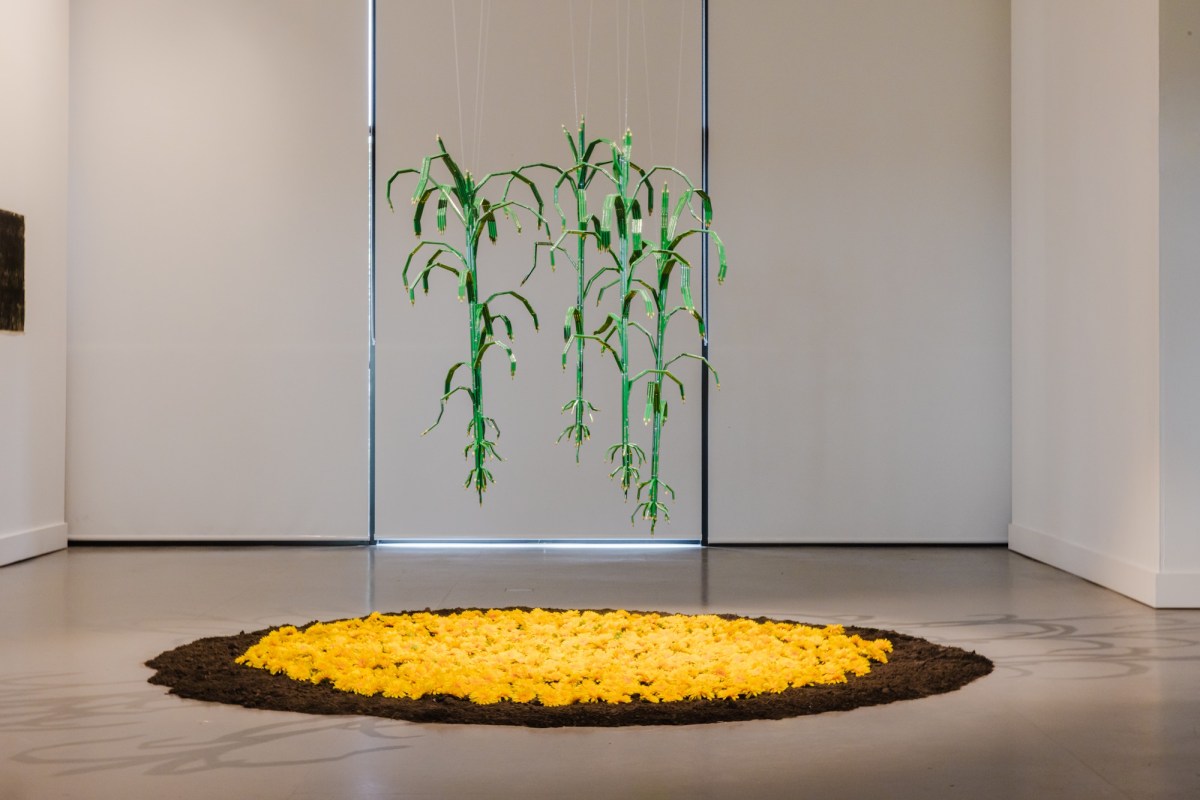
In the main gallery, Maya Kaqchikel artist Fernando Poyón’s Bringing joy to the earth (2025) hangs serenely. Comprising 1500 green pencils fashioned into what looks like an agricultural crop, it’s a testament to cultural regrowth, from an Indigenous Guatemalan artist pawing through time to ensure knowledge is not lost.
The soil beneath Poyón’s sculpture bridges the space and connects with Monica Rani Rudhar’s video installation The fire in me was lit long ago (2026). Here, dirt is sprinkled underneath the three screens, extending the visuals of flame and field into the immediate sensorial space.
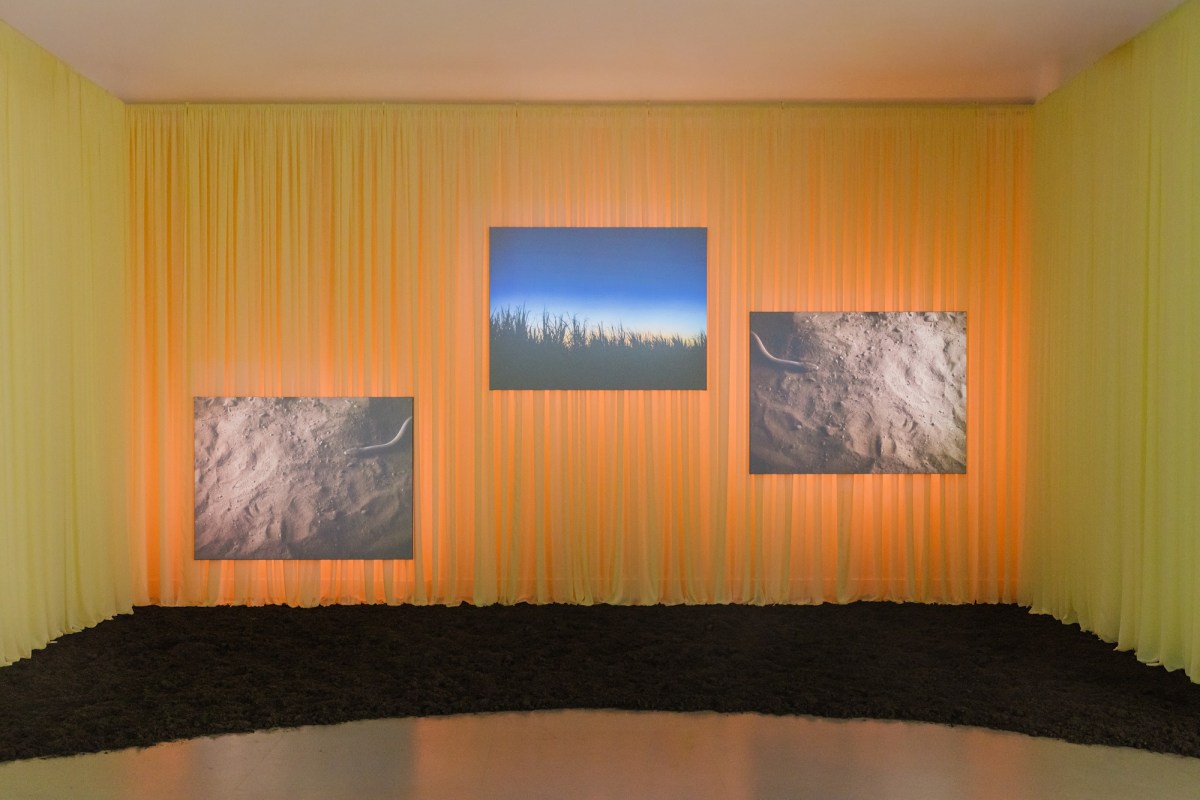
The same soil is used for both pieces – I checked with one of the gallery staff – which creates a beautiful circularity in the gallery, connecting Poyón’s agricultural reimagining with Rudhar’s reinterpretation of plantation fields, represented here as a space of resistance for her Punjabi freedom-fighting grandfather.
In PRG’s back room, Khalid Albaih’s Haboba (2026) sits at the centre of the sunny space, splayed on a couch. In Sudan, ‘haboba’ is the term for a matriarch. This work is an opportunity to sit next to the soft fabric sculpture inspired by the artist’s grandmother, safe. Surrounding the work, Albaih’s The Last Time (2026) is a series of printed photos suspended by string, collected from Sydney’s Sudanese diaspora.
The work offers a floating immersion into the migrant experience, one you’re invited to walk through, touch and exist between. Photography as sustained memory becomes a key theme in these galleries, but so does this invitation to interact with the art itself. It’s a warm gift, neatly contrasting with more Westernised expectations of art as distant and observational.
Campbelltown Arts Centre is the heart of it all
CAC is exhibiting for the second time in the Biennale of Sydney, and it presents a touching and smartly curated exhibition that thrives on the gallery’s location. As CAC Director Mouna Zaylah puts it: ‘It’s where the people are at. The population in Western Sydney reflects the diversity of this country, so it’s really important that an international arts festival is in areas the community is at.’
Irish-Iraqi artist Basil Al-Rawi’s House of Memory sits in the centre of the first gallery. Red cushions sourced from a local bazaar form a makeshift couch. You take your shoes off, hole up in the corner, put on your headphones and watch photographs on screen as three people discuss their memories of Iraq. In the artist’s own words, it’s ‘a space of representation where Iraqis can tell their own stories and narrate their own memories’.
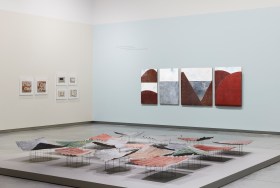
Basal Abbas and Ruanne Abou-Rahme’s installation Until we became fire and fire us (2023-ongoing) occupies the backroom. The Palestinian-American artists cover the walls in video works, capturing faces, nature, poetic odes to struggle, and a fleeting sense of memory amid dispossession. The freestanding structures in the room are abstract colourways that haunt the naturalistic videos. On the reverse are digital text files archiving the ongoing genocide in Palestine.
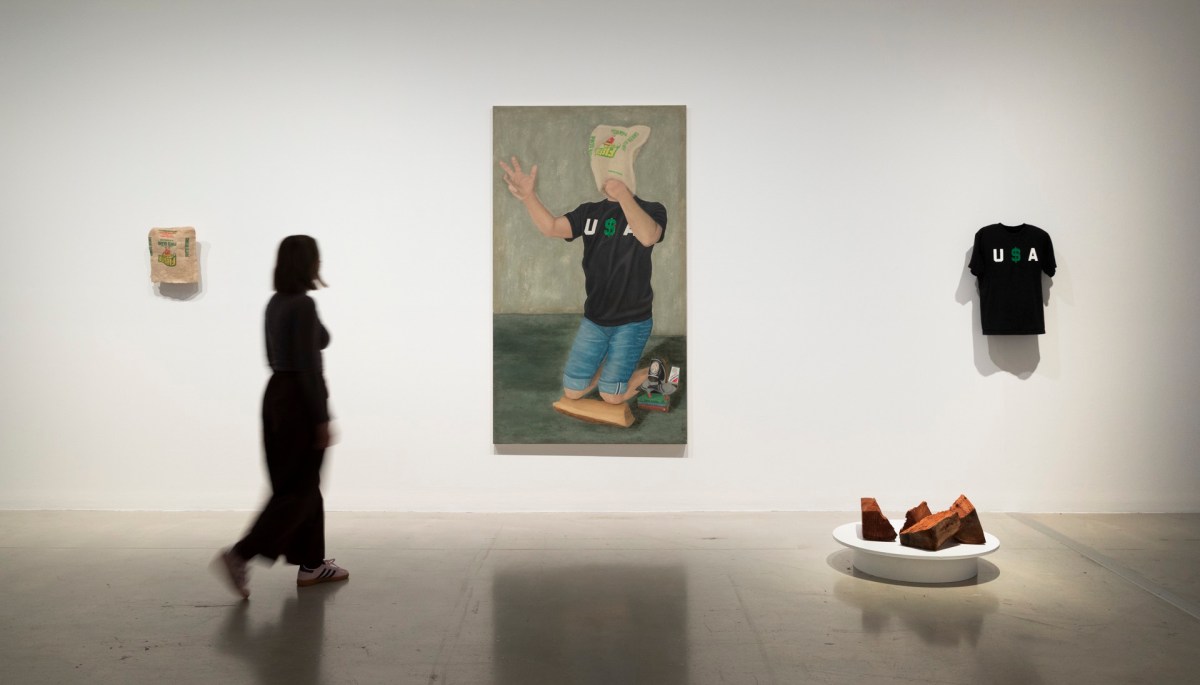
Vicente Telles’ multipart Primera Voz / First Voice (2026) was developed through a residency at CAC. The painting by the American artist features himself kneeling on a wood beam, head covered by a thatched bag of beans. To the left of the painting is the bag, to the right is the T-shirt he wears, and below is the beam itself.
The painting recreates the schoolyard punishments delivered to the generations before him for the ‘crime’ of speaking Spanish. His headless struggle is a phantasmic reckoning with the loss of culture and language through repressive colonial punishment. There are glimpses of reconnection, though, particularly through Telles’ use of clay from Mexico City in the paint pigments.
While the rest of the Biennale of Sydney programming may be distant from Western Sydney, it is so very worth going to these galleries. Sit, touch, watch, smell, hear these stories. Spend time with the narratives of reclamation and memory that the artists have been so generous to share with you. Listen to the heartbeat underlying the biennale, and know the pulse of Western Sydney is what brings it all together.
Rememory, the 25th Biennale of Sydney, runs from 14 March to 14 June across the Penrith Regional Gallery, Campbelltown Arts Centre, Art Gallery of New South Wales, Chau Chak Wing Museum, White Bay Power Station and Sydney Opera House. Admission across all venues is free.
This article is published as part of ArtsHub’s Creative Journalism Fellowship, an initiative supported by the NSW Government through Create NSW.