There’s something delicious about watching an audience lean forward in collective curiosity – which was very much the case at the Roslyn Packer Theatre last night when the new production of Art officially opened in Sydney, ahead of a national tour.
French playwright Yasmina Reza’s 1994 classic eviscerates the pretensions surrounding art, but even more than that, proffers a biting commentary on friendship. It has lost none of its sting, and in this new production, directed by Lee Lewis, the play once again proves how a deceptively simple premise can open a trapdoor beneath our assumptions about taste, friendship and certainty.
At first glance, the stakes seem comically small: a ridiculously simple painting – completely white, with perhaps some slightly less-white lines – purchased at great expense. But Reza’s brilliance lies in how swiftly that canvas becomes a provocation. It’s not really about art, of course, but about validation, about being seen and about the fault lines that appear when long-held certainties are challenged.
Lewis resists any temptation to over-interpret the play. Instead, she trusts the writing – and the audience – allowing the humour to land naturally while letting the deeper questions surface almost by stealth. It’s a confident, uncluttered approach that gives the performers room to breathe and the characters to develop.
Art – quick links
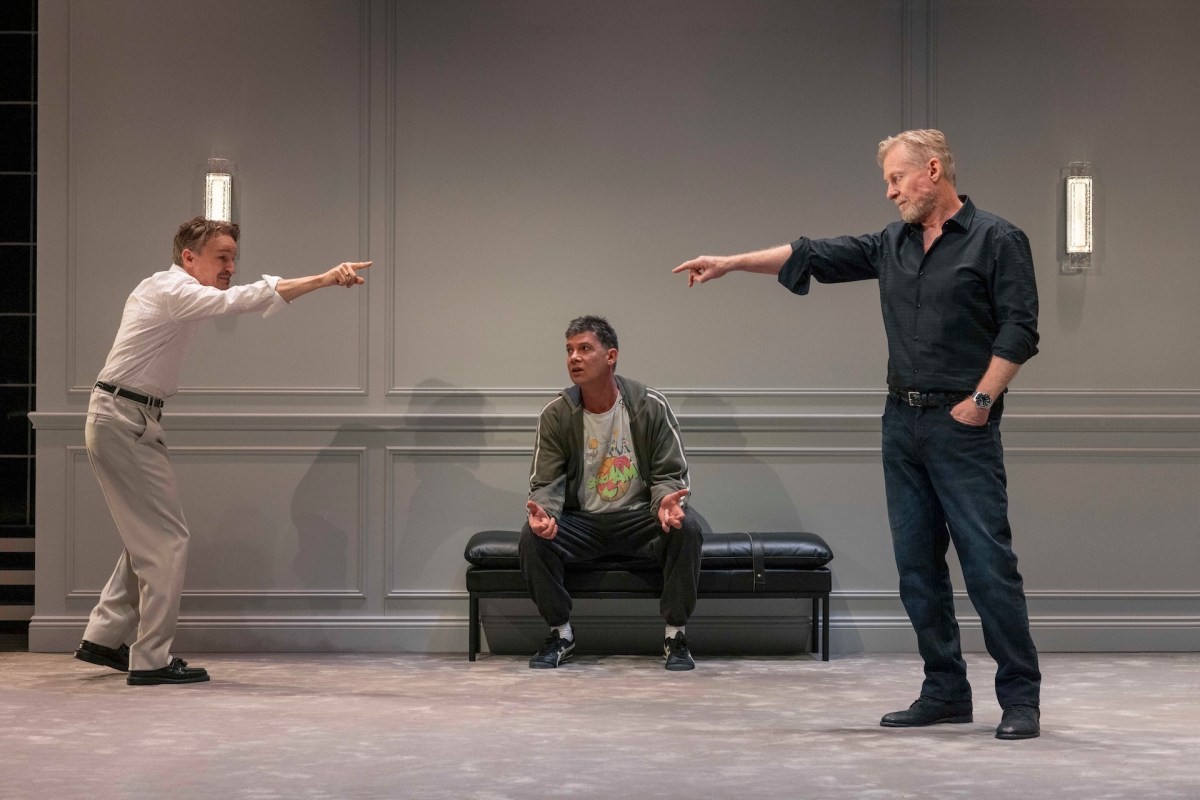
Three men and a canvas
The success of this play lives or dies on its trio of characters, and this cast delivers with confidence and clarity.
Richard Roxburgh’s Marc is a study in barely restrained disbelief. He’s outraged that a good friend has purchased the painting. His outrage is comic, yes, but it’s also rooted in something recognisably human: the fear that a friend has changed and is leaving you behind. Roxburgh expertly mines that discomfort, allowing Marc’s bluster to reveal vulnerability rather than mere bluster for its own sake.
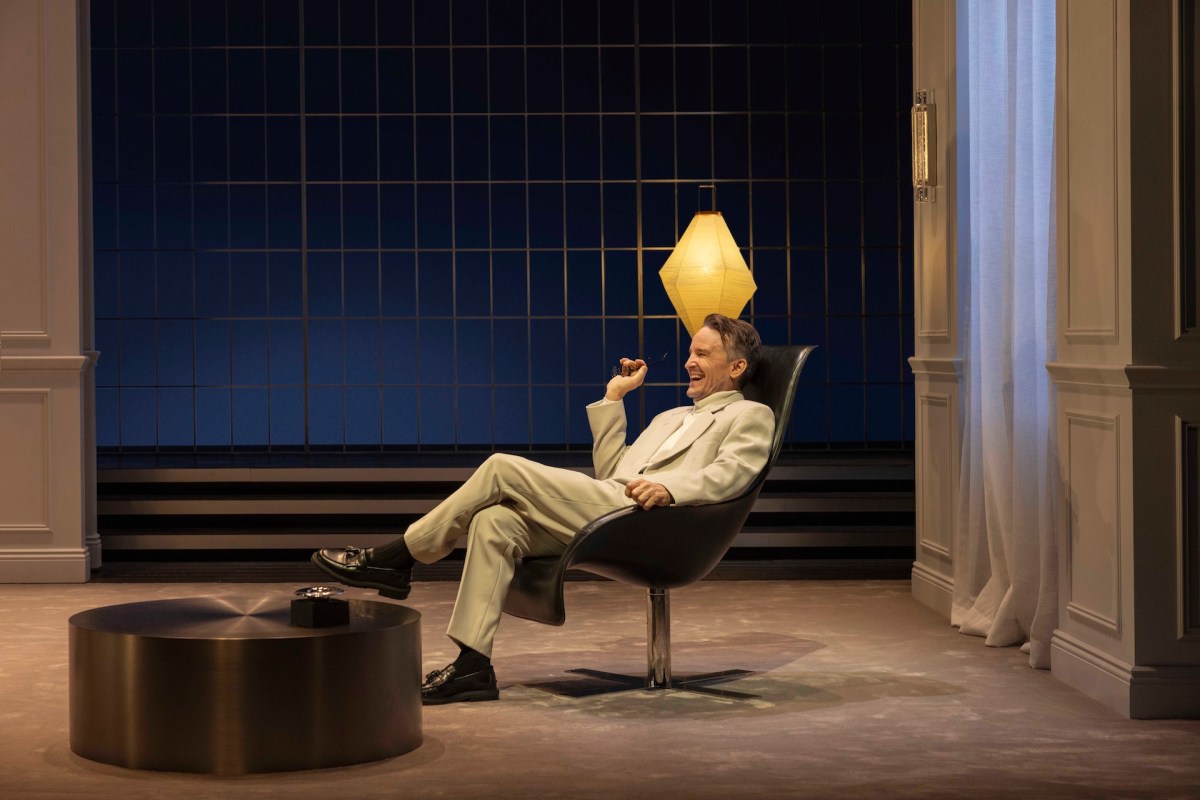
Damon Herriman brings an elegant assurance to Serge, the proud new owner of the painting. Herriman never pushes Serge into caricature; instead, he lets us see the appeal of the artwork through Serge’s eyes, even as we sense how much he needs approval for his quixotic purchase. It’s a performance laced with quiet defensiveness, and it pays dividends.
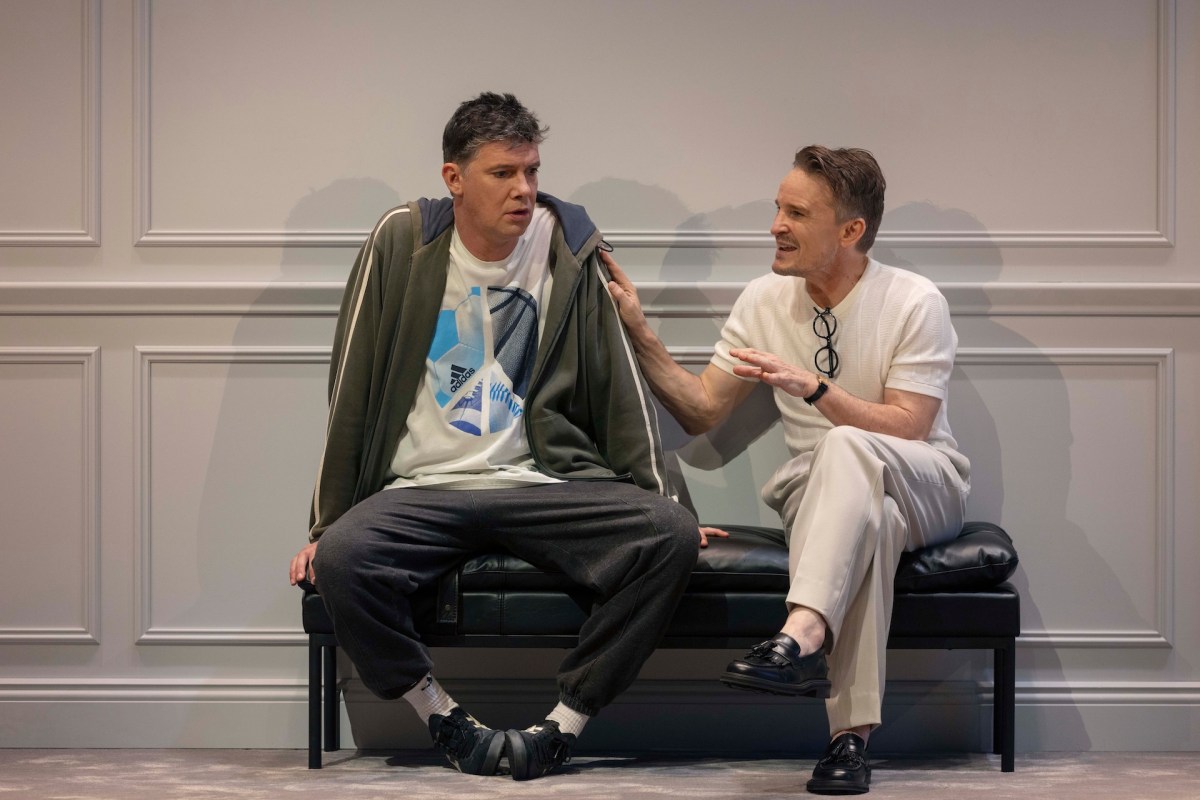
Then there’s Toby Schmitz as Yvan: anxious, verbose, endlessly accommodating. Schmitz finds the sadness beneath Yvan’s nervous humour, grounding the role in emotional truth. He’s the connective tissue of the play and here he gives it weight as well as warmth.
Together, the trio feels genuinely bonded. Their shared history makes the fractures all the more painful and the humour all the more pointed.
Laughter, friendship and the curse of opinion
While it debuted in Paris in the 1990s, what makes Art endure in 2020s Sydney is its understanding of how opinions operate as social currency. We laugh because we recognise the behaviour: the posturing, the need to be right, the subtle power plays disguised as taste.
The laughter on opening night was generous, but it was often followed by thoughtful quiet – those moments when the play nudges a little too close to home.
That said, Art is not immune to the very charge it levels at its characters. For all its skewering of pretension, the play occasionally betrays a fondness for its own cleverness. Some of its debates circle familiar terrain – particularly for seasoned theatregoers who have encountered years of works interrogating masculinity, cultural capital and the anxieties of taste.
There are moments where you sense the arguments arriving a beat before the dialogue does.
This is not a fatal flaw but it does mean that Art plays less as a revelation and more as a finely tuned reiteration. Its insights remain sharp, but they are also well-worn, and audiences steeped in contemporary theatre may feel they’ve ‘heard it all before’, even as they continue to enjoy the ride.
Said enjoyment is well-supported by the technical creatives; the design by Charles Davis is clean and unshowy, complemented by lighting from Paul Jackson, original music by Max Lambert and sound design by David Letch. Together, they create a space that feels simultaneously comfortable and taut – a domestic arena where ideas, egos and insecurities are put on trial.
Intellectual sparring
Comedy here is not a soft landing, it’s a pressure point. Reza’s dialogue slices cleanly and Lewis ensures the rhythm stays taut. The play doesn’t sag or over-explain. Instead, it trusts its audience to keep up.
What’s particularly pleasing is how conversational it feels. The performances never lapse into showiness; the laughs come from recognition rather than exaggeration. It’s theatre that understands its audience and respects their intelligence.
At times, the play’s intellectual sparring risks edging into self-satisfaction. The arguments are elegantly structured, the rhetoric finely honed – but occasionally, you can feel the machinery beneath the wit. Yet such moments rarely overstay their welcome. The actors keep the exchanges grounded in character rather than concept, ensuring the comedy remains human rather than academic.
There’s also a generosity in how this production handles humour. While there are moments of cruelty (particularly at the expense of Yvan) Art isn’t callous. Instead, it acknowledges the absurdity of human behaviour while retaining a genuine affection for its characters – a balance that’s harder to strike than it looks.
Final brushstrokes
This new production of Art doesn’t reinvent a modern classic – and it doesn’t need to. What it offers instead is clarity, precision and a strong sense of ensemble. It’s funny without being glib, thoughtful without becoming heavy-handed and confident enough to let the material speak for itself.
Yes, some of its provocations feel familiar, and its intellectual sheen occasionally mirrors the very pretensions it interrogates. But in performance – and especially in the hands of this cast – those ideas regain their sparkle.
By the time the final moments unfold, that white painting has accumulated layers of meaning, argument and memory, much like the friendships at the centre of the play. You leave the theatre entertained, certainly, but also gently provoked, perhaps examining your own thoughts on taste, pretentions and the compromises of friendship.