Kith and Kin – quick links
On Saturday 27 September 2025, kith and kin, created by Archie Moore and curated by Ellie Buttrose, opened at the Gallery of Modern Art (GOMA), Brisbane.
In poured art enthusiasts, keen to post in the presence the first Australian artwork to be awarded a prestigious Golden Lion at a Venice Biennale. That this pride of a nation explicates a brutal oppression of the artist’s friends and family is no small irony.
Longterm observers of Moore’s practice will attest that few elements of his installations are incidental.
kith and kin: Moore’s steady hand
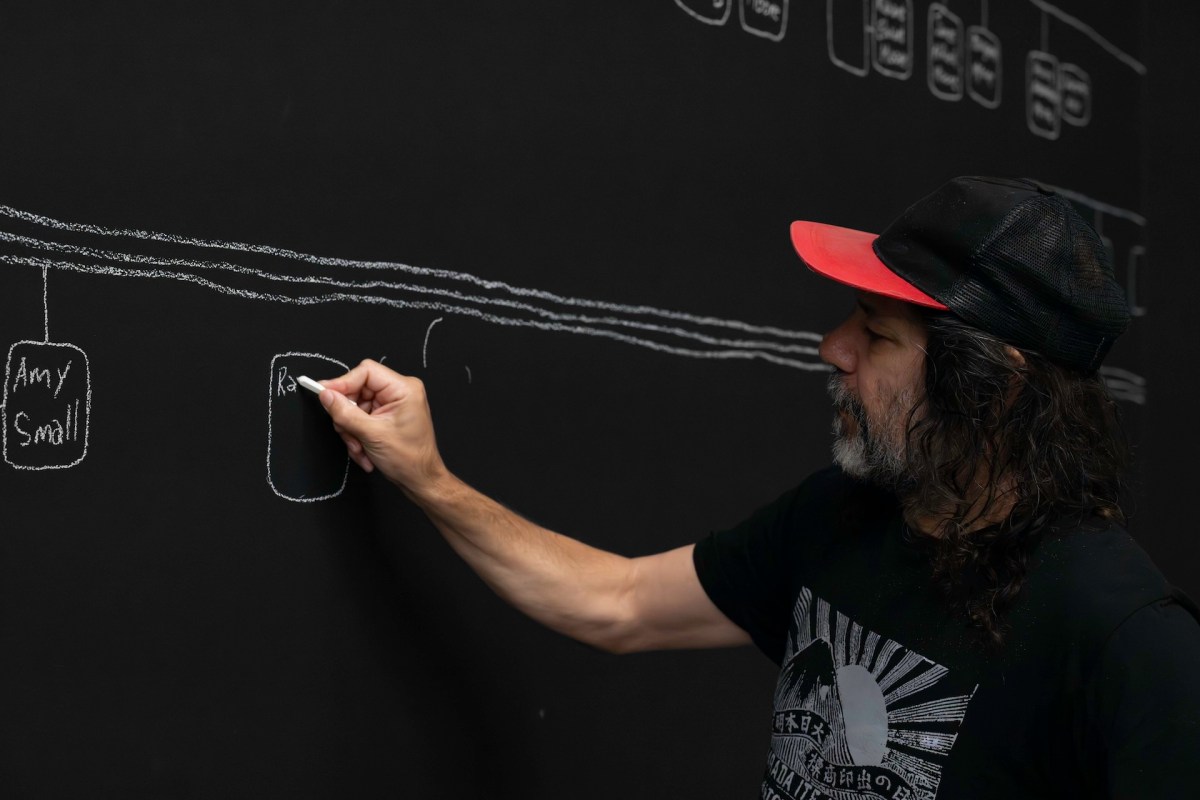
For Kith and Kin, Moore has exercised a steady hand. His writing on the wall endeavours to represent 2,400 generations of his ancestors spanning over a 65,000-year period.
In the past, he has used blackboards to signify the subtexts of subordination inculcated through formal schooling. Names were sourced from an array of archives, from burial registers to police memorandums.
These include offensive classifiers. ‘Gin’, for example, is a euphemism for a compromised First Nations woman. His subjects are humanised through this choice of medium. The sprawling family tree is primarily a homage to his maternal Kamilaori and Bigambul heritage. A small sprig acknowledges the arrival of his paternal Scottish great great grandfather as a 16-year-old convict.
kith and kin: time to adjust
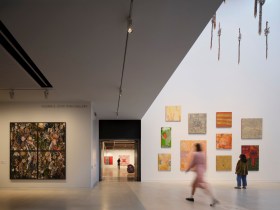
Upon entering the gallery, it takes a moment for your eyes to adjust. They might then be drawn to the largest of three celestial voids in the luminous text landscape. Chalk is a type of limestone, which reflects light.
The black holes have been left to account for omissions of information and interruptions to populations. Causes of the latter include a massacre and a smallpox outbreak. In the centre of a pool stands a topography of stacked paper.
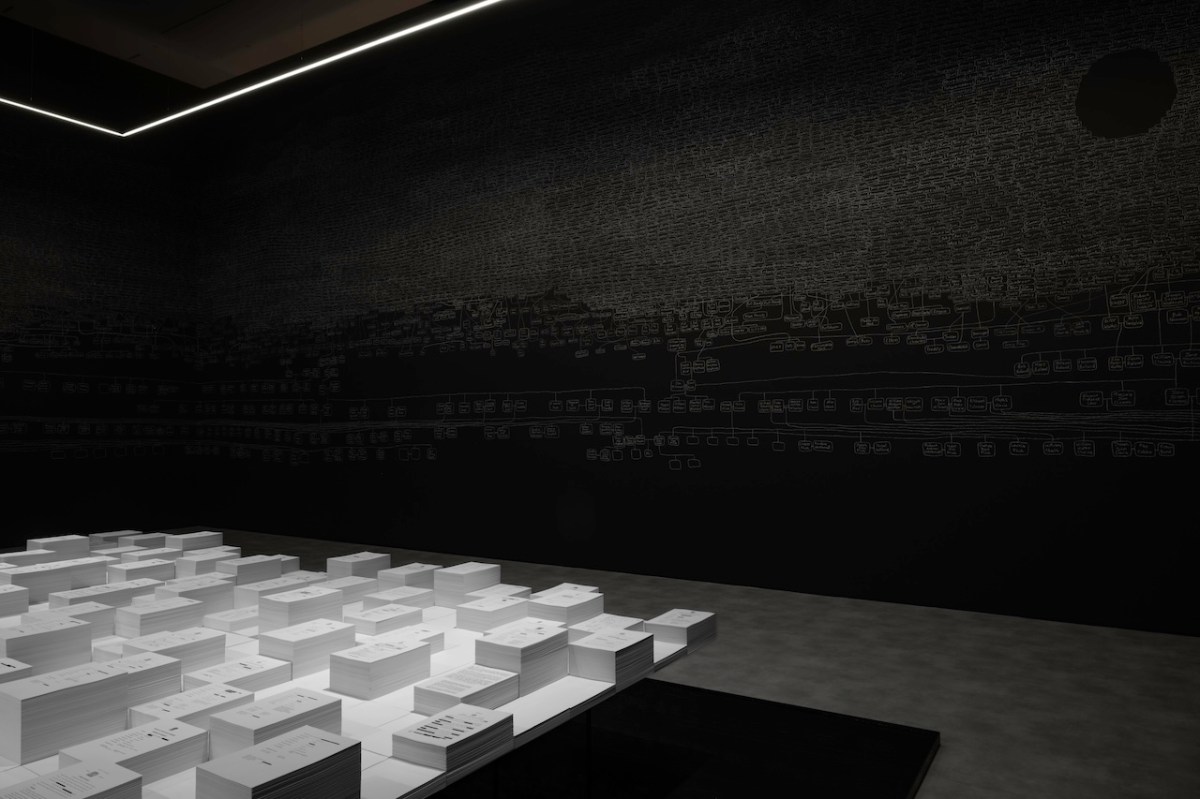
Dating back to the 1991 Royal Commission into the Aboriginal Deaths in Custody, 557 inquests have been compiled. The names of the deceased have been redacted. However, a relative of the artist is among their subjects.
Much like his modest inscription of ‘me’ at the bottom of the monumental ‘pedigree’ chart, the inclusion of paperwork processing the unfortunate demise of his family members brings home atrocities which might otherwise appear abstract. From perpetuating pejorative terms to homicide, the very worst of human behaviour is evidenced through this exemplary exercise in autoethnography.
kith and kin: the concept of time
The intention to memorialise has been explicitly expressed. A request that viewers reconsider their concept of time has also been made. In Kamilaori culture, the past, present and future are not perceived as linear progression.
The aesthetics are predominantly aligned to Eurocentric conventions. However, the ephemerality is a distinct departure. There is a fleetingness to the unfixed chalk and the unbound pages. Yet, the former could be likened to the pigments of Ubirr.
The paintings were layered at the sacred site for 40 millennia. This fragility adds to the reverence of the artwork. A possibility of change is also inferred through its impermanence.
kith and kin: gifting
A second of the firsts for Kith and Kin is its gifting from Creative Australia to both GOMA and the Tate. Some of the text has been traced from the scans of the artist’s writing. Parallels might be drawn to processes pioneered by Sol LeWitt during the 1960s.
For this Australian debut, the main parts were editioned by Moore’s own hand.
Irrespective of the drawcard, it’s difficult to imagine a viewer not being affected by this solemn testimony. To many, the suffering of his subjects will be palpable. Moore’s artwork could be considered a treatise on education. Is the congregation being preached to or perverted?
In this age of viral virtual reproduction, their conversion is of lesser consequence. Secondary viewers, of their posts, might get it.