For nearly 60 years, the American composer and sound artist Alvin Lucier found strange and beautiful things in the borderlands of art and science.
His 1969 piece I Am Sitting In A Room involved Lucier reading out a short statement and recording it, then recording a replay of that recording, over and over again until his voice becomes an unintelligible tone at the resonant frequency of the room itself.
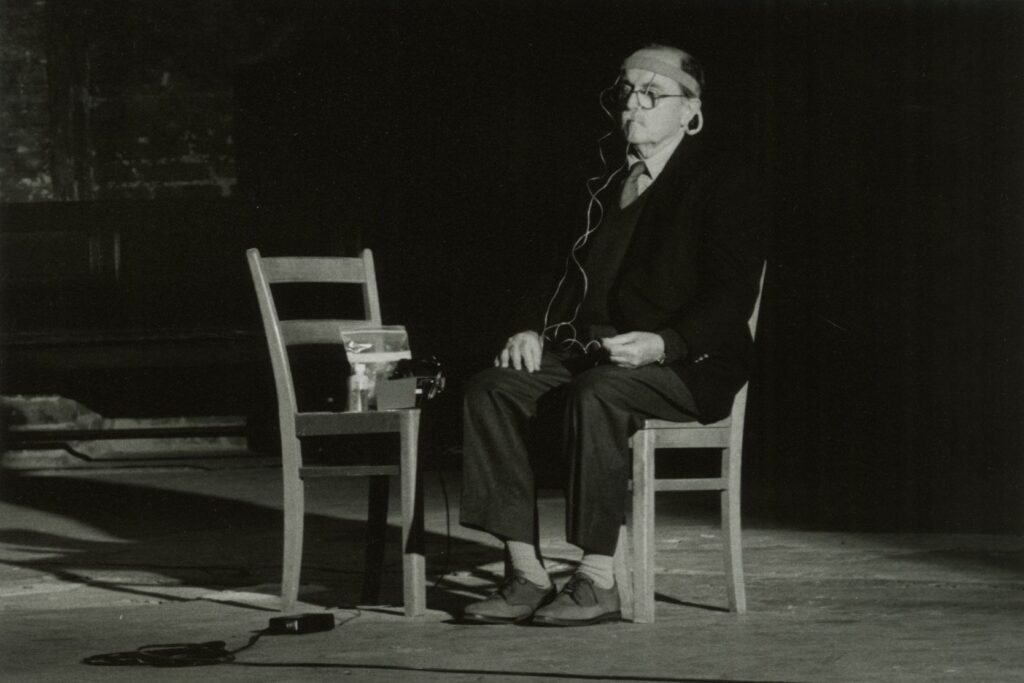
Another important piece, 1965’s Music For Solo Performer, saw Lucier sitting motionless on stage as electrodes around his head fed his brainwaves to speakers attached to various instruments. Within a few minutes, a motionless Lucier is surrounded by a cacophony of percussive noises.
Lucier died in 2021 – but even that, it seems, could not stop his sonic creativity.
Revivification and artistic immortality – quick links
Revivification
Near the very end of his life, Lucier donated some of his white blood cells to a team in Western Australia working at the intersection of art, biology and physics. This team – artists Guy Ben-Ary, Nathan Thompson and Matt Gingold, and scientist Stuart Hodgetts – took Lucier’s cells and cultured them into small lumps of living neural tissue, about the size of a pea.
These cerebral organoids are not brains as such, but they are composed of brain cells – and can produce some of the same sort of electrical signals. In their art installation Revivification, first debuted in Perth in 2025 and currently in Melbourne for the Now or Never festival, the electrical activity inside the cells is used to control an array of metal plates fitted with mallets. As the neurons fire, the plates produce gong-like noises at seemingly random intervals.
But the organoids are also ‘listening’. A microphone at the back of each plate captures sound and feeds it back into the organoids as electrical impulses. The organoids are thus reacting to stimuli from the room around them, including changes caused by the movement of visitors through the exhibit. The organoid thus becomes a ‘surrogate performer,’ in something very like the way the living Alvin Lucier’s brain did in the 1960s.
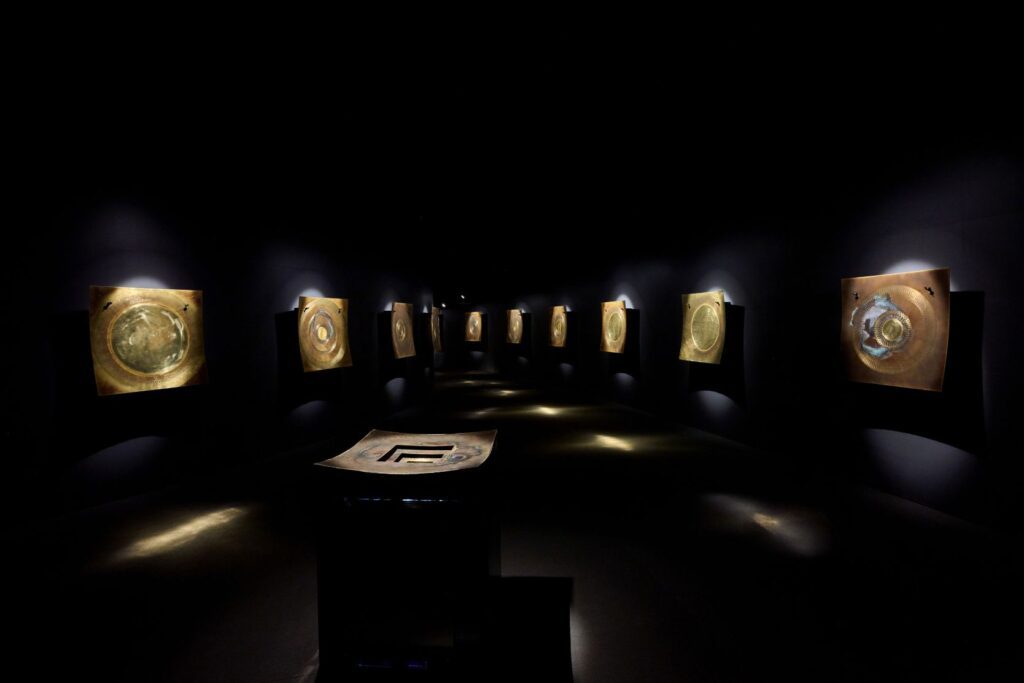
The exhibition is surprisingly confronting. The room is dark, the noises are sudden and chaotic (if spaced out) and the organoid, suspended in a clear glass box beneath a small viewing window set in a bronze-topped pedestal, is at once nondescript and unnerving (no pun intended).
I took a group of fellow philosophy academics to see the exhibit, who variously found it fascinating and overwhelming. For someone in our line of work, however, the questions raised by the exhibit are irresistible.
The boundaries of personhood
An obvious question is whether the organoids producing sounds in this way counts as Alvin Lucier producing art – and if so, in what sense?
The ‘surrogate performer’ label for the organoid opens up more questions than it answers. In a video accompanying the exhibition, Ben-Ary recalls Lucier’s daughter making it clear that the organoids are not her dad. Yet the artists speak of the exhibition as Lucier continuing to create even after his death.
Certainly, Lucier was an enthusiastic collaborator on the project. In that sense the installation is, at least in part, an extension of his agency, analogous to making a will perhaps. Yet something far more intimate is going on here too. If this is something less than full immortality – which, philosophers generally agree, would require ongoing consciousness – ‘immortality’ in this case also seems more than merely metaphorical.
Like other famous artists, Alvin Lucier lives on in his works and in the memory of those who knew him. But as Woody Allen once quipped, ‘I don’t want to live on in the hearts of my countrymen, I want to live on in my apartment.’ Alvin Lucier is clearly dead, yet his living cells continue to carry out his artistic project.
Even philosophers of personal identity, with our fondness for sci-fi thought experiments, haven’t yet grappled with survival of this kind.
Creativity without consciousness?
We might insist that unless Lucier is consciously directing the production of these sounds – which, clearly, he isn’t – then he is not performing, and not creating. Creation is an action, and action requires intention.
Of course, creativity isn’t always a highly deliberate, reflective act, at least not when it’s underway. When artists enter flow states, for instance in musical improvisation, they can seem to be acting in a way that involves no conscious control at all. (Classical Chinese philosophy calls this wu-wei, ‘acting without acting,’ a state in which we interact skilfully with the world in a way that seems effortless and even thoughtless.)
Lucier’s earlier work likewise used his brainwaves, over which he had no conscious control, to create music. Indeed, that 1965 performance specifically used alpha waves, low-frequency signals which are only produced when the brain is at rest. To perform, Lucier had to literally do nothing. (It’s an interesting irony that Lucier’s collaborator on the first performance of Music for Solo Performer was none other than John Cage, composer of the notorious 4’33’’ – the score for which instructs the musicians to play nothing at all).
If we take the Revivification organoids to be creating, it seems we have gone one step further. We’re dealing with a form of creativity that involves no actual consciousness beyond for Lucier’s pre-mortem willingness to take part. Creative expression emerges from flesh that quite literally shares Lucier’s DNA, but which has none of his awareness. What the show provocatively suggests is that creativity is something far more basic, something cellular rather than intellectual. Art is ‘cerebral’, but not in the way we might expect.
Revivification is a fitting, indeed quite moving, tribute to Lucier. But it also asks us to consider not simply where the artist begins and ends, but where creativity itself happens. Those pea-sized lumps of grey matter are working very hard indeed.