For two years, the doors of the Brett Whiteley Studio in inner city Sydney, have been closed. Behind the scaffolding and roofless structure, however, something more significant than a museum refurbishment has been unfolding.
Brett Whiteley Studio reopens – quick links
On the brink of no return
When builders removed the roof of the former Surry Hills warehouse, they discovered the building itself was in far worse condition than anticipated. What began as an accessibility upgrade quickly became a rescue mission to save one of Australia’s most important artist studios from structural failure.
It had been on the brink of no return, just as Whiteley himself had been in 1969, when he left New York after his dealer refused to exhibit his epic multi-panel painting American Dream. Vacating their Chelsea Hotel apartment, the family headed to Fiji via London intending never to return to Australia. Instead, circumstances forced them home, changing the course of Australian art.

This moment is the focus of Coming Home, the exhibition reopening the studio. ‘It is like Brett has come home again,’ said Wendy Whiteley – former wife, muse, patron and greatest advocate of Brett Whiteley – to gathered media. ‘When we started bringing the works back in, there he was, back again.’
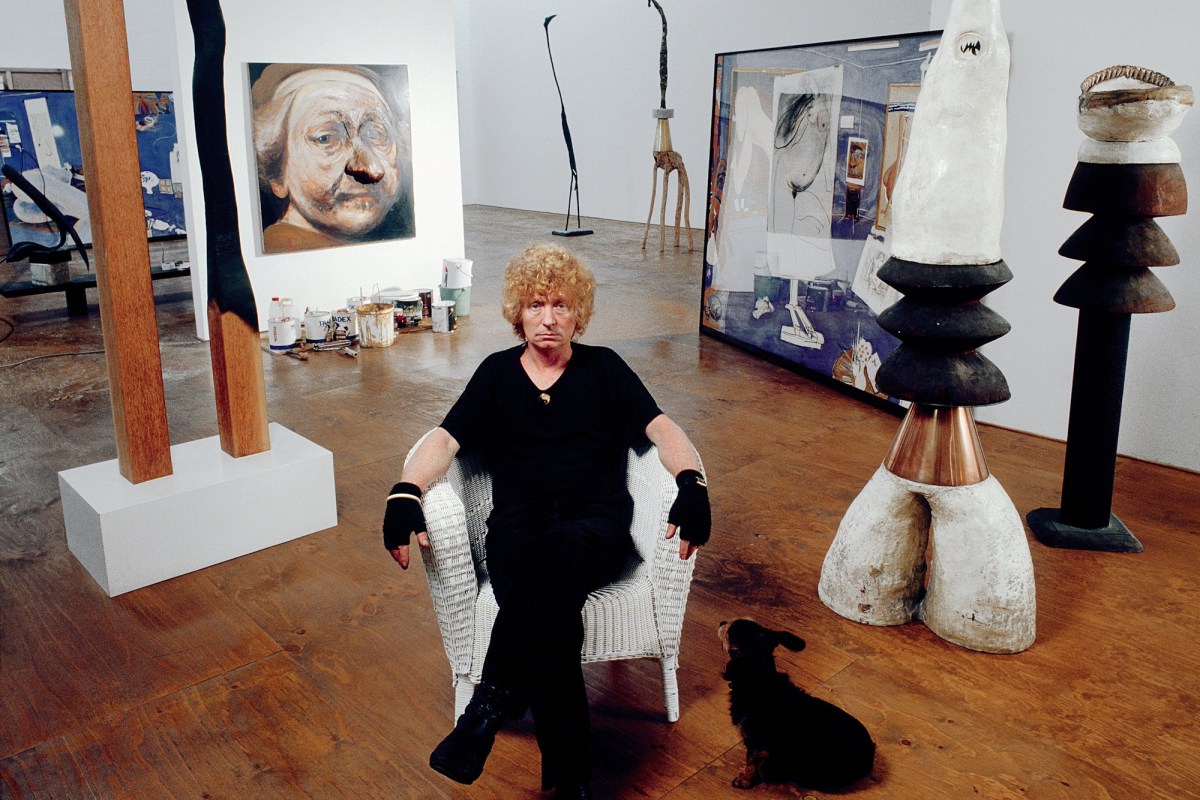
Brett and Wendy Whiteley bought the warehouse in 1985, converting it into a studio and exhibition space. He lived there from 1987, when the couple separated, to 1992, the year he died in Thirroul, south of Sydney. Since 1995 it has been managed as a museum by the Art Gallery of New South Wales.
Preserving Brett’s spirit (and building compliance)
The challenge was never simply to modernise the building. It was to preserve its soul.
Walking through the reopened studio, Brett’s graffiti remains on the walls, and paint splatters still mark time on the studio floor. His sunglasses, records, books and unfinished works sit alongside brushes and sketchbooks, as though he has only just stepped outside.
Preserving that feeling was what guided project architects, Tonkin Zulaikha Greer. ‘Our brief was only three things: we had to make it accessible; to have air conditioning you could run without disturbing the neighbours, and a new roof.’ While that sounds straightforward, the structure was roofless for over a year due to the need to sure up the building structurally.
‘They did their best not to homogenise the building – to homogenise him,’ said Wendy Whiteley. ‘The architects understood this, that the building was not to been taken over by a bunch of bureaucrats and compliance laws.’

The Senior Curator of the Brett Whiteley Studio, Beatrice Gralton, credits Wendy with ensuring every decision remained true to the studio’s character, describing her as the project’s ‘queen bee’.
‘You can’t get anything past her,’ she said.
Gralton added with a laugh, ‘Wendy absolutely hates a laser level. Because the floors of the studio have always been really crooked, they’ve always hung everything by eye. Now that the floor’s perfectly straight, she doesn’t care, insisting that they still hang by eye. That’s one of the reasons this place feels special. It’s a slightly domestic space, there’s work everywhere, and I think that’s part of the magic.’
Fiji: the missing chapter
While visitors know Whiteley’s Sydney harbour paintings and monumental works such as Alchemy (1972-73), the rare Fiji paintings gathered in Coming Home are the exhibition’s revelation.
Created while the family lived outside Suva without electricity or running water, the works capture a quieter, restorative period after the intensity of New York.
‘I think when you see those Fiji works, you see this reconnection with the landscape and with the earth around him,’ Gralton said.
The family intended to stay in Fiji permanently. Instead, political tensions surrounding the Vietnam War drew unwanted attention after an American flag being used as a doona cover was spotted drying on their balcony. Authorities raided their apartment and found a small quantity of opium. ‘He bought it from a local guy and didn’t know what to do with it,’ Gralton recounted. ‘He ate some, got very sick, and threw the rest in a drawer.’ Whiteley was ordered to leave Fiji and never return.
Ironically, that forced departure changed Australian art history. Rather than returning to London, where he still had a studio, gallery representation and works already collected by Tate, the family settled in Lavender Bay, where the harbour would become one of the defining subjects of Whiteley’s career.
He came back at a pivotal moment in his career and we get a hint of his star quality in the first image we encounter as visitors to the studio, a stylish photograph of Brett and Wendy dressed in white with dark sunglasses, little Arkie clinging to Brett’s legs.

Of course, early in that return, Whiteley worked on Alchemy, his sprawling 16-metre autobiographical masterpiece. It had been removed from the studio in 2023, so its return is also something of a homecoming.
AGNSW Director Maud Page observed how Coming Home incorporated both the Pacific, ‘a quiet moment of reflection and redefinition’, as well as ‘works that are big statements – but they’re also about introspection, and they’re about an Australian having been overseas, coming back to Australia, and reckoning what he’s seen, what he’s felt, into his place in Australia, and cementing that place.’
She added, ‘I think Brett managed to shift our view of what Sydney is in a very powerful way.’
Brett Whiteley’s enduring legacy
The reopening of the Brett Whiteley Studio reminds us that his legacy was never simply the paintings themselves. It was the relentless curiosity that produced them – which today is extended by a fellowship for emerging artists.
Page described the studio as an incubator. ‘It’s been a place of experimentation, of performance, a stage set, a private space, and also a space for younger artists to come. It’s a very unguarded space,’ she said, adding that it is an extraordinary gift.
Wendy Whiteley hopes visitors leave thinking less about mythology surrounding the artist and more about making art itself. ‘I get asked personal questions over and over again, for the past 35 years. Can’t we just talk about the paintings and the meaning of this place?’ she begged media.
She continued: ‘Brett’s workspace is the heart of the building. It is what makes this an interesting place, to glimpse the person and get a much bigger overall view. I hope people come here and feel closer to what it is means to be an artist.’
Asked what Brett would make of the renovations, she didn’t hesitate. ‘Short answer is he would be really pleased with what we have done, and if he isn’t, well tough shit.’