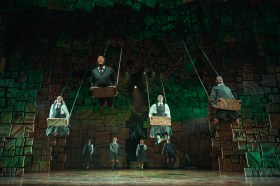
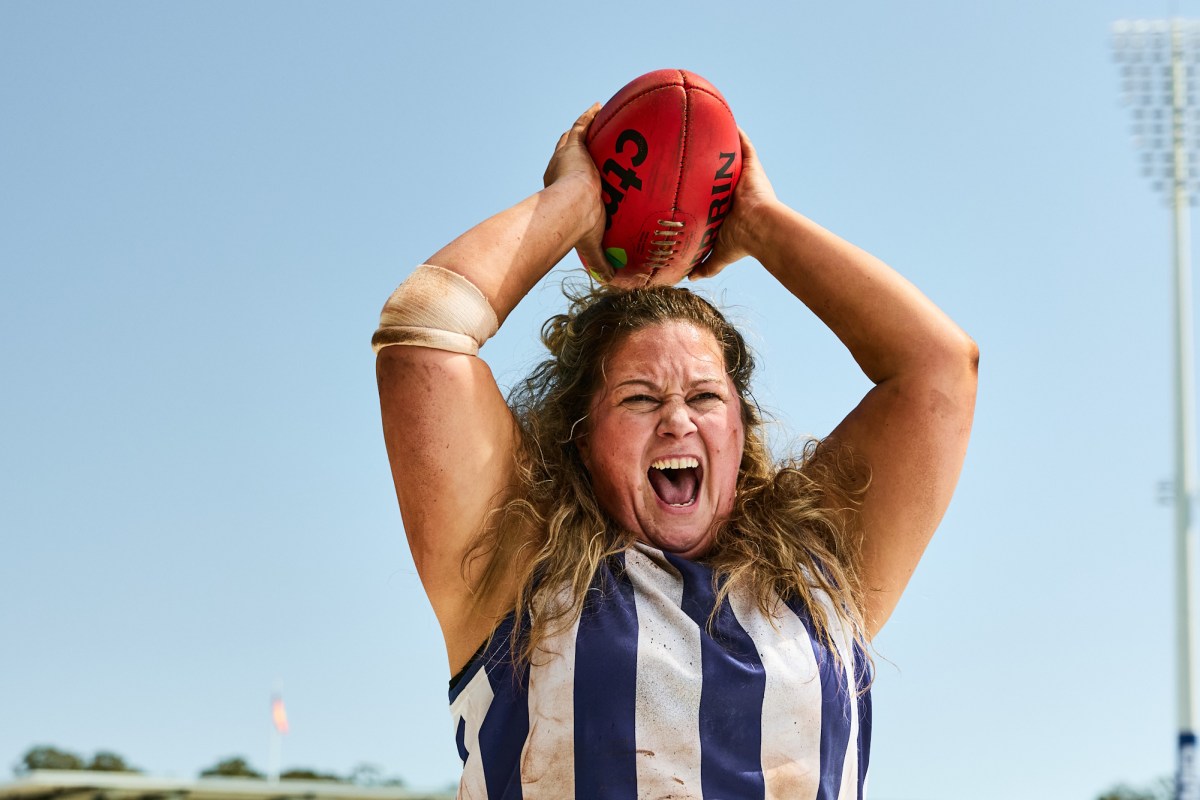
For four months of the year, female footballers at the peak of their Aussie Rules-playing powers turn suburban ovals into stages, thrilling crowds with their skills – and with the simple fact that AFLW exists, even a decade into the Australian Football League’s professional national women’s competition.
For three weeks at Brisbane Festival 2026, a new team is celebrating women’s football, but swapping sprinting across grass for treading the boards. Penned by acclaimed Australian playwright Suzie Miller, Strong is the New Pretty charts the journey to finally creating space for female athletes at AFL’s highest level.
As is the trademark of the playwright behind Prima Facie, RBG: Of One, Many and Inter Alia, Miller again hones in on very specific circumstances while having a broader conversation – here, about how women navigate male-dominated structures, make things happen despite that power imbalance and work together to enact change, all alongside the effort of chasing their goal.
‘She has this remarkable way of hooking you in with a story, hooking you in with the stuff that lures in an audience,’ says Sarah Giles, director of Strong is the New Pretty. ‘And then once you’re inside it, you find yourself being politically changed or activated by her work.’
‘She Trojan-horses the politics in there, and then you emerge and you realise that you’ve been moved or you’ve been changed, or you’ve had your thoughts confirmed or shifted.’
Strong is the New Pretty interview – quick links
First bounce
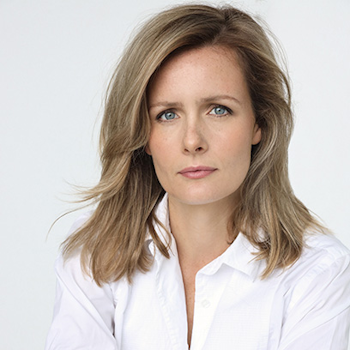
Giles is helming Strong Is the New Pretty’s world-premiere season in Brisbane, which runs until 19 September, as well as its subsequent stints in Canberra (24 to 26 September), Geelong (8 to 11 October) and Sydney (22 October to 5 December). She first crossed paths with Miller earlier in their respective careers. ‘We made some theatre together over in Western Australia, in Mandurah, a million years ago, and I really enjoyed how she worked,’ Giles tells ArtsHub.
With the pair’s new collaboration, ‘I think I was just excited to get into a room with her and create this thing from the ground up,’ Giles says – an eagerness that saw the award-winning theatre-maker step in when fellow director Lee Lewis bowed out for family reasons.
Joining the production fresh from seasons of Rusalka in Brisbane and La Traviata in Melbourne and Perth already in 2026, Giles inherited Miller and Lewis’ existing creative team and cast, but her enthusiasm is her own.
‘I could see how the project was about heaps more than football – how football was this excellent vehicle to talk about the way that women can create opportunities for themselves and create equality,’ she says.
‘It just felt like a really worthy, excellent story. And then I could see a way of theatrically doing that – and that’s what was interesting about taking over from Lee.’
Giles continues, ‘Lee had assembled the team, but there’d been no design, there was still lots of work to be done on the script itself. And so I stepped into a project that had been assembled, but I found a way in early in terms of theatrically how I thought it needed to be made, and that felt really exciting as well.’
Also part of the appeal – beyond ‘the combo of getting to work with Suzie again, and feeling that the subject matter felt really important, really political, really exciting,’ says Giles – was the fact ‘that I’ve never really made a show quite like this before’.
‘I love the idea of endlessly going into spaces you’ve never quite been before, in terms of making work, because you surprise yourself and you find yourself,’ she says.
From the field to the stage
Anyone familiar with AFLW’s route to the biggest Aussie Rules stage will spot recognisable themes in Giles’ words. Navigating new territory, embracing a challenge, grasping whatever opportunities arise, learning who you are along the way: this is the exact story that Strong is the New Pretty shares.
It took more than a century of Aussie Rules focusing solely on men at the sport’s top tier for a comparable women’s league to come to fruition. Indeed, when a 2010 report recommended AFLW’s creation, it was a dream come true for the half of Australia’s population that had never been able to aspire to play the game professionally in a national competition.
As the play explores, that report was just one of many steps before the inaugural AFLW match for premiership points took place in 2017, kicking off an eight-team league that grew to 10 clubs in 2019, 14 in 2020 and 18, matching the men’s competition as it currently stands, in 2022.
The quest to give AFLW its finest chance to thrive remains far from over, even now, but the impassioned effort to establish the league in the first place – and in a mere seven years – was immense, as Strong is the New Pretty also recognises.

This isn’t a small story. As Contessa Treffone, one of the eight actors in the show’s cast, explains, ‘because it’s so hard to fit something so big into a 100-minute show, what [Miller’s] done is mould teams around several players and teams, to get it into the one play.’
Telling this tale comes with a sense of responsibility for Treffone, a recent talent in Picnic at Hanging Rock, A Fool in Love, On the Beach and Rep Season. Here, she portrays both an Adelaide Crows player and Strong is the New Pretty’s representative of the media.
‘Also, I think I feel an even greater responsibility to speak to the greater themes inside of it,’ she says, ‘which is how we create space for each other.’
She adds, ‘What’s really amazing, learning about the AFLW and how it was created, is just how many women came together and made personal sacrifices or said, “Look, I can do a little bit, but it’s not going to be a lot, but I’ll give you everything I’ve got”.
‘It was that collective sacrifice that they all made. They knew they weren’t going to be paid as much as they should. They knew that there were going to be conditions. They knew that they were going to be playing in venues that weren’t up to scratch, that their season was going to be short, but they knew that for the future, that was just what they had to do – and there’s such spirit inside of that, there’s such courage.’
Girls to the front
Treffone sees another similarity between AFLW’s origins and Strong is the New Pretty: ‘this very interesting magic that comes out of having women together in a space – and particularly on this particular story, how that just naturally infused the work.’
Starring in a production alongside so many other women is a rare experience, she shares. ‘I haven’t been on a stage with all women since Top Girls in 2018, personally – and I just love the way that female-dominated spaces work. They work differently.’
Miller’s Prima Facie and RBG: Of One, Many are famously one-performer shows, with Sheridan Harbridge and Heather Mitchell each winning Best Actress at the Sydney Theatre Awards, and Jodie Comer collecting an Olivier Award and a Tony for Prime Facie as well. Inter Alia expands beyond a lone cast member, but still features a single narrator, with Rosamund Pike also taking home an Olivier Award.
A play about a team sport – and about women banding together to establish a national league for that team sport – was always going to require a larger cast. Treffone stars in Strong is the New Pretty alongside Lucy Bell, Amy Hack, Amy Ingram, Alex King, Amber McMahon, Tara Morice and Nyasha Ogden, in what Giles calls ‘a very different game’ from Miller’s recent hits. ‘It’s a very different space that you exist in.’
‘When you have one body on stage, there is, to a certain extent, a limited number of things that you can do with that body, especially if they are narrating the entire time on stage. But when you have eight bodies, obviously they’re not all narrating all the time. And so the form is just fundamentally different, which means that you have to find different kinds of theatricality inside the structure of this play,’ says Giles.
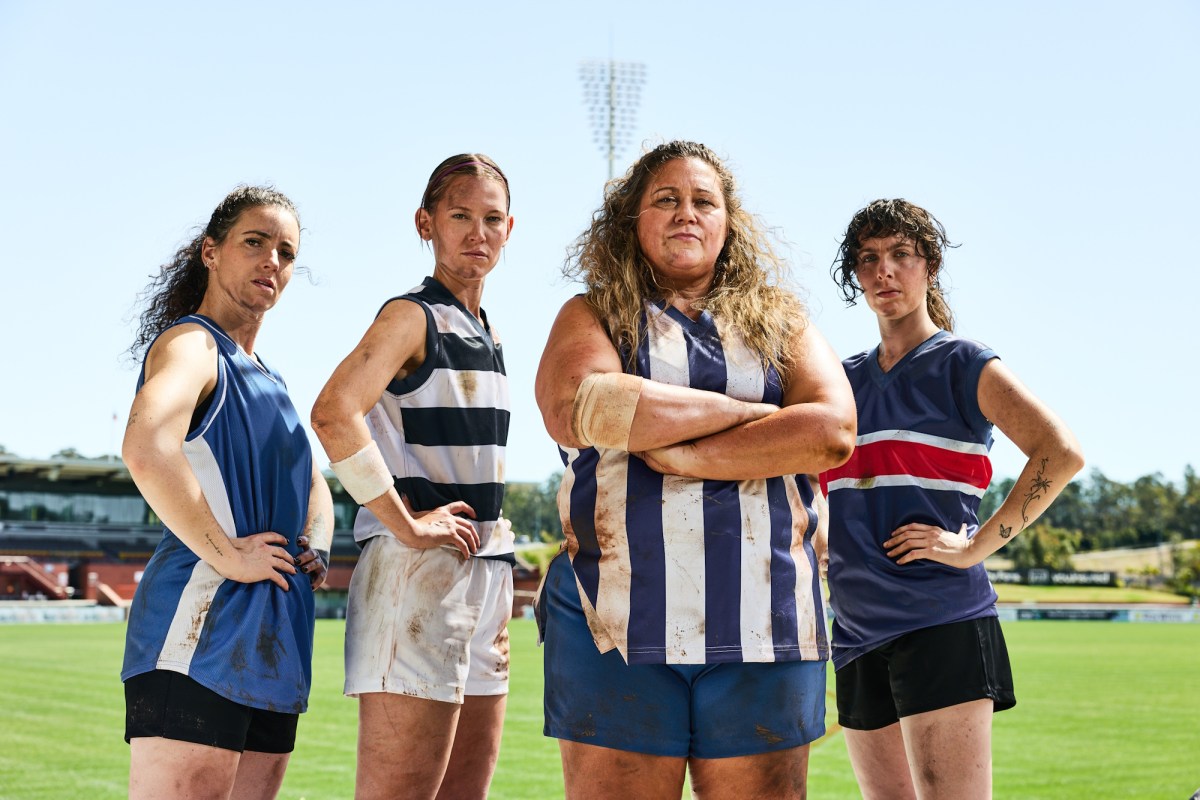
When she mentions Miller’s eagerness to give everyone in the production a voice in crafting the show, Giles again paints a picture of art, and the act of creating it, mirroring the life that it is depicting.
‘Someone will have an idea or an offer, and Suze will always be collaborative and thrilled at people’s notes. She always knows exactly what she wants to write, she knows what it is, but she’s got a way of folding in feedback and thoughts, and being plastic with the process that’s really delightful,’ Giles says.
‘This has been a very collaborative, playful process, in that I’ve been able to bring lots to the table and come up with offers that Suze has said yes to, or that the cast have gone, “Yes, let’s try that”. And so in that sense, the delight here is simply the number of people that we’re playing with, and that we’re creating with.’
It takes a team
Given that Strong is the New Pretty is ‘about the inherited patriarchal structures of societies and institutions that women have to work inside of,’ as Giles puts it, there’s also ‘been something really delightful about the majority of the people creating the work inside what is an ostensibly patriarchal society and structure,’ she says, pointing to the structures of theatre companies and the arts more broadly.
The team, she says, has ‘found a very different way of working, a very different way of collaborating’.
Treffone adds, ‘It’s a beautiful magic. It really is … Quite often in this process as a cast, we’ll be navigating through a scene, and Suzie’s quite deliberately at times allowed for the theatre-making to exist inside of a scene. So I think that’s going to be new for audiences as well, who are used to her previous productions.’
A crucial product of this female-led approach is authenticity, Treffone says. ‘There’s something really powerful in being in an environment and a room where you can just be your authentic self. You can speak to things, and you know that the seven people around you all understand your experiences. And I think that in itself is always magical.’
She adds, ‘When any person inside of any minority or community that doesn’t feel like it always gets represented, when they feel seen because they’re next to each other, standing strong, I think it makes for better work. It makes for a better world.
‘There’s natural obstacles that come with any job and making something, but quite quickly those obstacles are resolved or we pivot.
‘We, as a cast, joke around and say, “We all know how to pivot because we all played netball growing up”. And I joke and say, “Yeah, because we were all forced to play netball”.’
Elite actors playing elite athletes
While rehearsals have featured ‘a lot of netball references, but a lot of fun,’ says Treffone, again and again the Strong is the New Pretty team kept drawing parallels between the play and AFLW’s story.
‘It’s really interesting on this one, because the meta of this particular production is that, in a way, the AFLW was a space created where there was no space,’ says Treffone.
Giles makes the same comparison, which proved influential in how she tackled the challenge of physically representing the game of Aussie Rules with her cast.
‘I feel pretty clear in terms of the conceptual approach to the production that obviously we can’t put an AFLW match onstage,’ Giles says. ‘We’re not elite athletes. But what I do have is eight elite actors.’
‘What we talked about was creating a show where you see the virtuosity and the craft and the skill of the actors on stage in recreating a story … It’s more about how the theatre can communicate through the form of theatre itself, as opposed to any literal football stuff on stage.
‘So for me, it was about watching a show where you see eight women working together in a virtuosic, highly skilled fashion, where you come away and you see that these women have both created something out of nothing, in terms of the theatre, and that that has a relationship to how the AFLW was created.’
She adds, ‘Theatre as a form, it has an ability to communicate through staging, through form, through collaboration, through ensemble – that’s where I see this mirroring AFLW.’
Making opportunities
Strong is the New Pretty has company when it comes to shining a spotlight on women’s sport, arriving just as beloved streaming sitcom Ted Lasso swaps to women’s soccer for its long-awaited fourth season. Two high-profile projects across stage and screen mightn’t quite constitute a trend, but they give the world of women’s sports a chance to extend their audience, just as establishing AFLW did.
‘I think we make assumptions around what audiences want,’ says Treffone. ‘Even in our arts – and art always represents the world that we exist in. It’s a space for us to interrogate, represent, mirror.’
‘When this league was created, the biggest pushback was [the argument] that no one would come. And for an industry, that meant money, right? So they were like, “No one will come, which means we can’t sell advertising,” basically, “Because if we can’t promote this, then what’s the point?”
‘And I think very quickly, [the AFLW teams] were playing exhibition games and they had thousands of spectators rock up, and so they squashed that idea,’ she says.
Like Giles, Treffone also values how the relevance of Strong is the New Pretty continues well beyond sport. ‘I think audiences who are familiar with Suzie’s work, she has such a clear point of view inside of it, but it speaks to a bigger movement,’ she says.
‘It speaks to the communities that surround her protagonists, really, as well as her protagonists themselves. This production sits in another world – footy or AFLW and its creation is our vehicle, but she really is speaking to what it means for anyone to be invited [to] a table that they’ve never sat at before, what it means to create space for communities that feel like they have never had space, and what that is to give voice, to give power, and the knock-on effect that has to the greater community itself.’
For Giles, these themes resonate deeply, ‘because I think anyone who’s a woman knows what that’s like. Any job you have, any place you exist, we all have the same thing,’ she says.
‘Any woman who goes to this will see parallels. It’s a world that we all live in.’
Fighting for your rights
This isn’t just a production for existing women’s football fans, then. ‘I think if you love AFLW or if you don’t love AFLW, what’s so interesting about this is it’s a very inspiring, joyful example of how women got together over a long period of time and fought for something, and achieved it,’ says Giles.
‘And then it becomes a really specific example of something much greater – so the right to vote, the right to choose, the right to get divorced, the right to be queer, any right that we have as women, or any rights that anyone has, someone fought for them once.’
‘What’s incredible about this play is this idea of paying it forward. They were a group of women who fought for something that they could never specifically or personally benefit from, but the next generation are benefiting,’ she continues.
‘So actually, it becomes a very inspiring story of how women fought for things and how we will keep fighting for things.’ But in celebrating what can be achieved when we come together to create opportunities, and do more than just dream of a better future, ‘it’s not even just specifically about women,’ Giles says.
‘It becomes a really interesting example of – in a day and age when everyone’s endlessly being pitted against each other and arguing about this, that and the other – the moments where people can come together and all collectively push for something.
‘It makes me feel that sometimes, things like pushing for a universal wage, pushing for greater housing, pushing for greater equality, whatever that is, it feels like it’s an inspiring story of one way of getting those things done.’