When Deaf artist, filmmaker, curator, advocate Irene Holub was growing up, representations of Deaf artists were hard to find, she tells ArtsHub ahead of their new show, the Deaf artist-led opera Manifesto of Silences, which she directs and which debuts at Melbourne Fringe this October.
‘Deaf people were routinely excluded from the arts within a mainstream context,’ she says. ‘You mostly had to look overseas for role models, and even those were few and far between.’
When Deaf stories were told, they were usually appropriated by non-Deaf performers, often to significant acclaim, Holub adds. ‘The mainstream arts world has a long history of co-opting the lived experiences of Deaf people for their own purposes, mining these experiences for their uniqueness.’
Holub was determined to harness her own story. ‘From a young age, colour, movement and shape were my first languages, long before I had access to my actual language, Auslan,’ Holub says.
‘Growing up Deaf in a system with no cultural or linguistic access meant I had to pretend to be hearing just to participate. But even then, I was already an artist, attending life‑drawing classes in my school uniform, experimenting with materials, creating images on paper and building a visual world that made sense to me.’
Flourishing in an arts degree at RMIT, Holub felt more able to explore her creativity. ‘It was the first place where I felt the freedom to explore my practice deeply, even though access was still absent,’ she says.
Twenty years later, Holub has contributed to a significant shift, while there’s much yet to achieve. ‘Auslan and Deaf culture have moved from the margins into the mainstream, supported by programs such as Arts Access Victoria’s Activate Auslan, Melbourne Fringe’s Navigate, Northcote Town Hall Arts Centre’s FLOWfestival, Creative Victoria’s Deaf and Disabled Arts/Creative Australia grants.’
While access remains inconsistent, Holub notes that her co-founding FLOWfestvial in 2018 was a major turning point.
‘It created a platform where Deaf-led performance, visual art and culture could be seen on their own terms, generating visibility and momentum for our community,’ she says.
Deaf artists in the spotlight – quick links
Marrying opera and sign language
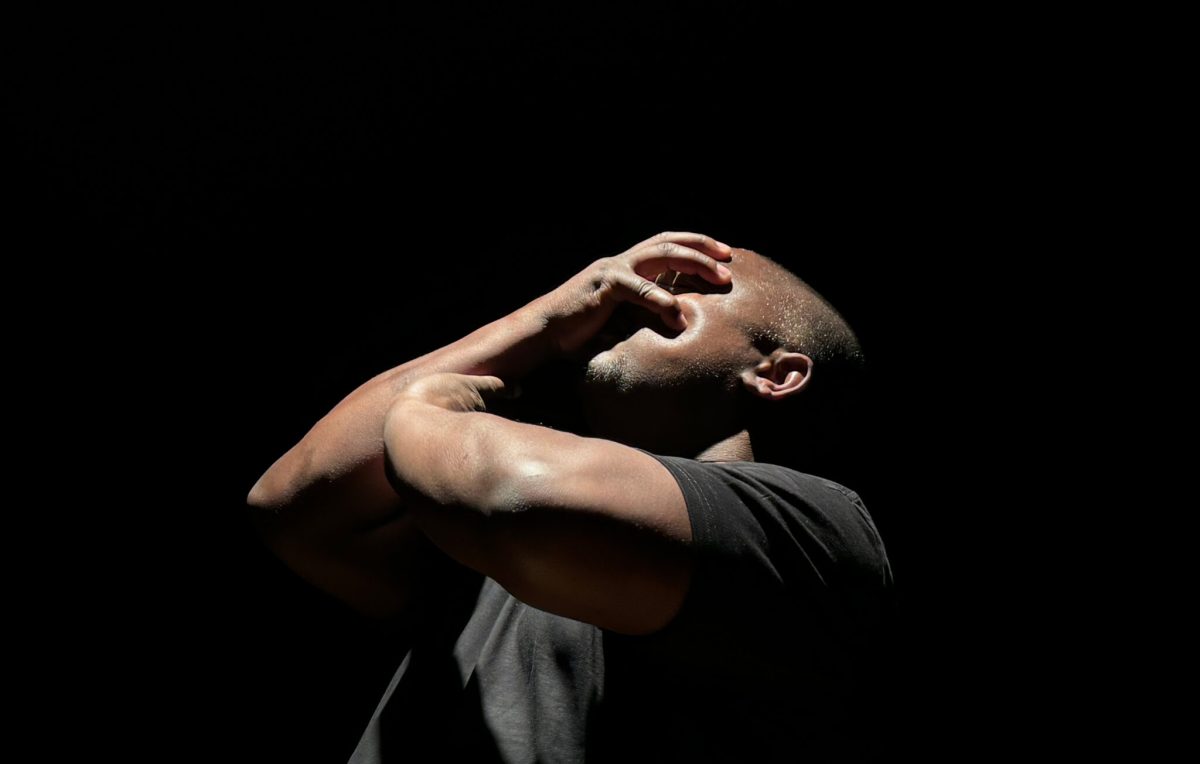
Holub’s Manifesto of Silences expands the operatic form so that it is told through sign language and movement alongside projections from digital designer Rhian Hinkley and lighting designer Bronwyn Pringle alongside Sharyn Brand’s immersive sound design.
‘Opera has always demonstrated the purity of emotion, carried through voices and music,’ Holub says. ‘Auslan in opera brings our experiences to the stage, inviting audiences into an immersive world where sign language becomes poetical motion. Auslan, like opera, uses movement, expression, and visual vernacular. It’s enhanced by sounds shaped in alignment with the language.’
Holub’s parents took her to the arts, including opera, as a kid. ‘I could not hear all the voices, but I could see the power of their stories in the movement, expression and the musical vibrations that travelled through my body,’ she says.
‘Even when the performances were mostly in Italian, I felt the energy in the room. I witnessed how the audience experienced emotion, and I felt it too.’
The perfect vehicle, then, to connect communities that should never have been held at arm’s length from one another. Featuring Walter Kadiki, Luke King, Anna Seymour, Ramas McRae, Maya Sandon and Franco Spadea, Manifesto of Silences promises to be a revelation.
‘They bring a sensibility, as Deaf actors, that cannot be replicated with hearing performers, as the work is created through Auslan, visual vernacular and the language of the body moving through space, something that lives inside the experience of Deaf bodies and minds,’ Holub says.
Working collaboratively, they also engaged movement director Anna Seymour. ‘I wanted to use a range of non‑verbal mediums to tell this story, so turning to dance felt like a natural way to expand the linguistic sphere of the play,’ Holub says.
‘I asked Anna to choreograph pieces that felt elemental to the themes, allowing Deaf and hearing audiences alike to feel their way through the work. The production isn’t interpreted into English, so we’re inviting audiences into a different kind of literacy, one that Deaf people know intimately.’
She’s felt fully supported by co-producer Arts House. ‘Their support feels tangible and meaningful, so that it’s not just tokenism or extraction. We have a long-term engagement, led by our needs and desires.’
She adds, ‘It’s not always smooth sailing, but we are learning together, and if things need to be discussed, they are up for a challenging conversation. That is very rare in a presentation partner, where in most cases you are expected to simply fit into their pre-established ways of working.’
ArtsHub: 20 years of Arts House – reflecting on where it all began
Seeing is believing
Prolific multi-disciplinary artist, musician, performer, author and activist Asphyxia (Blood Makes Noise, The Grimstones, Future Girl) likewise chose to create d/Deaf-led art where there was none.
‘I didn’t read a single book about a d/Deaf person,’ she recalls. ‘The first time I saw a d/Deaf person represented on a screen was Marlee Matlin in Children of a Lesser God, and it changed my life.’
‘I had this innate “understanding” that I was “defective” and Marlee gave me a whole new perspective. She was beautiful, strong, passionate and I suddenly realised I could be like that too. It changed everything for me.’
As did an early glimpse that validated her emerging queer identity. ‘In my school library, there was a single novel featuring two teen girls experimenting with being lovers and I fell in love with that book, reading it over and over,’ Asphyxia says. ‘It was a refreshing change from media which represented lesbians as having a hard life.’
Asphyxia has no doubt what the impact of seeing more positive representations of deafness and queerness from young age would have had. ‘I would have felt so empowered and so much relief.’
It wasn’t easy to find suitable homes for her innately creative urge. ‘When I was starting out, back in the 90s before email was commonly used, my main difficulty was the inability to make phone calls to festivals and theatres to tell them about my work,’ Asphyxia recalls.
‘I couldn’t call businesses to ask them to quote for items I needed. The National Relay Service was impractical for business use as it was very slow. A call that might take a hearing person a minute could take me up to 20. I had to use my own savings to pay people to call for me.’
Education was also difficult to access. ‘Much of the theatre, circus and art training available was aural-based, and even with an interpreter, it could be very difficult for me to participate. I’ve often worked around this by hiring private trainers who can work one-to-one, but again, this is very expensive.’
Collaboration and community
Affordable access is vital. Asphyxia has teamed up with the creative team behind The Legend Of Queen Kong, Sarah Ward and Bec Matthews of Fat Fruit fame, to help steer the Melbourne Fringe event Queering the Music Video, a truly collaborative work
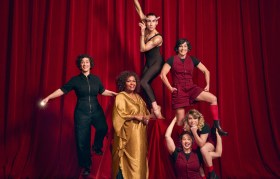
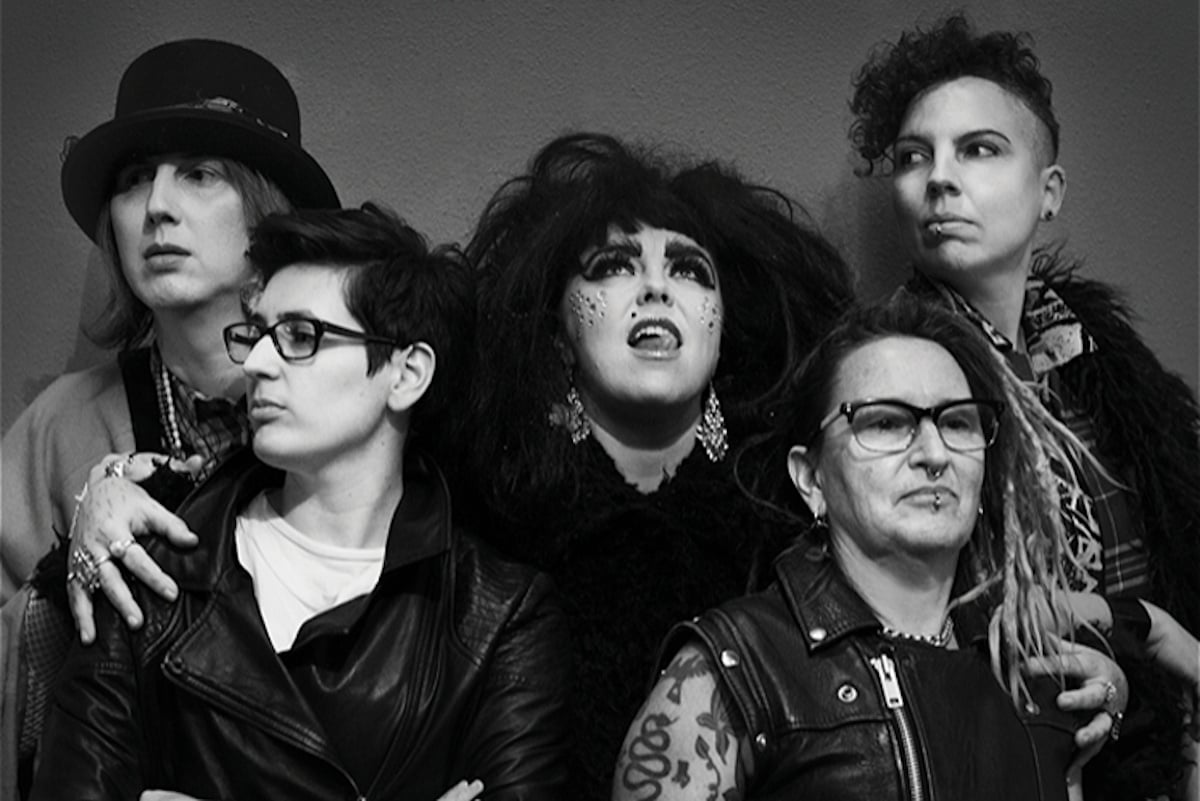
The latest work from the neo-punk, performance art, queer rock band, Queen Kong and the HOMOsapiens, the satirical sci-fi cabaret has evolved through many forms over the years, with this panel event teasing videos from their accessible visual album alongside live performances that will also feature The Huxleys and Dr Stayci Taylor, with Asphyxia appearing in the videos.
Auslan interpretation will be offered by Dr Kirri Dangerfield and Khang Chiem, with academic, cinema curator and HOMOsapiens guitarist Cerise Howard narrating in a role Ward describes as ‘somewhere between Philomena Cunk and Margaret Pomeranz’.
‘Sarah and Bec first contacted me to ask about signing a song in her show and I pointed out that signing a single song would be appropriation of our language that would not make the show accessible,’ Asphyxia says. ‘Better to make the entire show accessible.’
While Asphyxia didn’t expect to hear from them again, they came back a year later with funding to do exactly that, inviting her onto the project. ‘At every step of the way they have been very accommodating of my health issues and disabilities, and they really showed me a new benchmark for how I would like to be treated and considered,’ Asphyxia says.
‘Working with them has always been a pleasure due to their consideration … and the sheer fun of their willingness to be irreverent and stand up to what’s wrong in our world.’
ArtsHub: How to embrace ‘radical access’ in the arts
It’s a cause close to Asphyxia’s heart. ‘Stella Young and my girlfriend Sky both supported me getting political with my art and using it to make powerful statements,’ she says. ‘That has been very fulfilling. I like my art to say something, to make people stop and think, to feel seen and heard and understood.’
She’s also working on an app, Amplio, which she describes as being like Spotify for Deaf people. ‘It arose out of my own experiments to make music more accessible for myself,’ Asphyxia says.
‘Sarah suggested I start writing my own songs. I never thought that I, as a d/Deaf person, could write music, and was stunned when I ran an online survey and discovered that 60% of d/Deaf people, like me, would like to be able to but don’t know how.
‘So I got started on music theory and now I write my own pieces, even learning to sing; another barrier I thought I’d never be able to cross.’
Ongoing learning
Ward is forever grateful to Asphyxia for challenging her to be more actively inclusive. ‘There’s still so much to learn, and it’s an ongoing process,’ she says.
A few years back, Ward recalls hearing the inimitable Richard Watts interviewing Jess Thom about Backstage in Biscuit Land, a show about living with Tourette syndrome, on Triple R show SmartArts. ‘And I thought, “Shit, theatres are really inaccessible”.’
Ward adds, ‘Not just inaccessible physically, but also emotionally, including if you’re neurodivergent, anxious, have Tourette’s or if you’re a mover. And that’s beyond being able to afford the ticket, which is a class issue.’
She also recalls being impressed by Asphyxia’s hula hoop prowess in the show Rock Strip. ‘She was able to respond to the music and hit the beats with a prompt with the person at the front, and I was really into her art, including as visual artist and a puppeteer, and our paths collided a bit.’
They vibed on their shared queerness. While the plan was originally for Asphyxia to be performing on stage, videoing a piece that appears on screen was a workaround to meet Asphyxia’s needs with a health complication.
‘We didn’t say, “Oh, well, we’ll go find another Deaf artist who can be in the show.” Ward says. ‘We said, “How can we get you in the show? What does it mean to make space and provide possibilities for a person to stay included in a project?”‘
Ward wants to make as much space as she can. Presented in partnership with RMIT, Queering the Music Video is Fat Fruit’s latest evolution and they’re building on Asphyxia’s expertise with extensive community consultation.
‘We’re going out to Deaf artists and asking them what their experience is of the music videos that we’re making as well, so that we can get feedback about how we can make these music videos not only creatively exciting, but also accessible.
‘That’s undergoing the process of meaningful translation, and then also looking at other elements that can support Deaf and hard of hearing audiences from a visual standpoint, through access to music, the lighting and considering things like haptic vibration.
Melbourne Fringe plays an important role in expanding who gets to be in the room. ‘Fringe is not a journey to the mainstream; it’s an actual destination,’ Ward says. ‘We don’t have to compromise when we’re placing ourselves in the fringe model … [like] when you end up in the flagship venues or mainstream programming.’
She adds, ‘Fringe also curates and supports artists. If they had more funding, they could be more there for people, but they’re as there as they can be.’
Improving access for artists and audiences
Asphyxia continues to push for better access to the arts for d/Deaf people, both as audiences and artists
‘Deafness is still incredibly marginalised,’ she says. ‘I don’t see media with d/Deaf characters, or our language, Auslan, being represented in mainstream arts the way that queerness is now. The structural barriers to our inclusion are still significant.’
And that includes in venues. ‘Cinemas don’t tend to show movies with open captions, festivals and events often don’t have enough access information available. They often still or require phone calls to get that access information or make access-related bookings.’
ArtsHub: When public art is led by accessibility, the results are transformative
Holub says Melbourne Fringe has an important role to play in progressing things. ‘We need allies like [Melbourne] Fringe to work on redistributing power and resources to people and groups who are marginalised, not because their art isn’t equally worthy, but because we are still operating within systems of inequity.’
There’s been way too much inequity for far too long. ‘Deaf people have been forced into segregated lives because our language and culture, yet we are everywhere, in every profession, every community and every part of public life. That centrality of identity should be reflected in the arts.
‘We are First Nations people, people of colour, queer and disabled people. If we create space for people to be fully themselves and understand equity as giving people what they need to thrive, we will see a more generous, more imaginative arts sector capable of telling all our stories.’