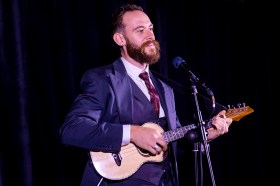
‘Our decisions are made on consensus,’ says James Jackson of independent Melbourne theatre company Bloomshed, when I ask about the process for making new work.
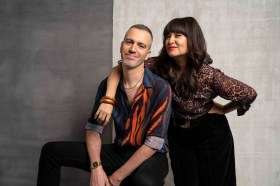
I’m chatting with Jackson, co-writer and creative director of Bloomshed’s adaptation of George Orwell’s 1945 novel Animal Farm, and his Bloomshed colleague and co-writer Elizabeth Brennan.
Their show is currently playing at Arts Centre Melbourne before opening at the Canberra Theatre Centre in September.
‘The company is a really long dialogue between 15 people,’ Jackson says.
‘It’s a constant juggle to try and live up to our ideals about what a democratic process should be in a theatre collective,’ Brennan says. ‘It’s very exciting, if sometimes, infuriating, to be locked in this kind of constant negotiation system.’
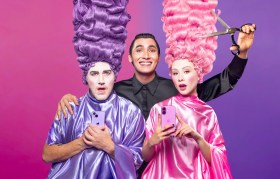
Founded as a collective in 2012, Bloomshed’s star continues to rise, gathering fans and critical acclaim for their entertaining and politically charged satirical adaptations of classic texts.
‘The best of our works have these moments where, if you’ve just gotten lost in the last minute, there’s something in this next minute that will catch you,’ Jackson says. ‘It could be something like a confetti cannon exploding. It could be a dance break.’
Bloomshed – quick links
Bloomshed: lockdown reading
‘James started writing the script for Animal Farm back in 2019,’ Brennan says. ‘He sent me the book to have a look at, because I’d never read it before, trying to woo me.’
‘It’s the best way to get someone excited,’ Jackson says, ‘because if you’ve actually gone to the trouble of buying them a copy of the book, they usually have to read it.’
Brennan came on board as co-writer, and the pair worked on the initial script throughout the Melbourne lockdowns of 2020, sending versions back and forth to each other, before a planned season in Geelong in 2021 was shuttered after one performance.

‘On the day of opening night, they announced that Victoria was going back into lockdown,’ Jackson says. ‘By 11:59pm we all had to be home. We did the show anyway, left all the props, everything, and just drove home.’
‘It was a blessing,’ says Brennan. ‘None of us were really happy with it as it was. I think our tastes had refined by the time we came to look at it again in 2023.’
Bloomshed’s rise
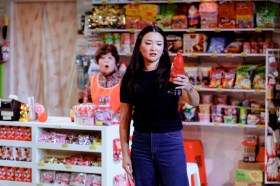
Since its breakout success with Paradise Lost in 2022, Bloomshed has racked up a webpage’s worth of award nominations, including Greenroom wins for best production and best direction in 2023 for Paradise Lost, and best production for Animal Farm in 2024. Most recently, actor Emily Carr won the Greenroom award for most outstanding performer for her performance as Mrs Bennet in Bloomshed’s Pride and Prejudice, ‘a love story in a housing crisis,’ which had a sell-out season at the Malthouse in May this year.
The company has a downloadable manifesto on its website: part first-person welcome script, part theatre-cult rulebook, part all-caps absurdity.
On page four, it declares:
‘WE MAKE BOLD AND BRASH WORK’
‘WE WILL MAKE CAREFULLY CONSIDERED AND EXTREMELY PRECISE WORK’
Bloomshed takes equal interest in having fun, working hard, and making meaningful work that doesn’t sacrifice entertainment value and laughs.
‘In Australia, the simple, searing, satirical sentence is what people use in the pub,’ Jackson says. ‘It’s like: Bang. Done. Undercut. Gone. And we love it. It’s a language that we’re familiar with. I think satire is the ultimate art form.’

‘That’s the benefit of satire,’ Brennan says. ‘You can approach incredibly serious material with humour. It’s able to entertain and give people joy without diminishing what is underpinning it.’
Bloomshed: Animal Farm as a critique of democracy
‘We set ourselves two challenges in making Animal Farm,’ Jackson says. ‘To adapt it without having a narrator, and to divorce the original text from Soviet Russia, from the communist revolution – to instead read the text as a critique of democracy. We really value class politics. You don’t need to be left or right to try and draw these ideas out.’
‘If we can help create a more politically literate society, it can only be a good thing,’ says Brennan. ‘We don’t know what the end goal of that is necessarily, but I mean, the pigs knew knowledge was power, didn’t they?
‘The gift of knowledge is not to be diminished.’
Bloomshed: theatre for everyone
‘It’s frustrating, the death of theatre, or the shrinking further and further into this tiny thing, that very few people engage with,’ Brennan says. ‘It’s a space where, particularly in independent theatre, you aren’t beholden to any institution. You can say the dangerous things that you want to say. And it’s so hard to participate in that, because it isn’t funded in the way that it could be.’
‘There are so many prohibitions for people to engage with it,’ Jackson says. ‘One night at the theatre is sometimes four times more expensive than a month of Netflix.

‘As a company, we talk about this a lot – the need for the work to be widely accessible and radically accessible, so that someone who has never seen theatre in their life can enter that space and not feel ostracised or alienated and can have a good time.
‘We should be trying to widen the spectrum of what we make theatre about to catch as many people as possible.’
Bloomshed: connecting with teenagers
In recent years, Bloomshed’s plays have regularly been selected for the VCE drama and theatre studies students, with Animal Farm on the 2026 drama playlist.
Not that teenage audiences are easy to win over.
‘You talk to a lot of high school students,’ Brennan says, ‘and they’re like “I don’t want to go see a theatre show. That’s just people talking to each other in a room. What’s interesting about that?” But they come to our shows and seem to engage with the fact that we are attempting something different. It isn’t studying Macbeth in a classroom. It can be weird, and surprising, and thrilling.’

‘We don’t set out to make theatre for young people,’ says Jackson. ‘We don’t try to dumb them down. We don’t avoid swear words. And even a well-placed swear word in a show, it can excite a young person to be like “No! You can do that? In these hallowed halls of the theatre?”
‘I think that would have been cool for me when I was at age. And it’s amazing how those little things can really make a huge difference.
‘I think this is the fourth time we’ve been on the VCE play list in five years. Young people are super politically active and aware, and maybe that’s the effect of the internet. They know what’s going on. They’re usually, in my experience at least, deeply concerned or committed to political issues.’
Bloomshed: the communion of theatre
Brennan and Jackson see theatre, and live art more broadly, as, in Jackson’s words, a means of ‘ stitching back the social fabric that got ruptured so badly in 2020 and 2021 and continues to be torn by extremist politics, by rhetoric, by phones, by all of this stuff.’
‘It’s about those things that give you connection,’ Brennan says.
‘There was a time when I really believed theatre could like take the place of the demise of community groups around the world,’ Jackson says. ‘The collapse in Australia of those traditional places, including religion – which have problems, sure … But at least they brought meaning.’

‘Everybody’s so divided physically nowadays,’ Brennan says. ‘To have everybody’s attention in one space in a theatre for a period of time – it’s rare, and therefore, of huge value. To have the ability to actually just sit and absorb, with a group of people.’
‘We just don’t know what’s AI generated, what’s real or true anymore,’ Jackson says. ‘And that’s really troublesome.
‘One thing you can guarantee about the theatre – it’s real.’