What if, instead of simply looking at art, you had to dig for it? That is the proposition at the heart of HEAP, an ephemeral installation that will be the centerpiece of this year’s Festival of Dangerous Ideas at Carriageworks, Sydney.
Eight artists have been invited to surrender their artworks to 120 tonnes of soil, where audiences will then get dirty in the search for art – and, more importantly, ideas.
HEAP at Festival of Dangerous Ideas – quick links
FODI Director invites us to surrender control

HEAP is an experiment in excavation, collaboration and relinquishing control. For FODI Festival Director Danielle Harvey, it is precisely the kind of artistic risk-taking that a festival of ideas should embrace.
She tells ArtsHub that every festival, she looks for unique artworks that ask ‘why a festival about ideas has art? What can it do to enhance the experience? And, how can it help us do danger in a different way?”
For this year’s festival, which has been given the theme of ‘Revelation’, Harvey began thinking about the act of bringing hidden things to the surface. The result is less an exhibition than a live archaeological dig.
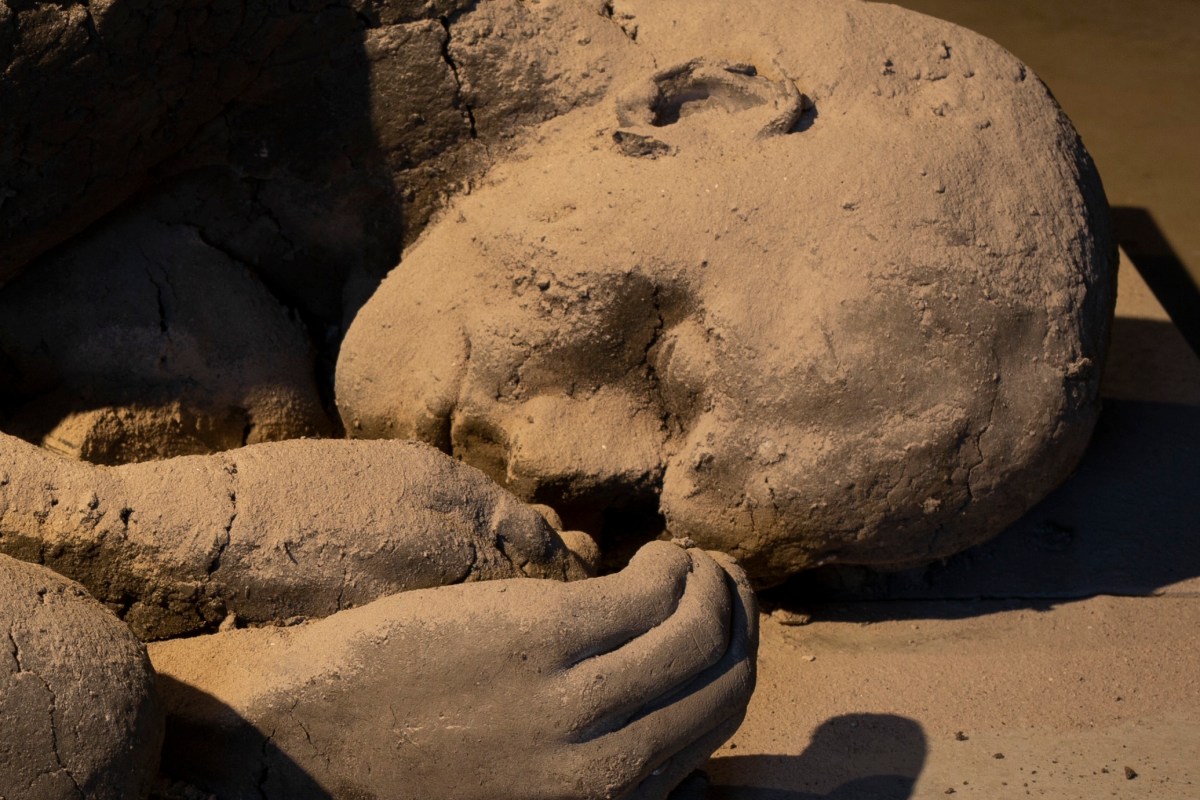
Audiences take off their shoes and enter a vast heap of soil in the foyer of Carriageworks, armed with a trowel or their hands to find newly commissioned artworks that have been buried. Upon discovery, the artwork is placed on waiting pedestals or into vitrines – and only then is the artist statement revealed.
‘We started thinking about ways that things are revealed through history, through time, and through action,’ Harvey says. ‘It’s really easy at the moment for people to feel overwhelmed and sit back and be a bit of a passive passenger. This work is very much about asking the audience to get into the fray – to literally get dirty, and to dig out those ideas that need to be brought to light.’
Ideas, Harvey suggests, require effort, curiosity and a willingness to get involved. ‘It’s not out of reach. Anyone can develop the muscles of critical thinking. Anyone can hold space for difficult conversation and trying to challenge themselves,’ she says.
ArtsHub: More Australian art news and reviews
The challenge of making dangerous art
The eight artists commissioned for HEAP are Brook Andrew (Wiradjuri), Aretha Brown (Gumbaynggirr), Keg de Souza (NSW), Tarryn Gill (WA), HOSSEI (NSW), Sophie Penkethman-Young (NSW), Tim Silver (NSW), EJ Son (NSW).

The act of excavation became the conceptual starting point for Korean-Australian artist EJ Son. ‘The greatest challenge was making sense of burying an egg, an object associated with life and potential, in a place that also evokes death, abandonment and failed emergence,’ Son explains.
The contradiction led them to question what excavation actually promises. ‘Perhaps we dig into the past looking for the truth, only to find something suspended between what has happened and what has yet to take place,’ they say.
For Son, the dangerous idea developed from questioning our impulse to make meaning as a way of coping with uncertainty. ‘The dangerous idea became that our impulse to search, interpret, desire and make connections is not simply a response to uncertainty, but a fundamental and generative way of relating to and constructing the world around us,’ Son tells ArtsHub.
The artists’ artworks are buried within 10 layers of soil, where placement is made around ideas of depth, density and discoverability. There is even the possibility that not all 80 works will be found.
‘It’s a live experiment,’ says Harvey. ‘That’s also part of the danger. I really want to see an Australian arts community that’s taking risks and making things happen that seem hard or impossible.’
Dead soil for live art
If Son’s work asks what we might find when we excavate the unknown, Keg de Souza’s turns that question towards the ground beneath our feet.
For de Souza, soil was both material and subject – and it presented an immediate ethical problem. Healthy soil is a living ecosystem, teeming with billions of organisms. Asking an audience to dig through it would not only pose health concerns but damage the very ecology the work seeks to value.
The solution was to use biologically ‘dead’ soil – which became part of the work’s conceptual architecture. ‘The challenge was how to create an experience of discovery within a material that deliberately lacks the life it is meant to represent,’ de Souza explains.

Her dangerous idea is chillingly simple: what if the only way future generations encounter the richness of living soil is as archaeology? De Souza collaborated with children to imagine the organisms that exist beneath our feet. Their imagined creatures become the basis for bronze fossils that hover between science fiction, children’s fantasy and a possible ecological future
‘The dangerous idea is that we could inherit a future where biodiversity survives only as memory, museum object or artefact, rather than as living ecology. Collaborating with children sharpened that idea,’ she says.
ScreenHub: Inside the Festival of Dangerous Ideas’ new film program
How to join the dig
It is here that HEAP moves beyond being an ingenious audience experience. The excavation becomes a rehearsal for a future in which the things we take for granted may no longer exist.
Harvey says the common thread shared by the artist and participant is that ‘you’re all relinquishing control in some way’. The artists relinquish control of their objects; audiences relinquish the safety of passive spectatorship; and Harvey, as curator, accepts that the experiment may not behave as planned.
But her ambition has been bold. Six 20-tonne trucks and four earthmovers have been involved in creating the installation over the past week, ready to welcome visitors to excavate from 22 to 23 August.
‘I really wanted the installation to take up space and be somewhat inconvenient,’ Harvey says. ‘I don’t think that inconvenience is overrated. I love it.’
For Harvey, that physical inconvenience is also a political proposition. In a moment marked by the rise of authoritarianism, technological control and increasingly polarised public discourse, the question of who controls narratives, markets, information and bodies has become difficult to avoid.
‘Control is everything,’ she says. And yet, HEAP deliberately gives it away.
Perhaps the most dangerous thing about an ideas festival is not having the difficult conversation. It is believing that ideas belong somewhere else – with experts, on stages, behind institutional walls. HEAP asks audiences to dig for themselves. And there is something wonderfully democratic in that.