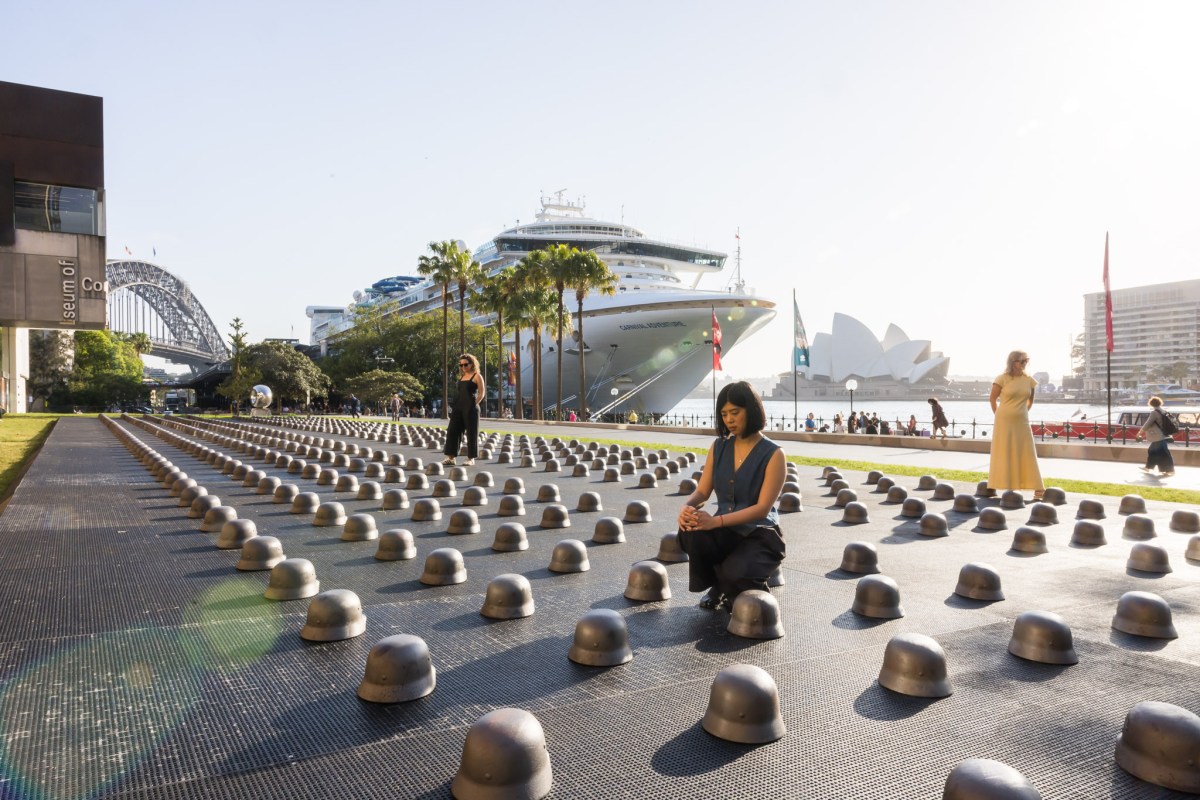
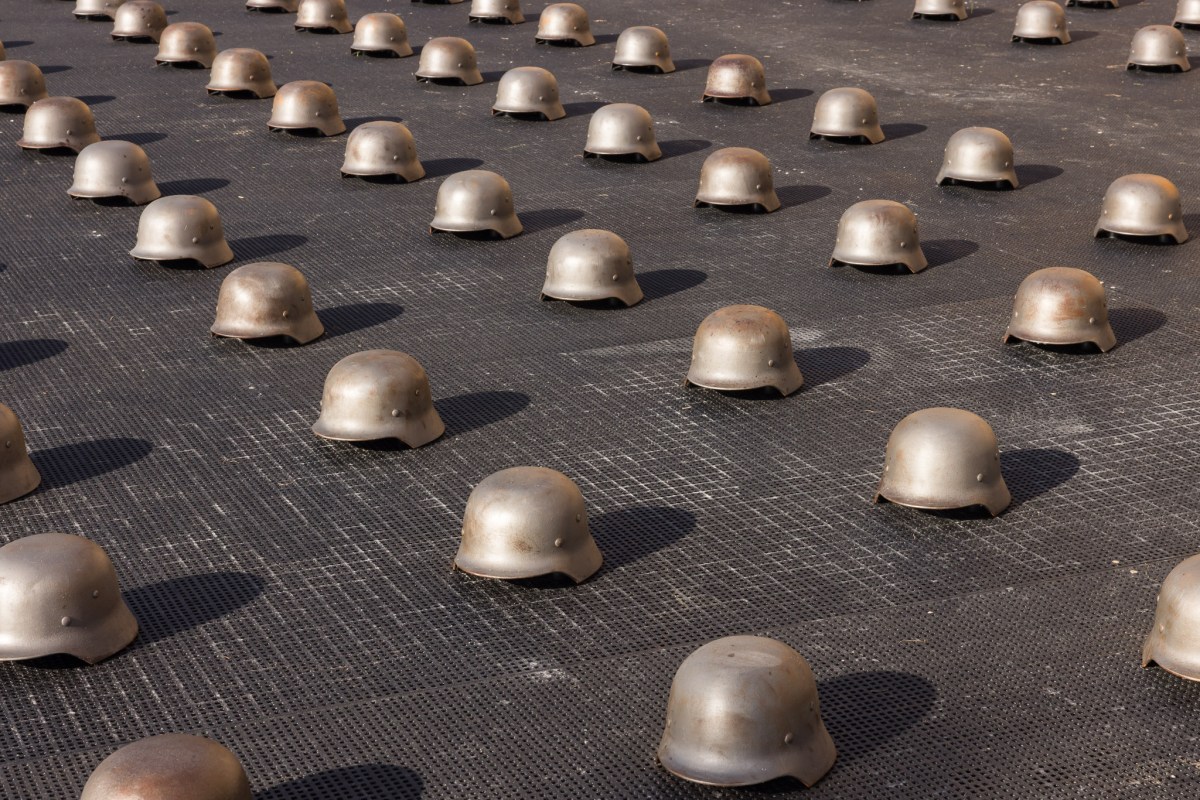
Five hundred combat helmets have taken over the Museum of Contemporary Art Australia’s lawn, transformed by famous contemporary Chinese artist Ai Weiwei into a meditation on war, peace and the fragility of human life.
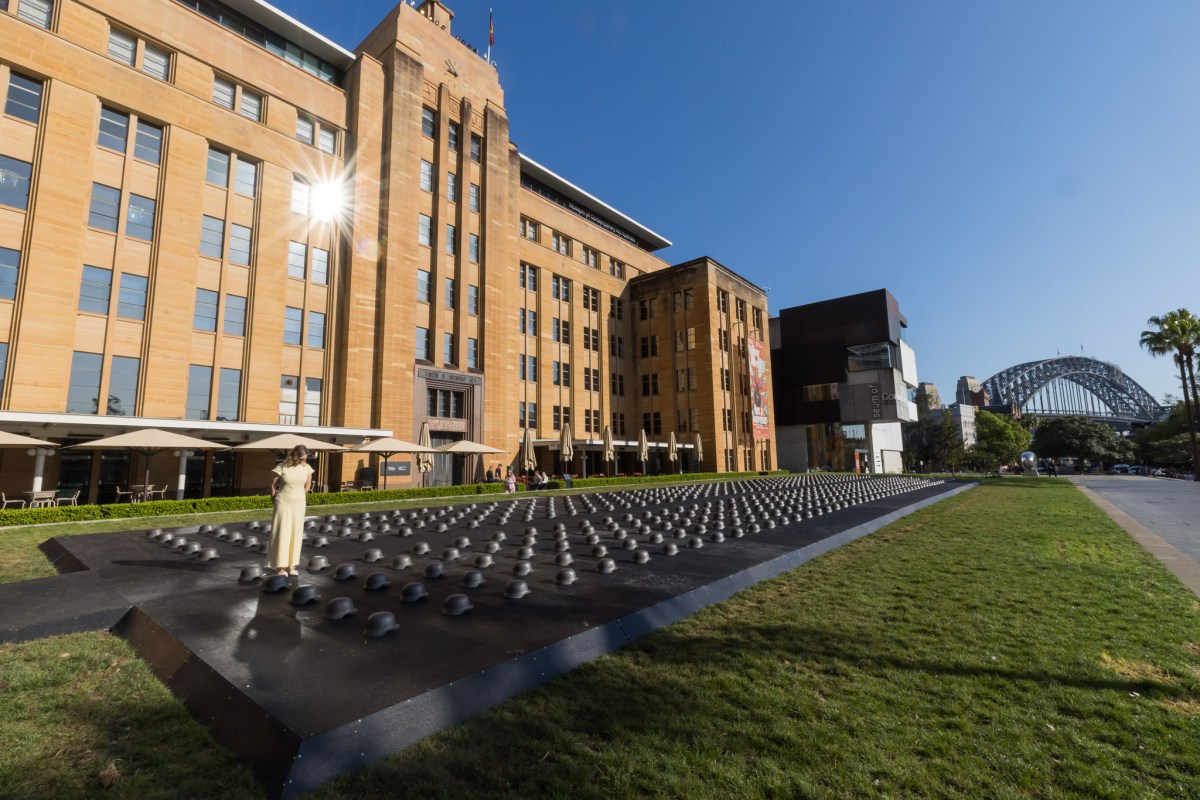
Mushrooms, unveiled 25 September as the 2026 Neil Balnaves Tallawoladah Lawn Commission, stretches 40 metres and overlooks Sydney Harbour. The temporary public artwork comprises 500 cast-iron replicas of 20th century military helmets, arranged on an elevated platform in 10 uniform rows .
Visitors can walk through the centre of the installation, encountering hundreds of objects originally designed to protect human life from the consequences of warfare.
It is a deliberately jarring juxtaposition with the pristine views of the Sydney Opera House and Sydney Harbour Bridge across the water – and one that Ai Weiwei says was central to his thinking about Mushrooms.
Born in Beijing in 1957, the artist has worked across sculpture, film, architecture, photography and writing. His practice frequently addresses state power, censorship, human rights, migration and freedom of expression.
Ai Weiwei artwork at MCA Australia – quick links
Why Mushrooms?
The title carries several layers of meaning. The helmets’ rounded forms recall mushroom caps, while mushrooms themselves evoke regeneration, decay and the transformation of death into new life.
The artist has also connected the title with nuclear mushroom clouds and the Chinese word for mushroom, which can suggest delay or endless waiting. The result is a work that turns an object associated with war into what the MCA describes as ‘a collective symbol of endurance and survival’.
The artist’s own framing is considerably more confrontational. Speaking to The Guardian from his farm in Portugal’s countryside where he has lived for the past six years, Weiwei spoke about how people deliberately refuse to acknowledge geopolitical crises.
The artist explained that his commission for the MCA is the result of his work on Human Flow, a documentary on the migrant crisis and contemporary warfare for which he and his team travelled to 23 countries, including four trips to Ukraine, where he spent time with soldiers on the frontline.
He says that the work was also inspired partly by Germany’s offer of 5000 helmets to Ukraine in 2022, a response he viewed as emblematic of the inadequate international response to the realities of modern warfare.
‘We continue to exist in a time where war and peace interchangeably assume each other’s roles,’ Weiwei says. ‘I hope this work prompts people to reflect on war and peace.’
The work continues a longstanding artistic engagement with conflict, displacement and political power that has defined much of Weiwei’s international practice.
Ai Weiwei in Australia
A superstar of the art world with a provocative track record of activism, Ai Weiwei is no stranger to Australian audiences.
His supersized installation Law of the Journey was a centrepiece of the 21st Biennale of Sydney in 2018: a 60-metre inflatable boat crowded with larger-than-life figures, reflecting the global refugee crisis and the artist’s interest in displacement and human rights.
The National Gallery of Victoria heroed his work alongside the forefather of pop art in the blockbuster Andy Warhol | Ai Weiwei exhibition in the summer of 2015 and 2016. Following the exhibition, Weiwei donated several new works to the NGV collection, including two large-scale installation works: Forever bicycles, an installation assembled from almost 1500 bicycle frames, and Letgo room, an immersive ‘temple’ comprised of more than three million plastic building blocks featuring portraits of influential Australian activists and champions of human rights and freedom of speech.
Boomerang, another oversized installation from Weiwei, is also currently on display at QAGOMA in Brisbane. An imposing waterfall-style chandelier, the piece is composed of 270,000 crystal glass pieces shaped in the silhouette of the iconic Aboriginal throwing tool.
A controversial choice?
The MCA’s decision to commission Ai Weiwei comes amid renewed debate around both the artist’s politics and the effectiveness of his politically charged work.
In February 2026, the Royal Academy of Arts in London held a vote on his membership after he posted a since-deleted tweet in 2023 about the war on Palestine; members ultimately voted to retain him, as reported by The Art Newspaper.
His recent work has also divided critics. Reviews of his 2026 Manchester exhibition Button Up! questioned whether the sheer scale and spectacle of some of his installations can overwhelm the ideas they seek to communicate. The Guardian’s critical review described some works as simplistic or heavy-handed, saying there was ‘too much silly Lego’. The Financial Times was prompted to ask: ‘what do we do with bad art by good people’?
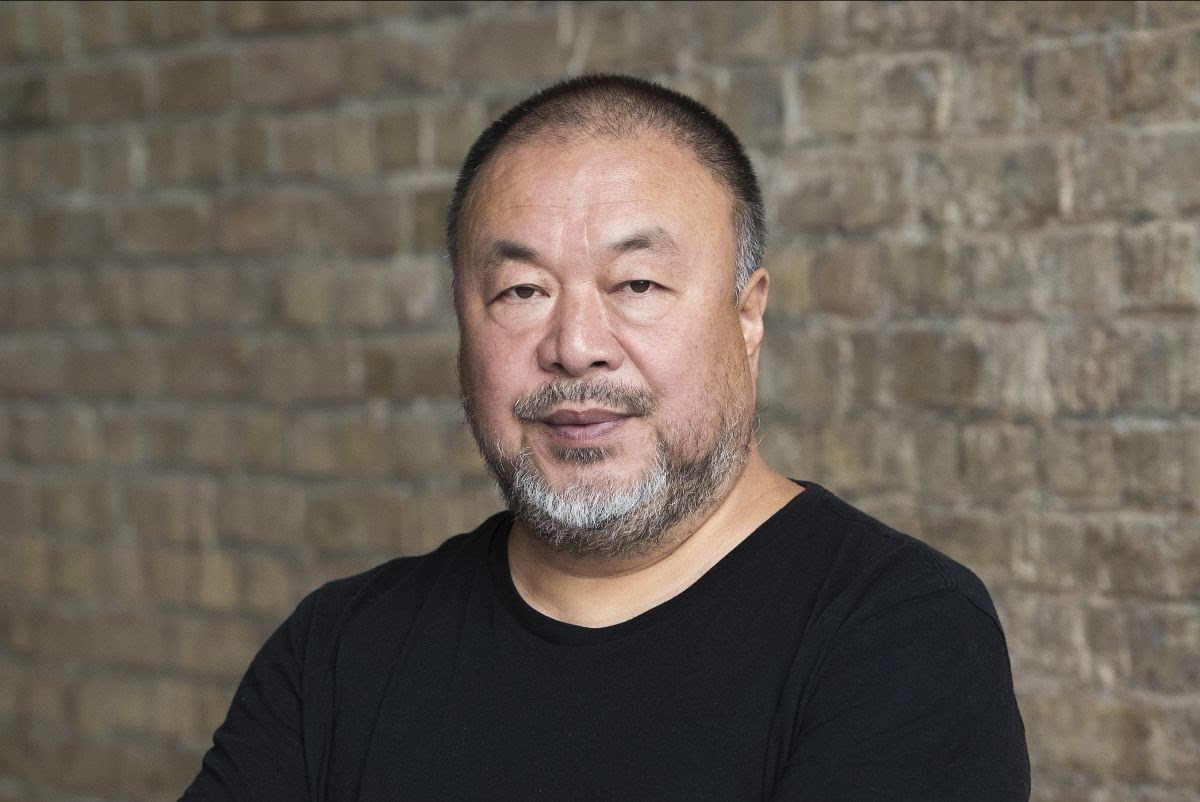
Weiwei himself is also openly critical about the state of institutional art, describing much of it as ‘decorative and sentimental’, saying genuine art should ‘question the existing order’.
In his chat with Michael Donkor for The Guardian, he said: ‘Art today is very corrupted – 90% of what we see in most institutions, or in so-called artistic circles, I think is just garbage. Real art questions the existing order.’
ArtsHub: Who is Ai Weiwei? Artist, dissident, superstar?
For the MCA, however, that capacity to provoke a response is precisely the point. As director Suzanne Cotter says, the commission is intended to bring statement-making contemporary art into the public domain and ‘spark conversations and engage dialogue’.
Meanwhile, Mushrooms is an artwork with a deliberately direct message. Whether its hundreds of identical helmets produce contemplation or simply monumental spectacle is ultimately left to the public.
A new public art tradition on the MCA lawn
Mushrooms is the second work commissioned through the Neil Balnaves Tallawoladah Lawn Commission, a four-year initiative supported by the Balnaves Foundation in honour of late philanthropist Neil Balnaves AO.
The series invites a major artist each year to create a large-scale artwork for the MCA’s waterfront lawn and aims to bring ambitious, large-scale contemporary sculpture to the public each year from 2025 to 2028, with the works free and accessible to the public.
ArtsHub: An extract from Elizabeth Ann Macgregor’s The Power of the Real
The inaugural commission, Ancient Feelings by British artist Thomas J Price, opened in September 2025. A large bust of an anonymous black woman with intricately braided hair, Price’s monumental bronze portrait sought to explore visibility, identity and the history of public monuments.