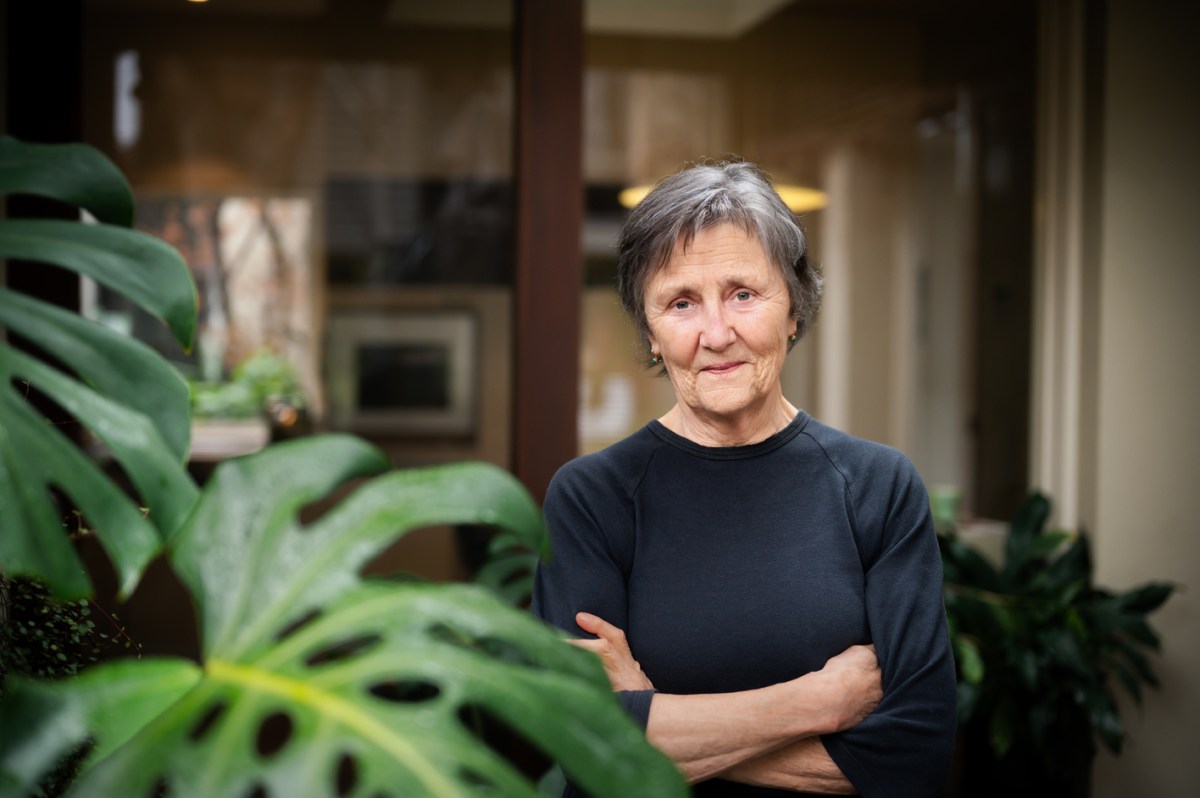
Australian author Helen Garner is so famous and well-regarded that to say you don’t like her has almost become a badge of honour among rebels, which I think is sad.
‘Can’t stand her,’ said one literary critic when I said was writing this article. Another friend said, ‘She reminds me of my mother and I don’t need that!’
Others admitted they’d never actually read Garner’s books – or they saw the movie of her first autobiographical novel Monkey Grip (1977) back in the 1980s, and that was enough.
Then there are the feminists who never forgave Garner for her first non-fiction book, The First Stone (1995), where she sympathised with a man accused of sexually harassing two Melbourne university students.
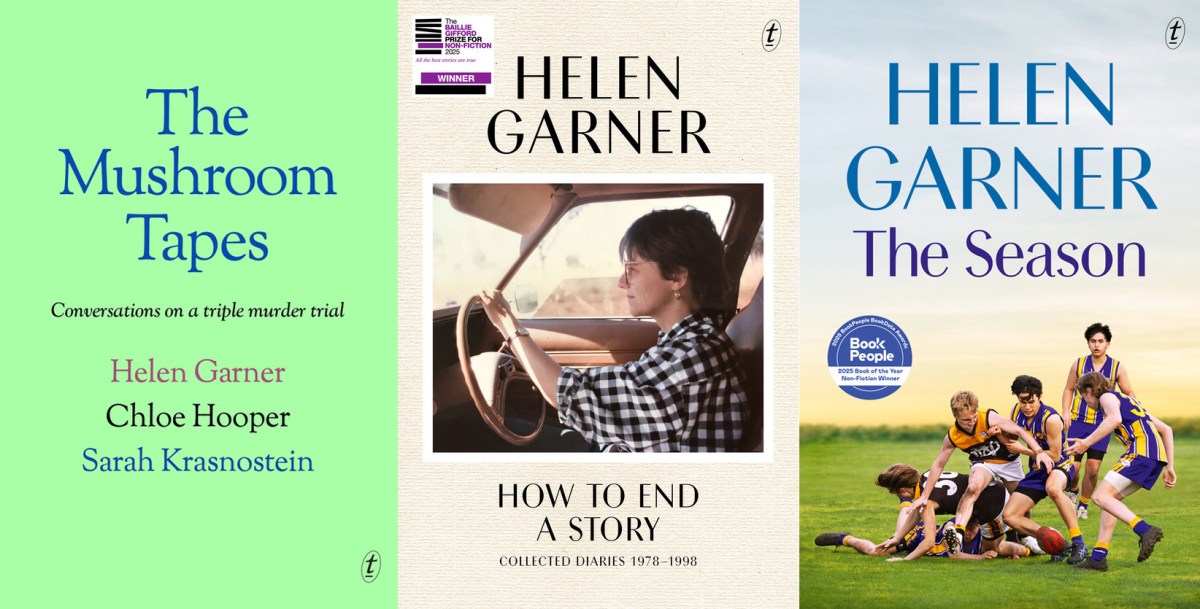
In subsequent years she’s rethought her position but still there many who resent the writer who inserts herself as ‘Helen’ or ‘I’ into almost everything she writes, from novels like The Spare Room (2008) to books about murder trials like This House of Grief (2014) and the imminent The Mushroom Tapes, written with Chloe Hooper and Sarah Krasnostein. Yet as a reader, it’s the ‘I’ and the ‘Helen’ that I’m always hungry for.
Helen Garner’s legacy – quick links
Helen Garner’s long legacy
While no writer is absolutely everybody’s cup of tea, Garner’s body of work is so wide and deep, and of such exceptional quality, that I can’t help thinking surely every reader would find something to appreciate amidst the novels, short fiction, essays, true crime books and, especially, the diaries.
She’s not difficult to read either. She’s never overly intellectual or boring and she carries you along with a style so precise and elegant that it looks effortless, always grounded in those famously well-observed details and telling snatches of dialogue.
Certainly, no serious writer working in Australia today should be unaware of, or ungrateful for, the singular position Garner has carved out in the field over the last 50-odd years. (She turns 83 this month!) Particularly in her non-fiction, she’s made possible new forms of honesty, of writing and speaking in the first person and letting the reader understand the writer’s process in doing so.
She puts herself out there courageously, perhaps sometimes foolishly, but she’s prepared to look ignorant, grumpy, petty and small if that’s in pursuit of emotional truth. She makes us all work harder and stay braver. Sean O’Beirne, in his excellent contribution to the Writers on Writers monograph series, writes that her work has shown him, ‘that you could really tell more as yourself and survive – that would be one of Garner’s best gifts to me.’
Love and loathing
So often Helen – and let’s call her Helen because if we love her that’s how we think of her – gives herself a hard time, loathes herself even, especially in the days when she was trying work out if her forte was fiction or non-fiction.
In her late-life book about her grandsons and football, The Season (2024), she’s often sick, depressed and self-doubting. But even in her deepest slumps, she quickly (at least on paper) pulls herself out of the nosedive, and finds the way back to her love of life and persistent curiosity.
Read: Book review: The Season, Helen Garner
There’s a delightful sociability about her. She seems so connected to friends, family and community, and she takes such pleasure in the small domestic tasks. Whenever I’m standing happily at my ironing board or making up a spare bed for a guest, I remember Helen’s enjoyment of those things too, a reminder that humble housework can coexist perfectly with big thoughts and literary aspirations.
No female experience should be off limits, according to Helen, whether she’s writing about her ‘cunt’ at the gynaecologist, her empty nest grief when her daughter moves out, or the rage she feels at her third husband (a very ‘serious writer’) who insists on absolute quiet in their Sydney apartment, forcing her to rent a space down the road for her own work.
In following the trial at the heart of Joe Cinque’s Consolation (2004), Helen recognises herself in Anu Singh, the disturbed young woman who drugged and murdered her boyfriend in Canberra. ‘With dread I recognised her,’ she writes. ‘She was the figure of what a woman most fears in herself – the damaged infant, vain, frantic, destructive, out of control.’
Me too. What a relief to read it confessed like that, alongside the huge compassion Garner extends in that book towards the victim and his grieving family.
Catching up: Helen Garner’s major works
So, a very potted and by no means comprehensive history for newcomers. Garner’s first book, Monkey Grip was published in 1977 when she was 35. (She’d notoriously been fired from her high school teaching job for talking too frankly about sex with her first-formers, an experience she wrote about in the poignant piece Why does the women get all the pain?, republished in True Stories.) Monkey Grip is narrated by Nora, a single mother living with her young daughter in a bohemian share-house and having a tumultuous, addictive love affair with the heroin-addicted Javo.
While initially insisting it was fiction, Garner later admitted the novel was basically her own diary ‘with the boring bits cut out’ – albeit with a lot of craft and skill involved. It captured the spirit of a certain kind of 1970s Australian inner city social life and was an immediate sensation, with Readings Bookshop’s Mark Rubbo famously saying half of Carlton was buying it because they wanted to see if they were in it. Monkey Grip won the 1978 National Book of the Year award with Garner the first woman recipient.
Then came the years of writing ‘real’ fiction, including the short story collections Honour & Other People’s Children (1980) and Postcards from Surfers (1985), the novella The Children’s Bach (1984) and Cosmo Cosmolino (1992), which was shortlisted for the 1993 Miles Franklin Award.
During this time Garner also wrote three screenplays: Monkey Grip (1982, directed by Ken Cameron); the excellent telemovie Two Friends (1986, directed by Jane Campion); and The Last Days of Chez Nous (1992, directed by Gillian Armstrong).
Read: Theatre review: The Spare Room, Belvoir St Theatre
The explosion of The First Stone came in 1995. Subtitled ‘Some questions about sex and power,’ the book was so controversial it inspired a raft of other books and essays and conference papers arguing with it, condemning it, and no doubt contributing to the fact that it sold over 100,000 copies.
In 2001, there was The Feel of Steel, a collection of short non-fiction works mostly written in the aftermath of her marriage breakup. These were pieces that first appeared in places like The Age, The Bulletin, Good Weekend, Heat and Women’s Weekly. (It’s amazing to note the sheer volume of freelancing Garner has done over the years to support herself.)
The title story of The Feel of Steel is about fencing lessons, and there are others about eavesdropping in a bridal salon, becoming a grandmother, learning the ukulele and buying a pair of golden sandals. There’s also a delightfully titled piece about colonic irrigation, A spy in the house of excrement.
This collection is one of my personal favourites, not least because I reviewed it as a very young and impressionable critic and got a generous, self-deprecating note from Helen herself. Here’s an example of the kind of thing she does so well in the final lines in The Goddess of Weeping: ‘I would have to acknowledge something that I already knew in my heart was true: the fact that people, even the ones you trust, the ones you are closest to are capable of anything. Anything at all.’
That harsh realisation comes again and again – and especially in Garner’s acclaimed coverage of crime trials, from the Walkley Award-winning 1993 Time Australia article about the murder of two-year-old Daniel Valerio, beaten to death by his mother’s boyfriend; to Joe Cinque’s Consolation; and This House of Grief (2014), about the conviction of an angry father who drove into a dam resulting in the deaths of his three sons in rural Victoria.
This last book got a new lease of life in August 2025 when British pop star Dua Lipa featured it on her book club. In even weirder news, Sarah Jessica Parker’s Carrie Bradshaw was also spotted reading This House of Grief in the final season of And Just Like That…
With gathering journalistic skill and confidence, Garner sometimes spends years at these trials and in crafting compassionate, intriguing narratives about almost unbearable events. Ordinary people do horrific things all the time, she says, asking how we as a community and our legal institutions serve or fail to serve justice, whatever that means.
There will be more of this kind of thing in conversation with two other virtuoso writers in The Mushroom Tapes if you haven’t already had your fill of the Erin Patterson trial, which I fear I may, but such is the lure of new Garner that I’ll probably give it a go.
The diaries, the masterpiece
For me, the diaries are the best of the best, the purest drug, giving the most immediate access to a Helen we know and love. Short paragraphs, pithy dialogue, self-excoriation and euphoria too, along with priceless insights into the day-to-day work of being a hardworking writer and sometimes public figure as well as a person trying to be good and often failing.
In the later diaries the compelling narrative arc of an affair with ‘V’ that turns into a marriage then a broken marriage is just one part of the page-turning pleasure. Here’s some simple dialogue presented as a single entry in 1987. It says so much about a doomed match:
“‘A girl at the supermarket gave me free coupons,’ I said. ‘She looked like Dolly Parton.’
‘Like who?’ says V.
‘Like Dolly Parton.’
‘Who’s Dolly Pardon?’”
As I write this, the news comes through that Helen Garner has just won the $100,000 Baillie Gifford Prize for Non Fiction for How to End a Story, the collected diaries covering the 20-year period from 1978 to 1998. This is the first time a diary has won the prestigious British literary award, with Chair of the judging panel, Robbie Millen, saying it was a unanimous choice and comparing them to the diary of Virginia Woolf.
This comes on top of gathering international fandom for Garner, which feels like a win for all of us Australians who’ve loved her so long. How interesting to see her ‘startling candor’ [sic] through the lens of a New Yorker profile.
And it’s not just the older people who love her either, the nannas and boomers who’ve aged alongside her. In a gorgeous and strangely moving write-up with the title Dear Boss, Cameron Hurst of the uber-hip Melbourne literary newsletter The Paris End reports from a symposium held in July at the University of Western Australia and devoted to Helen Garner – with the writer herself in attendance and given right of reply.
Also present at this symposium was ‘Thinker in Residence’ young Turkish-American literary superstar Merve Emre, who’s written about Garner’s work in the London Review of Books. In Dear Boss, Hurst depicts a vivid academic clash, where Emre argues against a paper by Australian star Ursula Robinson-Shaw. The two academics are thrusting and butting in the distancing abstract lingo of literary studies, but then Helen interjects and without disagreeing she brings it back to the ground of real felt emotion:
‘“I mean, what you’re describing is a kind of despair, isn’t it?” Helen probed, looking at Ursula across the space between the desks. A heavy pause hung in the air. For a moment, I felt that I could sense the consciousnesses of everyone in the room extending out to float between us, bristling and primed with alertness. No one could respond to the diagnosis: despair. Despair. We were paralysed. Then Helen spoke again, softly, and said, “Yeah, ok,” and it was as if she had released us all from a spell.”
Hurst said she got teary, and reading this I could have cried a tear or two myself because that’s how Helen gets to the heart of the matter.
Showing us how to do the work
Why do I love Helen Garner? Because she shows me how to do the work. I’ll never forget a Melbourne Writers Festival event where she was in conversation with Chloe Hooper and Beejay Silcox. Hooper was asking the more senior writer if maybe, hopefully, the process got easier and you didn’t have to feel so bad while you were doing it? Garner said no, that ‘feeling like a piece of shit’ was an important part of the process, at least for her. I find that comforting because unfortunately that’s how it is for me.
Helen’s version of doing the work means staying honest with yourself, even if that means changing your mind on the page or in public. She’s big on the importance of grammar and editing and getting your facts straight. But she also shows the way you can survive even when people are against you or wish you hadn’t written so frankly about them.
Like so many other writers who must imagine her at their shoulder when they’re getting cowardly or lazy, I take the lesson from Helen that even if your work occupies weird spaces between fiction and non-fiction, you have to be your own kind of writer and carve out your own position. That’s the only way you’re any good to anyone.