
From Frankenstein to I, Robot and HAL 9000, art is where we first imagined artificial intelligence. The AI models themselves have now been trained with this literature – including stories in which they turn against us.
Dario Amodei, CEO of AI safety and research company Anthropic, suggests that this might ‘inadvertently shape their priors or expectations about their own behaviour in a way that causes them to rebel against humanity’. (‘Oh no!’ says a friend. ‘Why did we let them read those ones?’)
In the meantime, art is one place we can try to make sense of this. I have heard numerous pronouncements of what art is – a site of resistance, a holding space for healing – all of which threaten, finally, to domesticate it. Art can be many things. It can be a place to process experience, an arena for mastery. It can be something to do for fun.
It can also be a deliberate source of friction. As the composer Igor Stravinsky observed, ‘the more constraints one imposes, the more one frees one’s self of the chains that shackle the spirit’. Creativity flourishes under limitations. I have devoted much of my life to the somewhat ludicrous problem of making the percussion instrument of a piano sound like a voice or an orchestra, of attempting to press human experience through an imperfect machine of hammers and strings and levers.
But if the awkwardness of the machine were eliminated, my spirit would not be freer. We set ourselves rules – for sestinas, sonnets and even soccer – in order to fly within them.
A central rule of drama, Aristotle wrote, is the need for ‘incidents arousing pity and fear’. Art that unfolds temporally depends on some form – however small – of problem. This is its motor; this is what prompts us to keep listening or watching. The principle of tension and release exists throughout all music, from the dominant seventh’s imperative to resolve, to the circuitous return to sam in Indian raga. Even the classical sonata form is itself a type of Aristotelian three-act structure, in which a musical crisis must be resolved to enact closure.
Why this fetishisation of problems? Why manufacture fresh difficulties in our recreations instead of fleeing them? It may be because art offers a safe(ish) arena in which to confront our demons, and sometimes to triumph over them: a fictive arena in which ‘happy endings’ remain possible, rather than the unhappy ending that awaits us all. In this sense, art operates as a set of reassurance rituals: the dominant returns home to its tonic; order is restored; catharsis is achieved. Even the most nihilistic works – those that withhold release and refuse neat resolution – can be experienced as anxiety-management systems. The problem is still over there, contained within the artwork. The theatre of cruelty ends; the lights come up; we return blinking – disturbed or enlarged or both – to the real problems of our lives.
Even travel can be a problem we set ourselves, with its own three-act structure: setting out into the unknown; the awkwardness of the unfamiliar; and the relief finally of returning home. As Oliver Burkeman observes, ‘the presence of problems isn’t an impediment to a meaningful existence but the very substance of one’.
* * *
The first and last of all our problems is the body: this thing that aches and laughs and bleeds and experiences pleasure. It is the source of our vulnerability, and our delight. It is also our trump card, the one thing we have that AI does not: our only true property, 60 per cent water, vulnerable to sharp objects, subject to time.
Nietzsche described the ear as ‘the instrument of fear’ – something that music addresses directly, soothing the savage breast. But all art is experienced in our fragile, frightened bodies. Dmitri Shostakovich, allegedly, told a joke about musicologists: ‘What’s a musicologist? I’ll tell you. Our cook, Pasha, prepared the scrambled eggs for us and we are eating them. Now imagine a person who did not cook the eggs and does not eat them but talks about them – that is a musicologist.’
This is no doubt unfair to musicologists, many of whom have tasted eggs before. Claude and ChatGPT never have, but this does not shake their convictions.
* * *
In December 2025, I visited the Department for Music Artificial Intelligence and Music Information Technology at the Central Conservatory of Music in Beijing. ‘The future of human art will advance on the shoulders of AI giants,’ read the sign, as the debonair composer Professor Li Xiaobing showed me around the impressive facilities, developed in partnership with technology firm Huawei. He flicked through a PowerPoint presentation on ‘the Power Law of Melody Variation,’ and then played a recording of a quartet of robot singers with the voices of angels.
‘We are not asking robots to replace humans as singers,’ he explained. ‘We just want to know what robots are capable of.’
Two robot conductors sat beside us in tablet-arm chairs, nursing water bottles. One of them was the star of the next video, in which he conducted an orchestra of human musicians, performing a score that was itself composed by an AI.
An accomplished orchestra of living, organic musicians gazed up at him from their instruments, their warm human eyes trained on his surprisingly supple beat, in service of a computer’s musical imaginings. It was fantastical, compelling, terrifying: the autocratic power of the conductor had never been so visible to me.
‘We are not asking robots to replace humans,’ Professor Li reassured me.
* * *
There was a moment in the development of computer chess in which a computer could beat a Grandmaster, but a Grandmaster working with a computer – in so-called ‘centaur chess’ – would still beat the computer alone. Oh, the relief! Proof after all of human exceptionalism. However, this triumph was short-lived: it soon became clear that humans were making the AIs worse. Around this time, Sam Altman notes, people lost interest in watching computers play each other – even if they technically produced a better game – because they ‘still want imperfection and flaws, and AI will not have as much of that’.
In April 2026, Sony revealed its new table-tennis robot, capable of beating elite players. The robot tracks the ball through multiple cameras surrounding the table, and returns it deftly, using an eight-jointed arm upon a movable base. But what does such a contest actually mean? Sporting achievement, usually, has to do with triumphing within the limitations of the human body – as well as the limitations of human psychology. Players report the difficulty of engaging with an opponent without eyes, or body language – which likely becomes a problem for the spectator too. If there is no accumulation of pressure, or risk of ‘choking,’ a central element of drama is removed.
Humans, it emerges, like watching other humans. We attend a Taylor Swift concert in person rather than watch it online, even though her figure is insect-small at that distance and the sound quality is not as good as what we can hear at home.
We hunger for communion, and for the experiential; we wish to know, through the evidence of our own senses, that a human body is doing this thing in real time.
We can accept the mediations of amplification or Auto-Tune, but we are nonetheless outraged when our favourite popstars are exposed as lip-synchers. In an era of deep fakery, it is no coincidence that authenticity has become such a buzzword.
Back home in Adelaide, I take R to a choral performance with a real human conductor, performing music composed by other humans. At the beginning, the singers assemble at the back of the auditorium and then process around us towards the stage, their individual voices coming in and out of focus.
R turns to me, face shining. ‘I love choral music,’ he whispers.
Music can be described by algorithms, but it is not contained by them. It exists in time and in bodies, trafficking in human emotions – perhaps the most elusive things of all. In an interview with podcaster Dwarkesh Patel, Sutskever muses on whether emotions are the missing element in AI development, suggesting that this could be an area in which ‘evolution might actually have an edge’ over AI. While our emotions can be mysterious even to ourselves, music is one place we go to find them.
As the choir files past us, the sound is less perfect than the quartet of angel voices, but infinitely more moving. There is that extra reassurance of the so-called chorusing effect, born out of imperfections, as different voices beat at slightly different frequencies, creating a warm halo around the sound. There is also the deeper resonance of knowing that each voice is created by the expulsion of warm air past an organic voice box, reporting on an individual emotional experience.
This is the sound of humanity, I think, and I realise my human eyes are weeping – at what? I cannot put words to it, but my body knows.
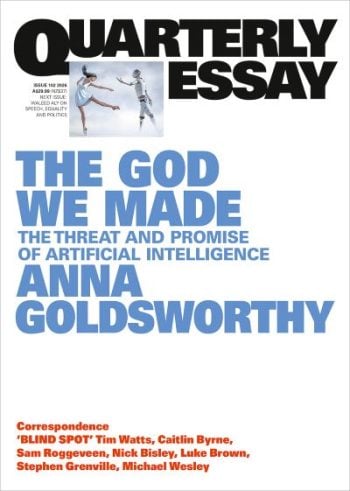
This is an edited extract from Anna Goldsworthy’s The God We Made: The Threat and Promise of Artificial Intelligence, published 1 June. Read the full essay in Quarterly Essay.