
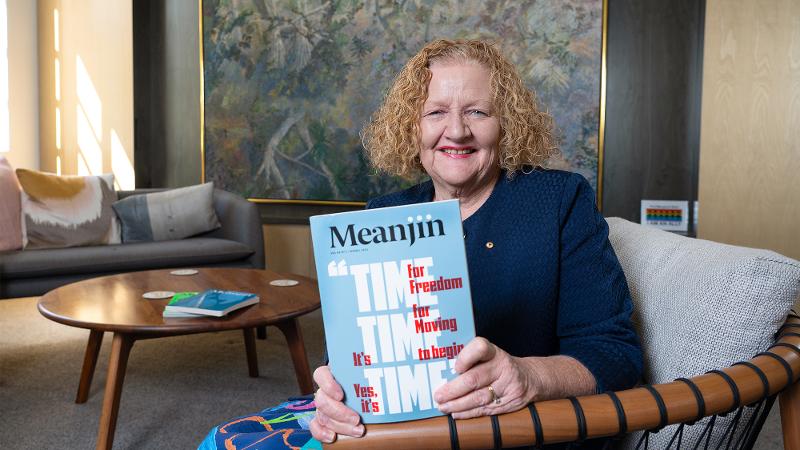
Queensland University of Technology (QUT) will become the new custodian of the literary journal Meanjin, bringing the embattled publication back to Brisbane some 80 years after it relocated to Melbourne.
QUT Vice-Chancellor Professor Margaret Sheil said: ‘QUT is delighted to bring Meanjin home to Meanjin/Magandjin – the lands of the Turrbal and Yugara peoples – where the journal was founded and where our Gardens Point campus now stands.
‘Since its foundation by Clem Christesen in Brisbane in 1940, Meanjin has been instrumental in shaping Australian literary and intellectual culture.
‘It has provided a vital platform for critical discussion, a showcase of emerging writers and a valuable training ground for leading Australian publishers and editors. We are honoured to be entrusted with the legacy of this cultural icon.’

Under the terms of the transfer, QUT will appoint an editorial board to ensure Meanjin’s independence, values and standards are maintained, and will recruit an editor through a national competitive search.
Meanjin, QUT says, will complement ‘the focused, high-quality creative writing program within the QUT School of Creative Arts’.
Read: Meanjin, Australia’s second oldest literary journal, to close
Professor of Creative Writing Kári Gíslason said QUT has a distinguished group of alumni writers who have gone on to be renowned Australian authors.
‘They will, I’m sure, celebrate this partnership: it affirms how creativity, literature and excellence in writing allow us to think deeply and connect our ideas in imaginative ways to the world around us,’ he said.
‘Meanjin’s move to QUT tells our students that this is as true now as it ever was.’
Read: I was the Archives Editor at Meanjin – its closure is baffling
Meanjin: understanding a legacy
In a prepared statement on the closure of the journal on ‘financial grounds’ last September, Chair of Melbourne University Publishing (MUP) Professor Warren Bebbington said: ‘This is a matter of deep regret for all at Melbourne University Press, as Meanjin has reached its 85th year of a distinguished history, the past 17 years as an MUP imprint.
‘The decision was made on purely financial grounds, the board having found it no longer viable to produce the magazine ongoing.’
The statement went on to say that the positions of the journal’s two part-time staff, Editor Esther Anatolitis and deputy editor Eli McLean, had been made redundant.
Bebbington today said MUP had received approaches to acquire Meanjin from a variety of organisations in recent months, but QUT’s understanding of the journal’s legacy surpassed those of the other expressions of interest received.
‘The Board is delighted Meanjin will continue, and in the hands of a university so clearly alert to the nature of the custodianship MUP had fulfilled for it for so long.’
More on ArtsHub: Meanjin: bean counting misses the intangible value of reading and imagining
Not only are we losing a critical feature of Australian literary heritage, but editor Esther Anatolitis and deputy editor Eli McLean have reportedly lost their jobs. As former editor of the Sydney Review of Books Catriona Menzies-Pike wrote in her 2023 report with Samuel Ryan, Literary Journals in Australia, insecure work is one of the reasons for a lack of diversity in literary organisations. As an author herself and champion of Australian writing and writers, the loss of Antaolitis’ commentary and editorial influence will be profound.
Meanjin has also been a mouthpiece for many in the literary sector. Jessica Alice, the driver behind the creation of new South Australian literary magazine Splinter and now director of the Byron Writers Festival, wrote in February 2023 of the neglect of the Australian literary ecosystem, particularly under the Liberal government.
She observed that where literary magazines such as Voiceworks, which focus on young writers, ‘serve as a training ground for the next generation of writers, literary journals are themselves the engine of literary culture, allowing for an experimentation with style, a testing of ideas and development of a uniquely Australian voice’.
Read more …