
Art hopping in Sydney is easier than you think

An amateur art hopper sets out with a friend to discover what Sydney has to offer.
Installation view, Archetypes: 30 years of 4A, 4A Centre for Contemporary Asian Art, Sydney. Photo: Diana Nguyen.

Pompeii is jumping on my ass while I’m staring at the hypercolour depictions of rural Australia in front of me. Pompeii is Eloise Cato’s dog, her so-called ‘Italian disaster’ (greyhound), who runs around greeting and shaking paws with everyone who comes into Cato’s gallery in inner city Sydney.

Pompeii ‘means everything to me,’ Cato says. ‘She’s just a happy puppy that loves people. During winter she occasionally has her own gallery open day, and we have 20 of her Italian Greyhound friends pop in.’

Joy and community are the priority for Cato, who has run Cato Gallery, an emerging commercial gallery in Surry Hills, for just over a year. When we speak, she’s just opened Sign Language, an exhibition pairing Blak Douglas and Jarra Karalinar Steel, with the artists using contemporary street and commercial signage to explore Aboriginal narratives of decolonialism.

Cato sees galleries as ‘spaces of pause and reflection for all people’, and wants her exhibition openings to celebrate artistic communities and those who appreciate art and collecting at any stage of life. ‘The age of blind deference is over’, she says, ‘and how galleries contribute and engage with our communities is everything.’

It’s that kind of welcoming approach that makes art hopping in Sydney much easier than you’d think.

Pushing through the intimidation factor

I first met Cato and Pompeii in late 2025, tagging along on a so-called art hopping adventure with my friend Calum, who is a freelance arts writer and commercial art gallerist. His pitch was that there were a few exhibition openings happening that night, and we could go before dinner to see a bunch of cool art and get a bunch of free wine. A pregame, with visuals. 

We went, and it was great – buzzy and funny and unexpectedly awesome.

We started going to exhibition openings regularly from then on. Very slowly, they demystified. When I first went, the walls of concrete and expensive price points were incredibly intimidating, and as we spoke to artists and art students with an extensive vocab around visual styles and exhibition histories, I felt unequivocally out of place. 

What I’ve discovered, though, is that everyone feels a little the same at first, and we all just push through.

Leaning on the experts

Olivia Scullard and Dion Dovas run Represented Sydney, a digital exhibition opening guide. They love going on gallery dates, and they started the page looking to build a resource for people new to the exhibition scene.

Scullard tells me they ‘wouldn’t consider [them]selves part of Sydney’s art world’, and Dovas thinks ‘we’re on the fringes, maybe’. I laugh when they say this – how can they not be part of the art world?

Dovas says, ‘The more you go and visit these galleries and enjoy what these curators have put together, it dispels the stigma that art is only for rich people to enjoy.’ Scullard affirms this. ‘You’re allowed to engage with the art and speak freely,’ she says. ‘As long as you keep in mind there are artists and people whose practice you need to respect around you.’

Online pages like Represented Sydney are a way for new crowds to easily access exhibition openings – the equivalent of a gig guide for art. Scullard and Dovas curate their lists based on publicly-advertised events, and Dovas reckons ‘everyone is fairly happy when you share their art’, even if some galleries engage less with third-party guides.

For artists wanting to reach new crowds, especially young adults, the approach makes sense. We’re the next generation of collectors, so why would you not let us in?

Coming up with a game plan

Ask anyone who goes to openings in Sydney and they’ll mention an organised monthly crawl, but throughout the month any number of galleries will be holding coinciding openings with meet-and-greets with artists and free or cost-friendly wine and beer. (Cato Gallery usually has gin, if that’s your thing.)

The price you pay, if not for drinks, is to respect the space and the art. It’s about engagement and slowing down. You could also play the game ‘how much is this one?’ You’ll usually be wrong.

It’s fun, though, to just relax into the space, be honest about the art, and see what kind of conversations you have. Talking to strangers becomes easy when there’s a very obvious point of discussion hanging in front of you.

Check the guides, then make a plan for an art hop, crawling through the streets and maybe stopping at a bar or two along the way.

If you’re in the city, you could begin with Artspace in Woolloomoolloo. Its current exhibition, 2026 NSW Visual Arts Fellowship (Emerging), is full of totalising, immersive pieces with delicate audio you’d never catch in a crowd. Then you can peruse the Aboriginal works at the multi-floor Art Leven in Woolloomoolloo, crawl over to the contemporary space that is Chalk Horse, before finally hitting up a pub for dinner and flowing those good vibes through to Oxford Street. 

If you’re in Sydney’s inner west, head to Camperdown to see the artist-led Chrissie Cotter Gallery, run up to the cozy Tiliqua Tiliqua on Enmore Road, then breeze into DRAW Space’s open corridor before a night out in Newtown.

Or maybe your night ends in art. The first few times I tried art hopping, we spent so much time travelling between the galleries and chatting up strangers to figure out the inevitable six degrees of connection that we dawdled home straight after. For even less commitment, you could sandwich an opening in after work.

Embracing the experience

I rock up to 4A Centre for Contemporary Asian Art in Haymarket one Friday in early July. The opening of Archetype: 30 Years of 4A is already dying down as I get there, and I pay $6 for a glass of wine in a plastic cup. The exhibition marks the gallery’s 30th anniversary, and is a captivating look at culture, community and the passing of time.

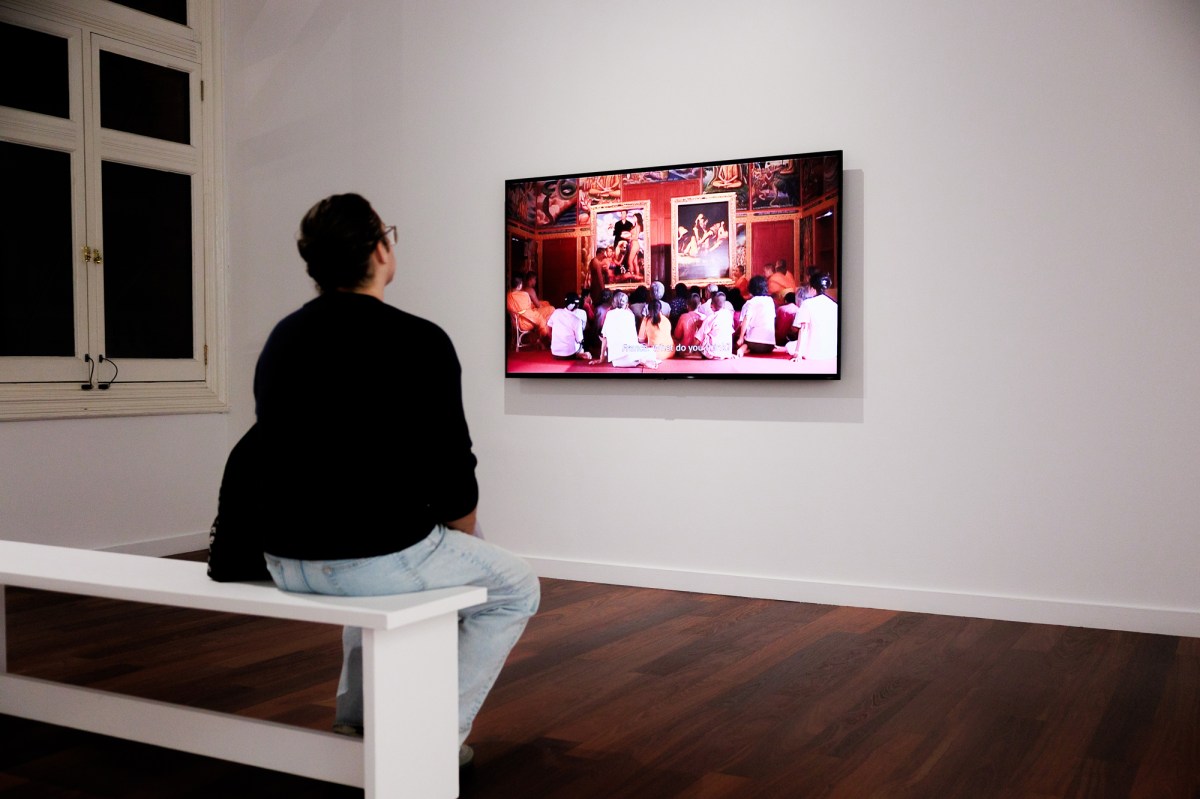
Installation view, Archetypes: 30 years of 4A, 4A Centre for Contemporary Asian Art, Sydney. Photo: Diana Nguyen. Art hopping in Sydney
Araya Rasdjarmrearnsook, Village and Elsewhere: Artemisia Gentileschi’s Judith Beheading Holofernes, Jeff Koons’ Untitled, and Thai Villagers, 2011. Installation view, Archetypes: 30 years of 4A, 4A Centre for Contemporary Asian Art, Sydney. Photo: Diana Nguyen.

Upstairs is a video work, Araya Rasdjarmrearnsook’s Village and Elsewhere: Artemisia Gentileschi’s Judith Beheading Holofernes, Jeff Koons’ Untitled, and Thai Villagers (2011). It shows a Monk in a Thai temple standing in front of reproductions of two famous Western artworks: the first, Jeff Koons’ technicolor triptych with two bikini-clad women and a suited man; the second, Artemesia Gentileschi’s oil painting depicting a biblical beheading of a man by two women. 

The monk talks to a crowd of children and elders, connecting these depictions of non-monogamy, treachery and desire to Buddhist precepts of love and devotion. He walks between the works and stands stiffly in front of the first. 

‘People go to an art gallery, they’ll stand quietly in front of the painting like this.’

One of the kids asks ‘why?’ Why, after we’ve spent all this time talking about the art, covering it from all angles, comparing it to our lives and empathising with things we’ll never know, would we go to an art gallery and simply stand quietly?

Because, the monk says, ‘it’s the place to show arts.’

He’s right. The art is in the art gallery. But so is the wine, so are the strangers, and so is my friend. 

Archetypes: 30 Years of 4A continues at 4A Centre for Contemporary Asian Art, Haymarket until 20 September. The 2026 NSW Visual Arts Fellowship (Emerging) exhibition is at Artspace, Woolloomoolloo until 6 September.

Discover more screen, games & arts news and reviews on ScreenHub and ArtsHub. Sign up for our free ArtsHub and ScreenHub newsletters. 

Will Winter (he/they) is a writer and creative operating on Gadigal land. He was a 2025 editor for Honi Soit, the only weekly student newspaper in the country, and his writing predominantly involves live performance review, queer culture and comedy.