
Wabi-sabi or sloppy? How to tell authentic from slapdash

In an age of artificial perfection, wabi-sabi is a refuge that offers lessons for embracing the human in art and craft.
Image: Riho Kitagawa on Unsplash.

The Japanese concept of wabi-sabi has been memeified in recent times. Late last year, audio from an old King of the Hill scene explaining wabi-sabi as the idea that imperfection has its own beauty found a viral new life over the top of TikTok videos about acne and crooked teeth. Makers use the phrase to sell all manner of ever-so-slightly-wonky handcrafts. Cake turned out a bit lop-sided? Fear not: it’s got wabi-sabi.

Like most Western appropriations, this one misses much of the conceptual heft. Grounded in Buddhist concepts of impermanence, wabi-sabi encompasses a love of simple aesthetics and a sweet melancholy at the transience of things. Wabi-sabi is built around an acceptance that nothing is perfect, nothing lasts forever, and nothing is ever truly finished or complete.

Even when reduced to an Instagram hashtag or a buzzword to sell pottery, this concept still picks out something real. People like things that are not too perfect, things that feel like they were made by a flesh-and-blood person. The little flaws remind us that we’re holding something made by fallible human hands, unique and fleeting.

But there’s a fine line between charmingly imperfect and shoddy. If we want to use concepts like wabi-sabi, we’ll need to know how to recognise that line.


Wabi-sabi: how good is good enough?

Even for a philosophy academic, this isn’t a wholly theoretical question. A few years ago I started making things out of fallen bits of timber. The results might best be described as ‘rustic’, which is an Etsy word meaning ‘sloppy’.

Then, a couple of years ago, I unexpectedly found myself in possession of a wood lathe, which is usually nature’s way of telling you to start booking in for prostate screenings. Wary of this newcomer in my shed, I went off to an introductory woodturning class, hurried home, and excitedly presented my wife with a cedar candle stick. I was hooked.

Image: Nasim Keshmiri on Unsplash.

After a year or so of spindle work (making pens, handles, and the like) I was ready for the next step. I took a bowl turning class, hurried home, and excitedly presented my wife with a camphor laurel bowl. So far, so good.

A few weeks later, I was watching a video by Richard Raffan – arguably the world’s leading wood turner, with a career spanning more than 55 years. Raffan still posts several fantastically informative woodturning videos on YouTube every week from his backyard workshop in Canberra. In this particular video he showed the viewer an example of a ‘typical early bowl’ – and proceeded to describe my bowl with uncanny accuracy. Heavy base, flat bottom, shapeless rim, ‘and off it goes to the admiring relatives’.

It was a sobering message for a novice, but it posed an intriguing question: how good is good enough for something to be shown to others, let alone gifted or sold? How do we tell the difference between wabi-sabi and sloppy?

Wabi-sabi: skill without perfection

It’s important to understand that wabi-sabi isn’t meant to be a repudiation of skill. It’s true that wabi-sabi rejects perfectionism and accepts (even celebrates) defects. Adopting this idea can have significant psychological benefits, not least self-compassion.

Yet wabi-sabi was never a licence for half-hearted work. Rather, the imperfection and impermanence of the world need to be met with learned craft, not in order to eradicate them but to work with them. Much of the skill in producing art comes down to problem-solving: working out how to take the unexpected flaw and make it part of the expression.

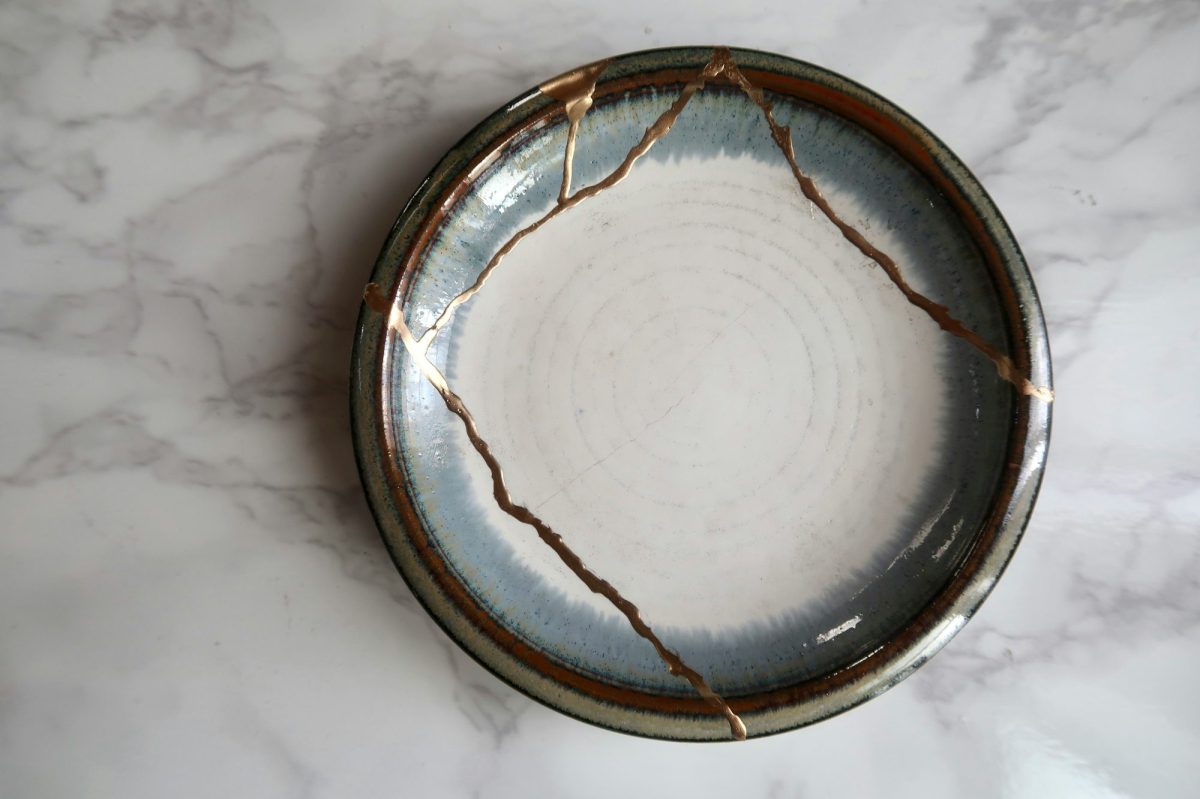
The artworks we think of as exemplifying wabi-sabi, like the iconic kintsugi cracked pots with gold poured into the gaps, are neat visual metaphors for imperfection. But they also reflect what the philosopher of mind Hubert Dreyfus called skilful coping, the way in which embodied expertise responds to its environment. It’s not just that the item is cracked and imperfect. The artist has cleverly worked with the imperfection, finding a new pathway to resolution.

Image: Riho Kitagawa on Unsplash.

Likewise, wabi-sabi may hold that nothing is ever truly finished, but that doesn’t mean you can present it before it’s ready. Or to quote Adam Jones from Tool, a band known for taking a painfully long time to finish albums: ‘it’s not good when it’s done, it’s done when it’s good‘.

The heavy wall thicknesses and unsightly chuck marks on my first turned bowls were hallmarks of inexperience, not to mention impatience. But hard-won skill doesn’t necessarily show up as unnatural perfection, either.

Wabi-sabi: seeking authenticity

It’s telling that the rise in popularity of wabi-sabi in the West comes at the very moment that mass production moves out of the physical world and into the linguistic and visual ones. Where once we only had to deal with machine-made consumer objects, now our world is awash with AI-generated text and image.

Image: Anthony Camp on Unsplash. Wabi-sabi.
Image: Anthony Camp on Unsplash.

In the 1930s, Walter Benjamin famously argued that mechanical reproduction robbed art objects of their ‘aura’: the sense that this is the piece of marble that Michelangelo worked or the canvas that Monet painted. In our drive to reclaim authenticity we’ve often tried to recreate that aura after the fact. Think of the ‘distressed’ look in architecture, or the deliberately torn jeans so many of my contemporaries wore in the nineties. (Or ‘relic’ed’ guitars, brand new instruments that are deliberately chipped and scuffed to appear old and worn-in).

These are all attempts to get wabi-sabi on the cheap, to mimic the patina that only comes from loving use over time – which is, as Richard Raffan warns us in his woodturning videos, ‘the sort of finish you can’t get from a bottle‘.

In an age of artificial perfection, wabi-sabi is a useful rebellion on behalf of the human and fallible. There is indeed beauty in imperfection. But skill still matters too. Perhaps that’s also what wabi-sabi teaches us: things take time, so you should take yours.


Discover more screen, games & arts news and reviews on ScreenHub and ArtsHub. Sign up for our free ArtsHub and ScreenHub newsletters.

More by Patrick Stokes on ArtsHub:

Patrick Stokes is a philosopher at Deakin University, and has previously held research fellowships in the UK, Denmark and the US.