StarsStarsStarsStarsStars

Retrograde review: Ngabo nails it as Sidney Poitier

Retrograde sees a persecuted Sidney Poitier fighting back against Joseph McCarthy's 'Red Scare' crusades in the USA.
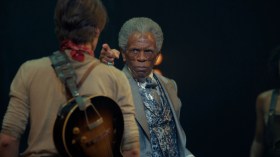
Donné Ngabo in Retrograde. Image: Sarah Walker.

Sidney Poitier was an indomitable spirit, an activist, actor and director who stands tall in history, not least as the first Black person to win an Oscar – for Ralph Nelson’s Lilies of the Field in 1964.

That was a hard-won victory, in the face of grindingly racist resistance. But things were bleaker back when we meet a young him in London playwright Ryan Calais Cameron’s crackling West End hit, Retrograde.

Brilliantly portrayed by a commanding Donné Ngabo, in the play’s Australian premiere produced by MTC at Arts Centre Melbourne, Poitier has just wedged the door open.

Born two months premature in Miami while his Bahamian parents were visiting, Ngabo’s Poitier tells us he survived through the sheer will of his mother’s determination. A stand-tall tenacity the star inherited.

Raised on Cat Island before returning to the States at 15 years old, Poitier was horrified by the segregationist hatred he witnessed in the Jim Crow south, deciding to try his luck in New York City instead. Though things were better there, odious racism persisted.

Undaunted, Poitier studiously Americanised his Bahamian creole, listening to the radio and reading newspapers aloud while working a string of dishwashing gigs.

Now wielding the iconic baritone, he’s leveraged his stage credits with Harlem’s American Negro Theatre into a screen career, following his breakthrough role as rebellious teen Gregory in Richard Brooke’s rock and roll infused Blackboard Jungle.

Hollywood took note.

Retrograde: make-or-break

Poitier’s burgeoning fame is at a make-or-break crossroads in Retrograde, punchily directed with a boxer’s light-footed heft by Bert LaBonté, who also delivered the MTC’s knock-out production of Topdog/Underdog.

Riding high off Blackboard Jungle, Poitier’s about to star in the pioneering teleplay A Man Is Ten Feet Tall. He’ll play Tommy, a proud union dockworker who forges a tight bond with a white comrade – a role he’d expand on in Martin Ritt feature, Edge of the City.

Director Robert ‘Bobby’ Alan Arthur, buoyantly depicted by Josh McConville, is overjoyed to see his pal soar and, as a struggling artist himself, happy to ride those coattails.

Alan Dale, Josh McConville and Donné Ngabo in Retrograde. Photo: Sarah Walker.

Bobby’s enthusiastically waiting for Poitier to sign on the dotted line in the Mad Men-like office of NBC lawyer, Mr Parks, a slippery character portrayed by the esteemed Alan Dale, returning to the stage after two decades away.

Park’s wooden-shuttered lair – a stunning set designed by Zoe Rouse, who also handles the braces, pinstripe suits and boots costumes – is bathed in an amber glow.

Lighting designer Rachel Lee and Rouse harness this from a sepia-hued picture of New York’s scraping skyline, feigning the real deal. Turreted towers that peep through floor-to-ceiling windows in a hall just outside of Park’s office, binging elevators around the corner. It’s an eminently convincing build that appears to double the dinky Fairfax’s lemon-wedge of a thrust stage.

No sooner has Bobby sat down on Park’s moss-green couch than the older guy gets funny about just how Black Poitier is. And by funny, I don’t mean ha ha. You know the type, that flinty menace lurking behind a curled-lip smile, a charade concealing the drool of a hungry wolf patiently salivating over its prey.

Donné Ngabo and Alan Dale in Retrograde. Photo: Sarah Walker.

Poitier is prey. Park clearly doesn’t appreciate a Black man encroaching on his station, rudely interrupting the star’s bonhomie with Bobby, a bounce-off endearingly conveyed by Ngabo and McConville. Dale adeptly feigns the contract man’s hollow mateyness and the passive-aggressive way he pushes Poitier to be thankful, pressuring him to drink a morning dram.

No sooner has Park ushered Bobby out the door than he springs his trap.

Retrograde: reds under beds

The Cold War was simmering like a pot boiling over in the 50s. Senator Joseph McCarthy’s Reds under the bed witch hunt was in full flight, denouncing so-called Commies as enemies of the state, with J Edgar Hoover’s FBI stalking the accused.

Hollywood was engulfed by the malignant hysteria, with the House Un-American Activities Committee demanding penitential confessions from its victims, many of whom were handy scapegoats, backlisting from the industry.

The victims were hounded with the aid of a pliantly corrupt media, including notorious gossip columnist Hedda Hopper, whose insidious calumny gets a dishonourable mention in Retrograde.

Park’s faux nice guy act is a tap dance routine, distracting from his real goal. Poitier was a staunch supporter of the Civil Rights movement who idolised fellow multi-hyphenate travellers like Harry Belafonte and Paul Robeson.

And so to the gut-kick: Park insists Poitier must sign a demeaning oath of loyalty to the country to land the gig, a union role the lawyer loathes, and he must also take to the radio and newspaper columns to denounce his hero, Robeson.

Ngabo’s performance, as Poitier writhes in the steel jaws of this indignity, is astonishing. You can practically feel his tired muscles tighten beneath his plum-coloured suit, as Poitier’s bundle of pent-up fury is constrained for fear of it being used against him by a wily white man, a game-player who despises his skin while fearing for his own fiefdom.

Retrograde: broadening opportunities

Actor-turned writer Cameron, a child of the Windrush generation, resisted leaving London for the opportunity-rich US because he wanted to broaden the opportunities for Black British actors. There’s a sweet sense of historic justice, then, that in telling the origin story of Poitier, he brought Hollywood to the West End.

Retrograde is as taut as Poitier’s pain, a chamber piece writing back in the behind-closed-doors trial. It recalls Kemp Power’s also sterling One Night in Miami, which imagined the details of a real meeting between Malcolm X, Muhammad Ali, Jim Brown and Sam Cooke, later directed by Regina King for the big-screen adaptation.

Ngabo is on top form as he ducks and weaves around Park’s punch-down manoeuvres. Fourth wall-breaking segues fill in his backstory in spotlit monologues, a flashing applause sign blinking as if we’re on a TV set. 

Dale is deviously good in the bad cop role to McConville’s ambushed good guy. The latter also delivers a grand performance in a heartsore role, balancing backing in his buddy while wrangling with a moral quandary that could sink them both. The ‘red menace’ label had a habit of spreading like a spilled wine stain.

Donné Ngabo in Retrograde. Image: Sarah Walker.
Donné Ngabo in Retrograde. Photo: Sarah Walker.

Cameron tackles the knottiness of wavering allyship, the eggshell dance around white fragility and how the law circles the wagons of the rich and powerful in a dazzling denunciation of structural abuse.

LaBonté once again proves he’s more than a match for this material, with composer Jethro Woodward’s sparingly deployed strings and air-sucking sound design aiding this claustrophobic dilemma, soaked with summer’s sweat.

When the real Poitier’s words take over in Retrograde’s closing moments, his mighty legacy, raised up again on Ngabo’s shoulders, is a timely reminder, in dark days twisted by bad men, that history repeats itself and we will all be judged by our actions.

Retrograde is at Arts Centre Melbourne until 27 June 2026.

Discover more screen, games & arts news and reviews on ScreenHub and ArtsHub. Sign up for our free ArtsHub and ScreenHub newsletters.

Stephen A Russell is a Melbourne-based arts writer. His writing regularly appears in Fairfax publications, SBS online, Flicks, Time Out, The Saturday Paper, The Big Issue and Metro magazine. You can hear him on Joy FM.