
Emilya Colliver on why Making Art (with corporates) Matters

Cultural Entrepreneur Emilya Colliver has written a book targeted at developers and corporates, to assist in navigating board room discussion and planning pitches, and to ensure the role of the artist is kept in sight.

With the simple subtext, ‘How to work with artists to bring art into our buildings, spaces and communities’, Marking Art Matters is the debut publication for cultural entrepreneur Emilya Colliver, founder of Culture Scouts, Art Pharmacy, and responsible for bringing the first London-style artist-led fair to Sydney.

She uses two decades of experience of sitting in boardrooms with clients, developers, tourism operators, councils and corporates – and their perpetual glaze of disconnect faced when pitching for that mandatory arts spend – to help join the dots, and cattle-prod some passion for art engagement.

Making Art Matter is a quick read – an easy digest – and is a great ‘paperback scale’ with punchy design and illustrations. In many ways, Colliver uses boardroom vernacular of the presentation – blockquotes and slogans to catch attention in bites that take hold.

She reminds us, in her introduction that there are no courses that you can take at university to be an art consultant, describing what she does as ‘a creative translator who works between two different worlds’.  Her book is another step in brokering that bridge. It is also a two-way street, and is as useful for artists as it is corporates.

Colliver says that it was the words of her former teacher Dr Ian Glover that set her on her course. He advised: ‘You have to pick a side and remain in your lane’.

She chose the commercial art world. And this small publication takes giant steps in removing the muddy – and often ‘artsy airy’ view – taken by the non-art world setting the record straight: art can also be business.

Glass ceiling of the arts

Speaking with Colliver about the launch of the book, she told ArtsHub: ‘When you commission art, it is either mandated or someone at the top is driving for it, and that comes from a culture within the organisation’s leadership.’

She said her experience has been that when a company is mandated to deliver an arts spend, the brief is usually bumped around between departments before signing off. ‘In most cases they don’t know how to start,’ she told ArtsHub.

Colliver described a situation where she was briefing a boardroom of corporates charged with delivering an artwork, encouraging them to describe how art might be part of their everyday.

‘In the corner someone was laughing, and when it came to his turn he said, “I dunno”. I later discovered he was the dude writing the art strategy,’ said Colliver.

‘I see the book as a tool – I can say, “Here, this is what I do and this is how you can make it happen”.  It is part marketing and part education.’

Colliver describes herself as a disrupter within the industry.

‘When I started I reached out to some art consultants but got nowhere. It is so closed this art world. It shouldn’t be that way. It’s better to give [this advice] away than be cagey,’ she told ArtsHub.

Her implication was that there is a kind of glass ceiling stopping the arts punching into other sectors by a coterie of gate-keepers who have the deals stitched up.

‘The problem at the moment is that the same artists are commissioned again and again for these developments. The architects have a say, and they keep flogging the same artists, the same consultants,’ she continued. ‘The whole city looks homogenous.’

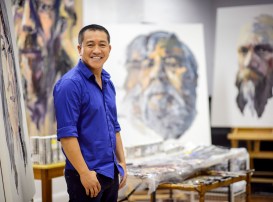
Emilya Colliver. Image Supplied.

Pushing back against the mould

In a crazy twist, it is these artworks that are slated for non-elitist, largely public spaces that are being arguably usurped by an elitist group who have the gongs on delivery.

Colliver says that at Art Pharmacy they have a philosophy to take new artists to the boardroom table, both a mix of emerging and established artists.

She added, however, that this has created a perception of ‘down paying’, relaying that one major developer said: ‘You work with emerging artists, can’t you just get one to paint something in the foyer for $100?’

‘They connect emerging with cheap,’ said Colliver, adding that this was one of the great drivers for her book.

‘People just don’t know where to start. For example, they are very picky about wine or food, but with art, people fall back on saying “I don’t know what I like.”  It is a cult we haven’t bread here in the Australia.

‘If you pick up the Wentworth Courier [a real estate street paper in Sydney], page after page there are houses over a million dollars and no art in them. You just have to keep pushing – pushing these ideas out that art can make our world more liveable. And the only way to do it that is education.’

Colliver concluded that in past times it was the churches of the world that were the great patrons of artists. ‘That doesn’t happen today, but the property developers have the money and they commission new work – they can be next patrons – we just have to help them along that path.’

To learn more about Art Pharmacy or get your copy of Making Art Matter.

Colliver is currently working on her second publication – a practical handbook for artists when working in public spaces, with government and clients.

Unlock Padlock Icon

Unlock this content?

Access this content and more

Gina Fairley is ArtsHub's National Visual Arts Editor. For a decade she worked as a freelance writer and curator across Southeast Asia and was previously the Regional Contributing Editor for Hong Kong based magazines Asian Art News and World Sculpture News. Prior to writing she worked as an arts manager in America and Australia for 14 years, including the regional gallery, biennale and commercial sectors. She is based in Mittagong, regional NSW. Twitter: @ginafairley Instagram: fairleygina