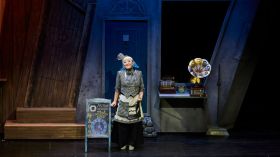

As a longstanding teaching artist for the National Institute of Dramatic Art (NIDA) Open Studio Program, actor, director and teacher Louise Birgan doesn’t want to train an endless parade of identical actors.
‘I want them to see the parts of themselves that are the entertainers or are the actors; I want them to actually connect to a script in their own, unique way,’ says Birgan, who has taught NIDA Studios’ acting students in Brisbane since 2013.
Encouraging students to identify and develop their individual skills and strengths is a central part of NIDA Open Studio Program, which offers part-time, pre-professional courses in acting, musical theatre, directing and writing.
The Studio Program courses can be studied over six or 12 months, and are run on weekends in Brisbane, Sydney and Melbourne. Designed as a precursor to professional training or a professional career, they have a twice-yearly intake, in January and July 2026.
NIDA Open Studio Program: rigorous training taught by professionals
The NIDA Open Studio Program is for committed and creative individuals seeking rigorous, practice-driven training, with each course taught by highly skilled industry professionals.
‘They’re [taught by] people who’ve been in the industry for a very long time – when I started teaching for the [NIDA] Open Program, for example, I was already 10 to 12 years into a professional acting career,’ Birgan tells ArtsHub.
Youth Studios provides training for participants aged 15 to 18 who aspire to arts careers once they’ve completed secondary school. While Adult Studios cater for early career artists aiming to polish and refine their respective craft before applying to study at NIDA, as well as ‘people who are a little bit older, who have started another career and then decided to come back and try and get the best training possible, to see if they may be able to move back into the arts after all,’ Birgan says.
She adds: ‘Some of my students have gone on, obviously, to be placed in professional training programs, but have also gone on to be quite well noted on the screen or in theatre. We have quite a success rate for students to move out into the professional training arena.’
‘And on a personal level, it’s wonderful to see people better understand the craft of acting – to watch them really blossom in that process and actually begin to really love the craft.’
Practical, skills-based learning
Each Studio is structured so that it provides ‘really well rounded, comprehensive training for people who want to go into the industry,’ Birgan says.
In the Actors Studio, ‘we explore voice, movement and improvisation skills; character skills; scene work, preparing for a play [and] breaking down and analysing scenes; and then actually getting up on the floor and producing work,’ Birgan says.
‘In the Screen Acting Studios, we cover the basics of acting, obviously, and [participants] also learn how to develop a relationship with the camera and refine technique for screen, doing scenes for screen and so on.’
Teaching in NIDA Open Studios is a two-way street for Birgan, who has been inspired by her students to return to studying. She is currently enrolled in NIDA’s Master of Fine Arts in Directing.
‘I had a couple of older students in my Studio class who I worked alongside for a year, and they actually taught me to go out and seek, that age is not a limitation [and] to push myself, which is why I’m now studying NIDA’s Masters’ program. I learned from them just as much as they learn from me,’ Birgan says.
Read: How stage and screen directors can deepen their understanding of their craft
January 2026 intake closing soon
Applicants are selected through an audition or interview process, depending on the course they have elected to study. Birgan’s advice for would-be applicants to any and all of NIDA Open Studio Program courses is to ‘be themselves and speak the truth. Show your enthusiasm through the audition or interview process’.
Applications for the January intake are now open. See the Studio Program brochure for audition or interview dates.
Birgan urges would-be students for the Acting and Musical Theatre Studios to ‘really look deeply into [your chosen] monologue and then present how you connect to it, not what some other actor may have done with it.’
She adds: ‘In the end, we want to see uniqueness. We’ve already got the Meryl Streeps and the Robert De Niros and we now want someone new. We need to see you – because it’s what’s uniquely you that stands out.’