UP THERE (Boorloo) is a site-responsive audio walking tour of Perth’s empty spaces, and it reminded me of how, when I first moved to Perth from Vienna, I kept wondering where all the people were.
Walking around the CBD in the evening was like being in a disaster movie after a bomb, virus or zombie apocalypse had wiped out the population – apart from the homeless, who increased in numbers over the ensuing years.
Gradually I learned that rampant property ‘development’ – enabled by lax urban planning laws, state capture by corporate capital at all levels of government, and a culture of complacency and corruption – had devastated what was allegedly once a lively and liveable city (at least for the White population and those with money to spend) and destroyed much of its heritage architecture, natural environment and social infrastructure.
That included trees, parks and waterways, but also shops, theatres, cinemas, restaurants and bars – the parts that sustain a sense of community. All of this was part and parcel of the underlying history and ongoing dynamics of capitalism and colonisation. In brief: I’d moved to a large mining town.
Up There (Boorloo), the second iteration of a project by Perth company Up There Collective, journeys into this side of Perth (Boorloo) to investigate spaces that are uninhabited, neglected or empty.
UP THERE (Boorloo) review – quick links
Up There Collective takes a look around
Last year, I was enchanted and deeply moved by Up There (Walylup) in Fremantle. Up There (Boorloo) is even more fascinating and poignant because of the difference between the two locations.
In the case of Fremantle, a great deal of heritage architecture has been preserved, even if much of it is uninhabited and neglected. The port city has retained a sense of community, history and collective identity, despite ever-widening social disparities.
With the Perth CBD, however, there’s a sense of sadness, devastation, isolation and anomie that feels irredeemable. Fremantle may be at the edge of the land (and the end of the train line), but Perth feels like the end of the world.
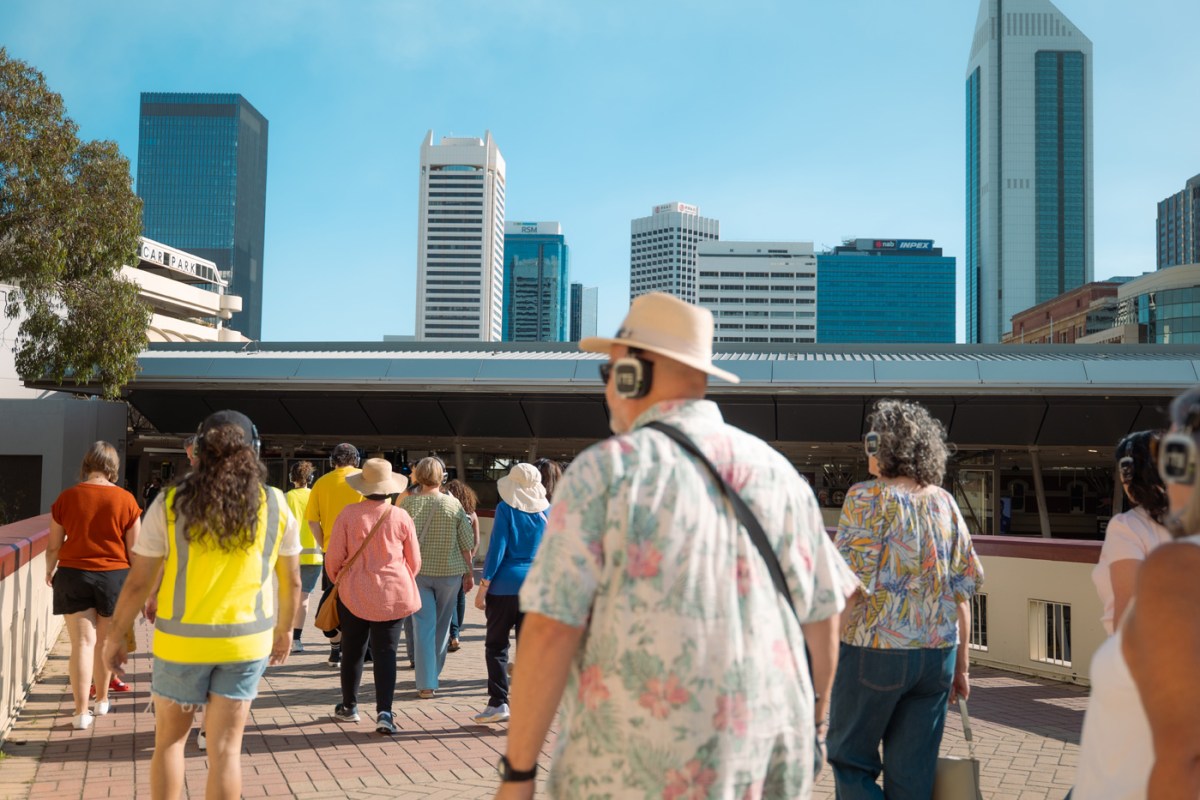
Up There (Boorloo) is a walking tour for a small audience of about 20, wearing headphones and guided by the three performance-makers who make up the collective, William Gammel, Tay Conway and Leah Robyn.
The soundtrack consists of subtle but atmospheric ambient electronic music by Perth sound designer and composer Rebecca Riggs-Bennett, interspersed with extracts from interviews with Perth locals sharing stories and memories about the cityscape we’re walking through.
Tour guides into the uncanny
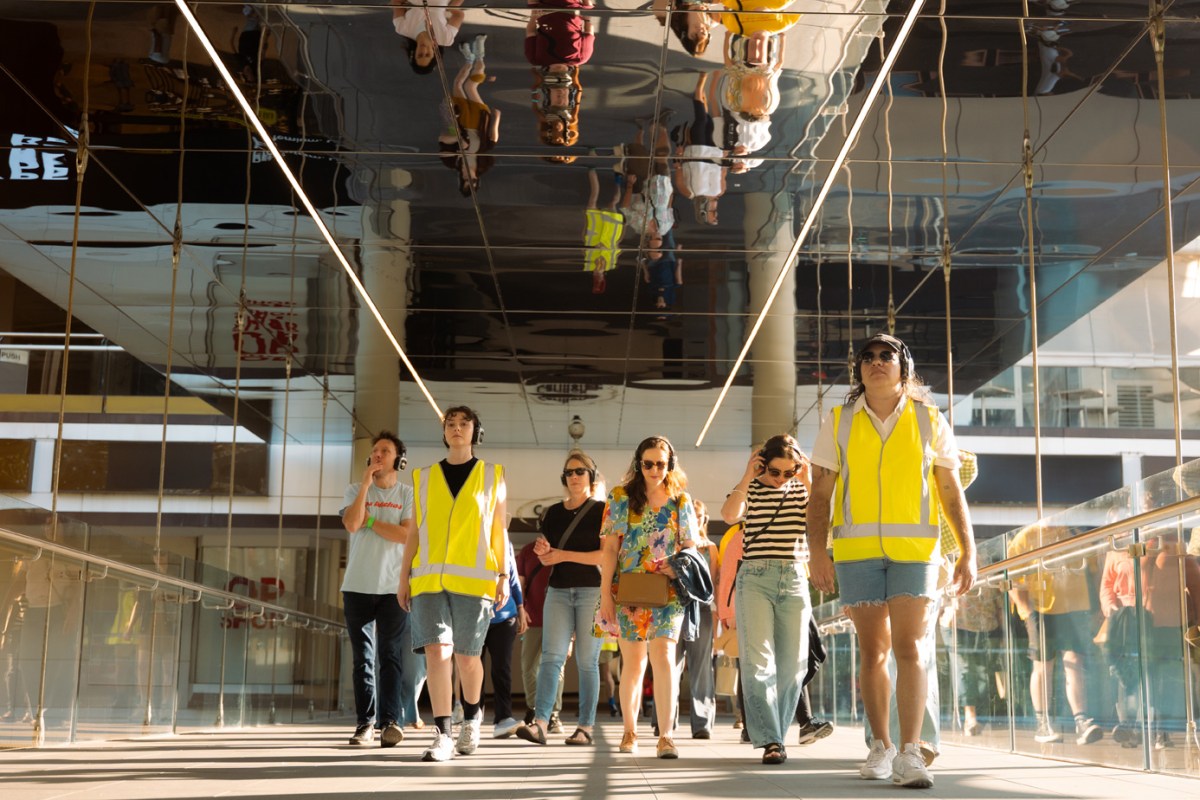
Gammel, Conway and Robyn are friendly and reassuring but silent and non-obtrusive guides, using simple hand signals to indicate when to stop, sit, look around, walk in single file or (at one point) ‘bust a move’.
Occasionally I found myself watching them almost as if they were dancers interacting with the built environment, say, trailing a hand along a wall or peering inside an empty shop.
Strictly speaking, there are no performers in this show. Or perhaps rather we’re all performers – guides, audience and passersby – in what becomes a pageant not unlike the ‘unreal city’ of London in TS Eliot’s The Waste Land.
With the headphones and soundtrack heightening the sense that we’ve become characters in a kind of immersive film, the city starts to feel like a performance space, theatre stage or film set.
UP THERE (Boorloo) invites new connections to the city
The effect is a Brechtian estrangement – or what the Russian formalist Viktor Shlovsky called defamiliarisation – which redoubles the sense of alienation and strangeness that already haunts the city by rendering it uncanny, like a simulacrum of itself.
As such, UP THERE (Boorloo) becomes the occasion for a meditation on the nature of performance as well as a critique of capitalism and colonialism. It’s also strangely beautiful, just as ruins are beautiful when one wanders through them as a tourist; and one can even ask whether this aestheticisation sits at odds with the work’s political intentions.
I prefer to think that there’s something redemptive and even utopian about the mode of contemplation that participants are invited to engage in, and that entering into this becomes an act of resistance rather than acquiescence to things as they are.
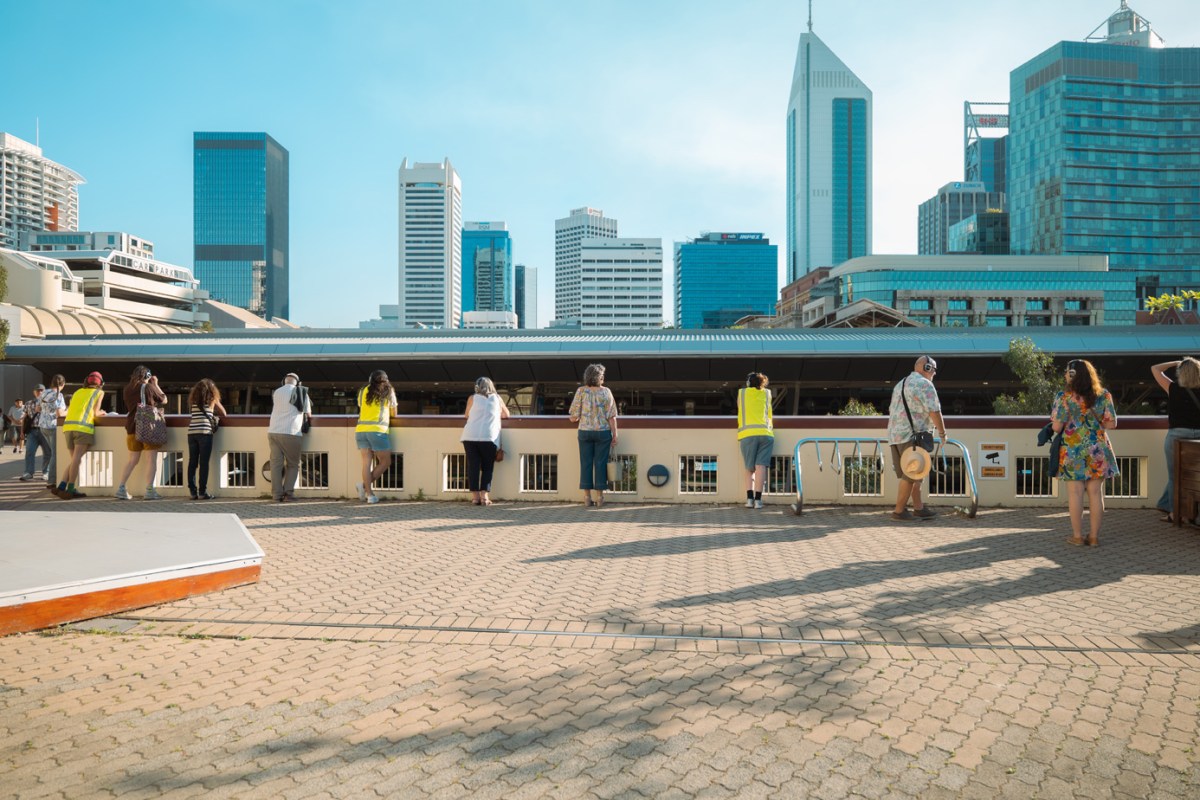
At the end of the show, as we stood at the edge of the Urban Orchard on the roof of the carpark and gazed out across the train station to the glass and concrete towers that render Perth indistinguishable from every other city on the planet, I found myself thinking, this may be the end of the world, but it’s also home.