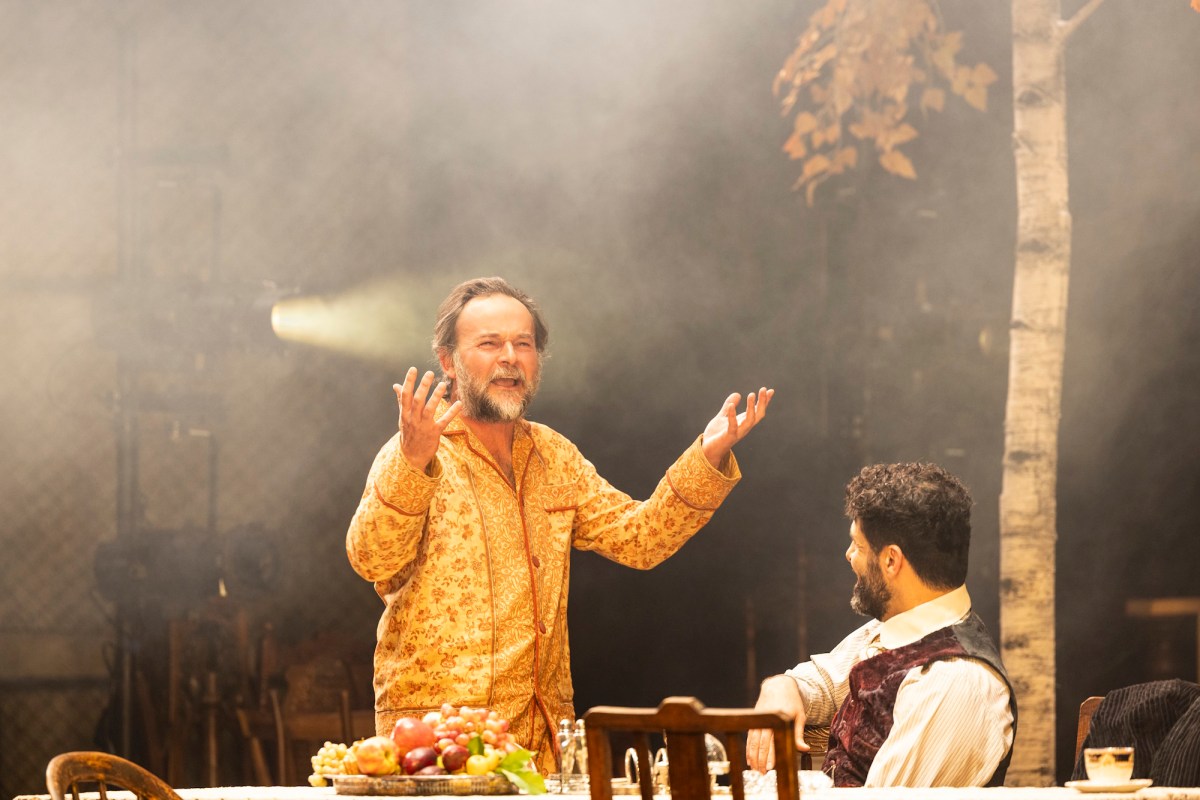
Too many folks take the vaunted Russian writer Anton Chekhov far too seriously. Sure, he has an uncanny knack for cracking open ennui about the inexorable awfulness of our 1%-weighted world and the systems that suppress us. And yet, he’s absolutely having a laugh, too, in his tragicomic tales.
It’s a fact amplified by the prolific, and prolifically awarded, Australian playwright Joanna Murray-Smith (Honour, Berlin, Switzerland, Julia) in her irrepressibly playful new adaptation of Chekhov’s Uncle Vanya.
‘Chekhov’s reputation as one of the greatest writers ever has meant that too often his works have been interpreted as overly serious, as if greatness can only be expressed with sober gravitas, says Murray-Smith in her writer’s note. ‘I wanted to make his play as funny as it would have been to his own audiences.’
Popping aside the lost-in-translation vagaries of linguistic adaptation, Chekhov’s own audiences wouldn’t precisely recognise Murray-Smith’s script. She subtly, sassily and I think successfully reworks Chekhov’s piece with contemporaneous language, though not overbearingly so, even leaving room for a few sly Australianisms. Specifically the word ‘chook’.
Murray-Smith also adds a whole lotta crowd-pleasing swears in this barnstorming re-do that casts star of stage and screen Daniel Henshall in the title, though not necessarily central, role.
Uncle Vanya review – quick links
Words matter
Changing the text of a classic play can be fraught business. Some estates outright forbid it, flexing their copyright muscle when signing off permission, notably with Arthur Miller’s Death of a Salesman and Edward Albee’s Who’s Afraid of Virginia Woolf.
But Melbourne Theatre Company’s canny artistic director Anne-Louise Sarks is more than capable of sympathetically wiggling around such limitations. Her nimble directorial work on Tennessee Williams’ similarly guarded A Streetcar Named Desire stayed true to the letter of the writer’s word, while perceptibly adjusting the spirit ever so slightly – particularly in the broken-souled denouement, with star Nikki Shiels’ outstanding Stella determined to physically hold her head high while facing her disastrous future.
Chekhov died in 1904, and Uncle Vanya is well out of the realm of copyright enforcement, allowing Murray-Smith and Sarks artistic license, though both remain equally respectful of this still-close text reading. Again, with just a little nudge, the strength of the play’s whip-smart women is foregrounded.
Managing the estate
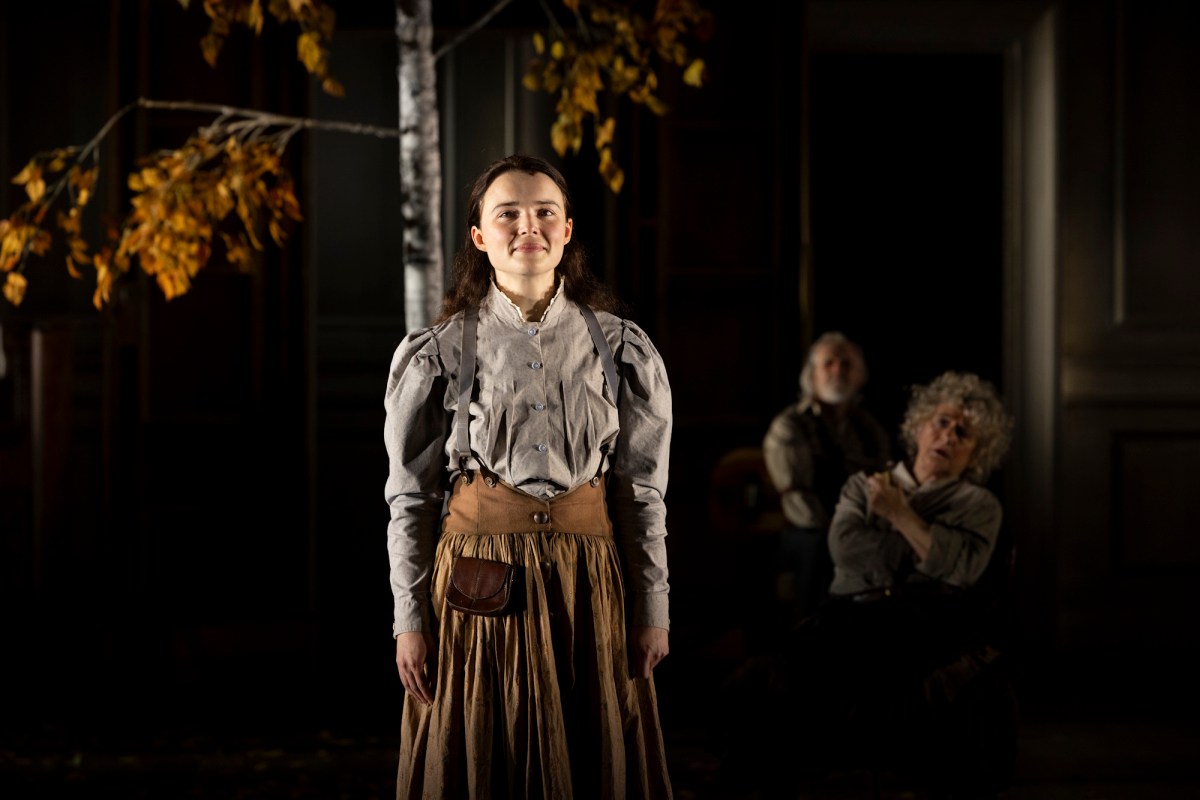
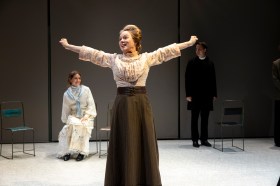
Philippa Northeast is astonishing as Sonya, the hardworking niece of Henshall’s estate manager, Vanya. He’s a woe-is-me type who feels robbed of a better life, constantly complaining about his lot while slogging away as the estate manager of the farm that’s owned by her absent father, the airy fairy Professor Serebryakov, who’s played with buffoonish, undeniably hilarious arrogance by Shaun Micallef.
Sonya accepts her circumstances with relatively good grace, while Vanya hits the vodka bottle and bitches to the good Doctor Astrov (Fayssal Bazzi). A general practitioner, Astrov’s summoned to the farm to tend to the most likely imagined ailings of the hypochondriac Serebryakov, who has shown up for a rare visit with his much younger new wife Yelena in tow (played by a fantastic Catherine Văn-Davies).
Serebryakov, the widower of Vanya’s late sister, is a busy-work nuisance who thinks remarkably highly of himself. Higher, perhaps, than his academic writing would merit. Yelena is resigned to his boorishness. Vanya’s mother Maryia (the brilliant Carolyn Bock) laps it up, idolising the professor, much to the chagrin of her son Vanya, a grievance guy who should not be let loose near the dramatic tool of Chekhov’s gun.
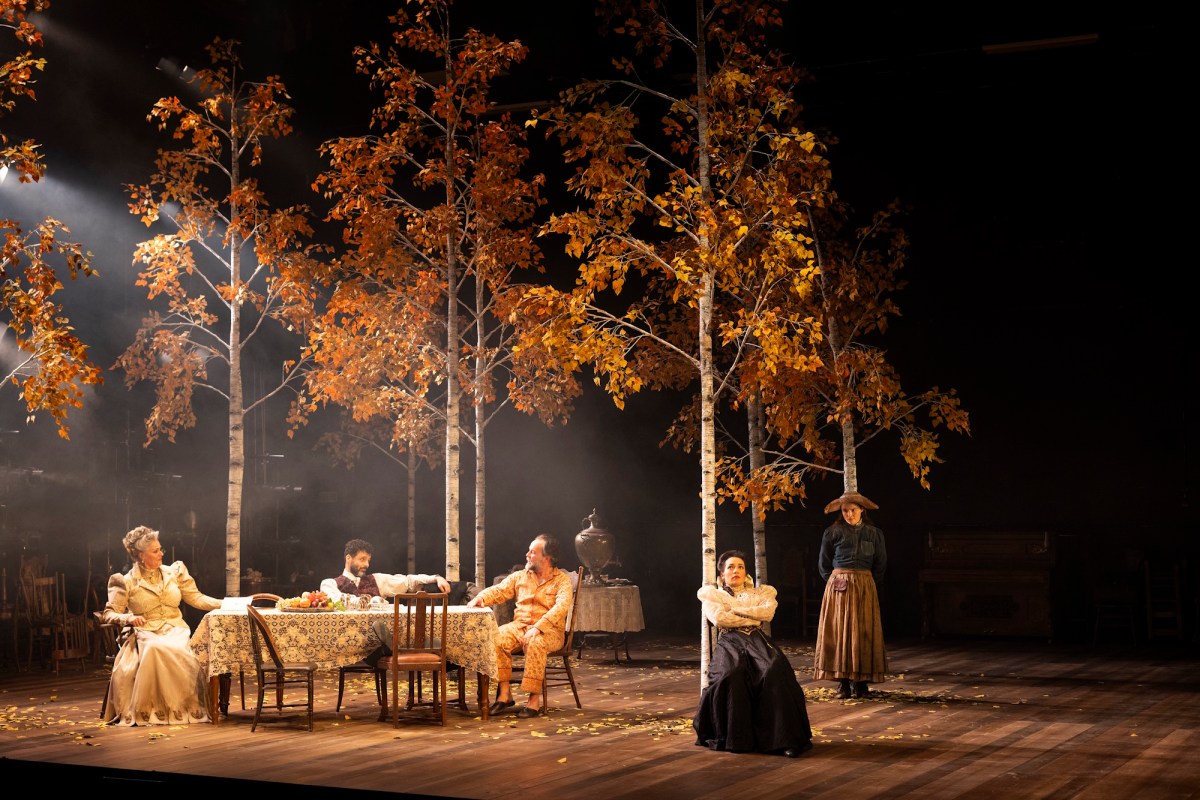
Both he and Sonya, who has adopted him as a father-figure, toil near the poverty line, alongside the stalwart old guard of Nanny and Telyeghin, aka Waffles, played in a comedy gold pairing by the legends Evelyn Krape and Don Bridges, adept Statler and Waldorf-like hecklers with the good sense to be more discreet about it than Vanya.
Astrov is a kind and confident man with an environmentalist’s view far ahead of the time that he finds himself in (though what has really changed?) and while he doesn’t resort to Vanya’s near-constant niggling, he’s also demoralised with the state of the world and would rather hang with trees than other humans.
This does not stop both the frustrated Yelena and the hot-and-bothered Sonya from dreaming of running away with him.
Watch the trailer
Fake plastic trees
Murray-Smith’s magnificent and sprightly adaptation leaps and bounds around the absurdity of Chekhov’s pressure-cooker set-up, with the characters’ newly minted curses letting off steam hysterically.
Văn-Davies brings abundant heart to the Hedda Gabler-like role of Yelena, smothered by her future-securing marriage that came at the price of her musical career. Co-composers and sound designers Joe Paradise Lui and Grace Ferguson lean into the tragedy of her Faustian pact with discordant piano interludes piecing their atmospheric score.
Northeast is the real MVP in a uniformly great cast, with Sonya’s 20-something longing spot-on. She’ll play the coveted role of Miles Franklin’s headstrong Sybylla in the upcoming Netflix adaptation of My Brilliant Career, recently inhabited by Kala Gare in MTC’s marvellous musical adaptation. I cannot wait, with the roles sharing a similar energy.
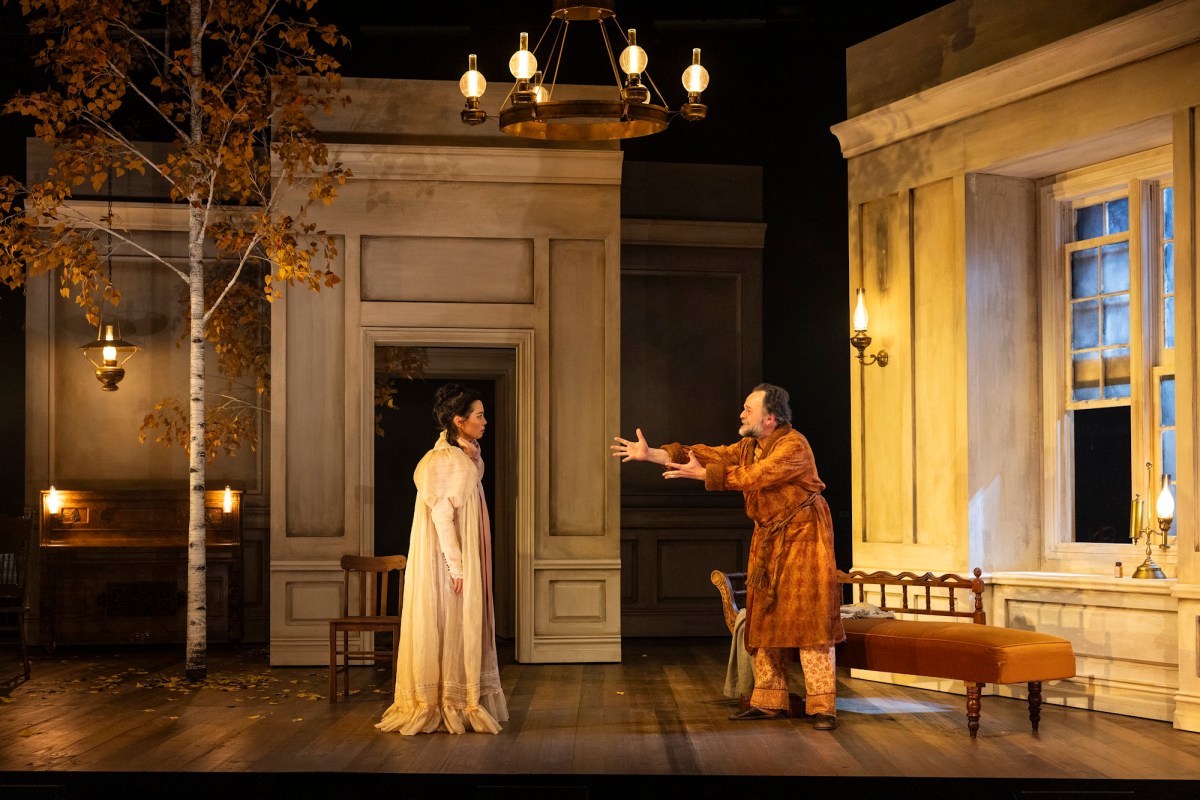
If Henshall had a bad case of the opening night jitters, tripping over his lines, he rallied in the second act to bring home the goods. Bazzi, charismatic as ever, is excellent as Astrov, his dapper attire the highlight of costume designer Dann Barber’s uniformly superb work.
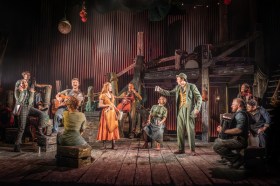
Barber also wows with his Brechtian set design, showing off the artifice with especially rubbery, if real-looking, trees that Sarks has her cast embrace, upping the physical comedy ante. Barber also has the mansion house walls roll from the back of the fully exposed stage, spinning from plywood faux to fancy at the command of the on-show stagehands. They hand Vanya his bottles and scatter a never-ending array of autumn leaves in Sonya’s perma-sweeping way.
Paul Jackson’s poetic lighting design dims the dying day as the second act shifts into its more melancholic, yet strangely still hopeful invocation of whatever may come. As backbreaking workers brush up against the indolent rich, with faults on either side of the divide, it’s clear that Murray-Smith and Sarks’ fabulous new spin on Chekhov’s Uncle Vanya remains as faithful(ish) as the withering Yelena.
The play still has so much to say about our unequal days, fake plastic trees and all.