Her Majesty’s Theatre in Adelaide was originally built in 1913 and named the New Tivoli Theatre as part of the nation-wide Tivoli vaudeville circuit. After successive renovations, little remains of its former Edwardian art nouveau glory apart from the façade, and there’s little sense of history once one enters the auditorium.
Nevertheless, Black American cross-genre composer and multi-instrumentalist Tyshawn Sorey’s one-off solo recital, Tyshawn Sorey: Alone at Adelaide Festival managed to raise a few ghosts. In fact the atmosphere felt somewhat like a séance even before the show started.
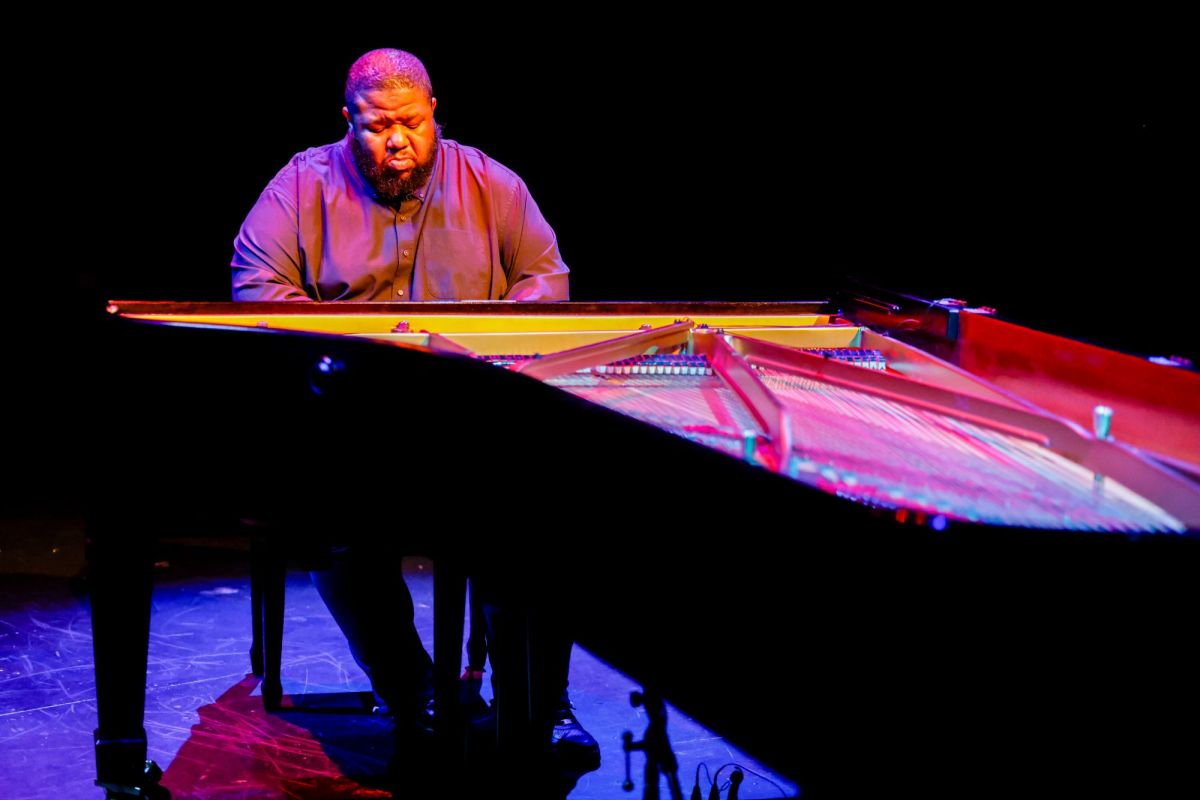
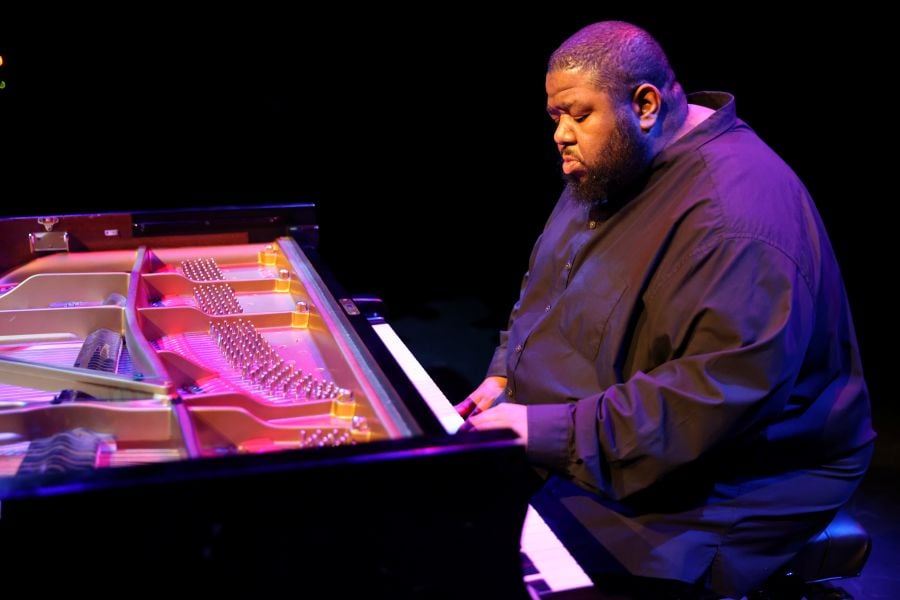
A grand piano with its lid removed had been placed centre stage and turned 90° to face the audience beneath a single blue spotlight. Sorey entered and sat down behind it like a medium at a table.
An unbroken wave of sound
He’s a giant of a man, and something of a giant on the contemporary music scene: Pulitzer Prize-winner, McArthur ‘Genius’ Fellow and a recipient of many other honours, he’s known for crossing musical boundaries and incorporating improvisation into his compositional practice. As an instrumentalist he began as a trombone player before transitioning to jazz drumming and piano; he also has a stated commitment to changing perceptions of Black and Afrodiasporic music.
Sorey also appeared at the Adelaide Festival as composer and musical director for Perle Noire (also presented at Her Majesty’s in the same week), but Tyshawn Sorey: Alone was a very different experience; he basically improvised at the piano for an hour to create what felt like a single unbroken wave of sound.
The music was infinitely varied in range, dynamics, pace, genre, emotion and even – despite the sole instrument – texture; at times Sorey coaxed extraordinary sounds from inside the piano by reaching forward and plucking the strings.
Read: Manifest Destiny review: Alex Frayne’s photographic roadtrip through a national crisis
The recital began slowly and quietly somewhat in what felt like the realms of classical music and particularly Impressionism: to my ears, the opening chords had echoes of Debussy’s Sunken Cathedral.
However, there’s considerable cross-influence between Impressionism and jazz, so we were already in the liminal territory of what Sorey prefers to call ‘mobility’ rather than using terms like ‘hybrid’, ‘crossover’ or ‘fusion’.
Music as spiritual experience
What followed was a journey into unknown territory through increasingly dark, tempestuous and occasionally atonal terrain (much like a Mahler slow movement in fact) that made me think at times of Bartok, Schönberg or Messiaen but also Ornette Coleman. ‘Free jazz’ might be one way to describe what we heard, but for me it transcended genre and language – verbal or musical – and became a deeply personal, meditative and even spiritual experience.
Compared to the famous solo improvisation recitals of Keith Jarrett, Sorey’s process felt much more experimental and free-flowing. Despite my clutching at evanescent classical or jazz analogies, there were fewer hand-rails to guide us, less repetition, less rhythmic pulse, less grounding in traditional tonality.
As such, Sorey’s notion of musical ‘mobility’ also arguably has a cultural and even political dimension. It avails itself of whatever is at hand, but in a profound sense it refuses to be identified.
At the same time, there’s something deeply grounded in his improvisational process that doesn’t seem to refer so much to externalities, but to something intimate and mysterious, which nevertheless communicates itself to something similar inside us, if we are open to it.
The entire recital had a circular structure, returning at the end to a similar murmuring oscillation that echoed where the performance began. It reminded me of the opening moments of Mahler’s 9th Symphony, or perhaps more simply a heartbeat.
As TS Eliot wrote in The Four Quartets, ‘in my beginning is my end’.
On the other hand, as my former compatriot Wittgenstein famously wrote: ‘Wovon man nicht sprechen kann, darüber muss man schweigen’(Whereof one cannot speak, thereof one should remain silent).