A vast crown of seeming iron lies on the Theatre Works stage. Before long, it will be hoisted to the rafters, hanging heavy over the sorry players doomed to a terrible fate in Shakespeare’s bloodiest of plays, Titus Andronicus.
Assumed to be the Bard’s first tragedy, Titus Andronicus will see no fewer than 14 bodies broken by curtain call, many brutalised before they fall. But first, we meet the Roman army in all its might.
Marching in place, in almost balletic movements slowed like the drip of honey, they’re led by the too-proud general of the title. Portrayed by Texan actor Josh Morrison, he’s a member of the Prague Shakespeare Company. This English-language Czech outfit first staged this production in 2023, brought to Melbourne now by Th’Unguarded Duncan and Theatre Works.
Titus and his soldiers, played gender blind by an impressive ensemble, have not only defeated the Goth army – led by Philadelphia import Victoria Haslam’s Queen Tamora – after a 10-year campaign, but they have also humiliated them.
Titus Andronicus review – quick links
Queen Tamora’s vengeance

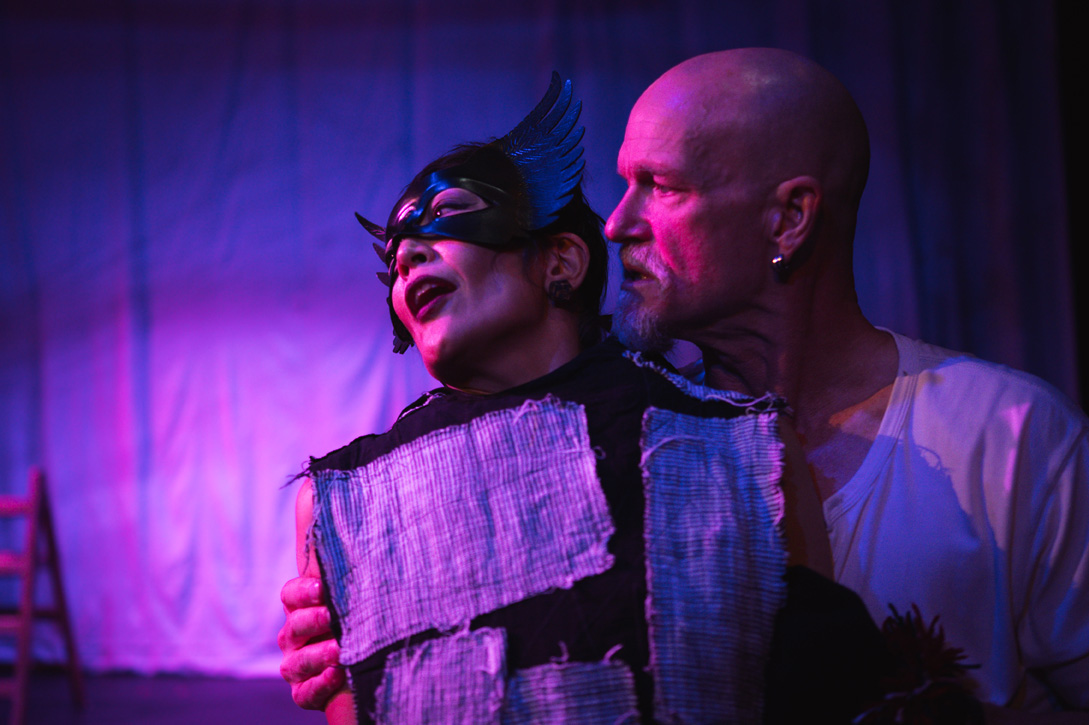
As envisioned by PSC costume designer Paulina Kostov and styled locally by Haslam herself, the Goths costumes have a black leather, punk rock aesthetic that nods to the adoption of the Germanic peoples’ name by many an emo since. Titus and the Romans skew halfway between Samurai and Highlanders in their kilt-like togas.
Cracks in hot-headed Titus’ sensibility appear immediately. Instead of showing mercy to the monarch whose house he has already demolished, he drags Tamora back to the capital in chains to witness the sacrifice of her eldest son, Alarbus, in the scorching lick of Rome’s eternal flame despite her desperate pleas.
It’s this cruel indifference that sets in motion Tamora’s disastrous path of backstabbing vengeance, “And make them know what ’tis to let a queen kneel in the streets and beg for grace in vain.”
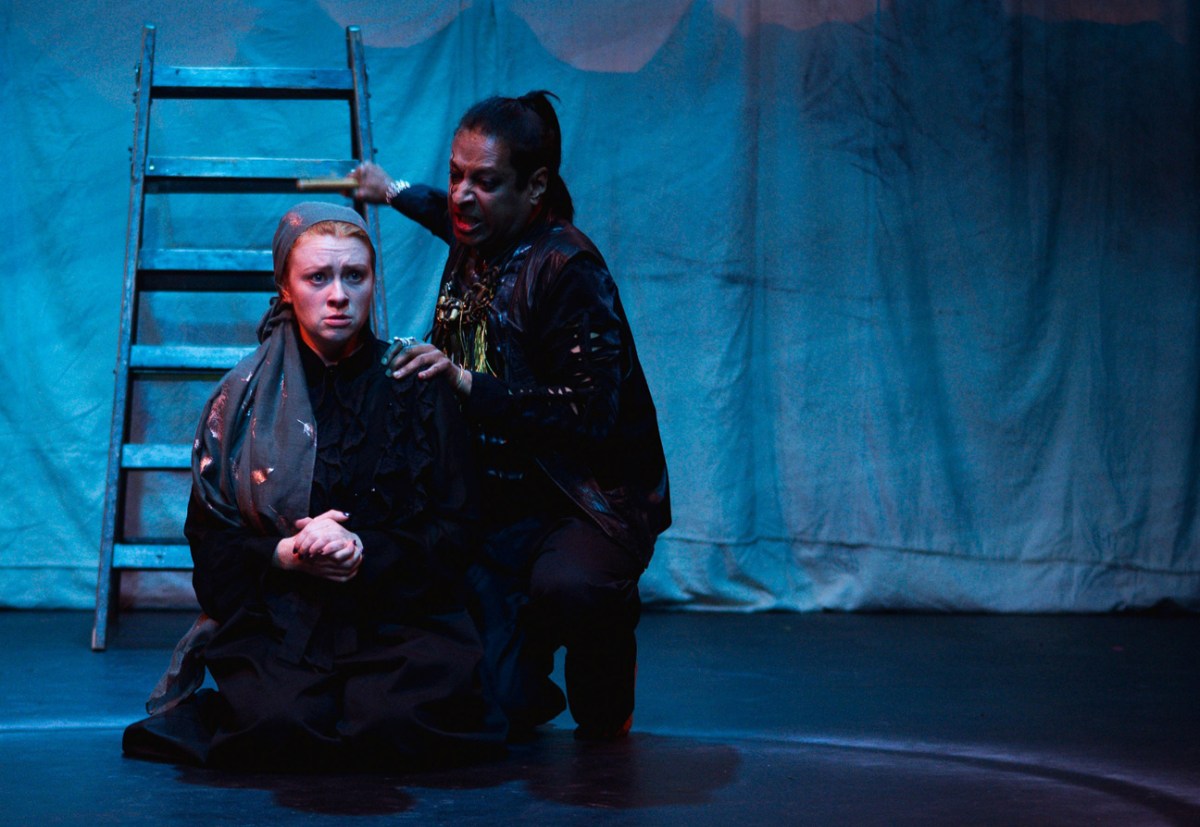
Tamora plots with her remaining sons, Demetrius (Seon Williams) and Chiron (James Cherche), as well as her lover, Aaron the Moor, played by Rajendra Moodley. She’s intent on destroying all that Titus holds dear, his house and the Roman Empire itself. “Revenge it, as you love your mother’s life, or be ye not henceforth called my children.”
Titus Andronicus comes apart
Musclebound and grizzled from the steely strokes of war, Titus may be a good battlefield strategist, but he isn’t the brightest player when it comes to countering Tamora’s limber political manoeuvres.
Morrison brings the appropriate strutting cockiness to the role when, on return to Rome, he brushes off the declaration by his brother, the tribune Marcus (a consistently excellent Helen Hopkins), that the people want him as their new emperor.
There’s some humility here, with Titus arguing he isn’t fit to wear that lofty wreath. And he’s right; his missteps come thick and fast, throwing his weight behind the buffoonish and brash Saturninus, played broadly comic by a sneering Scott Jackson.
Duly elevated, Saturninus wastes no time in making matters much worse by bullishly demanding the hand of Titus’ beloved daughter, Lavinia (Joanna Halliday), as his bride. This, despite her already being betrothed to Saturninus’ brother, the more suitable leadership candidate, Bassianus (James William).
When the lovers resist the overstepping Emperor’s callous claim, Titus is so committed to Rome that he slaughters his youngest son, Mutius (Belle White), for perceived treachery as his family rallies to the cause of Lavinia and Bassianus.
All the while, the scheming Tamora has woven her will around Saturninus. He casts off Lavinia in her favour, despite the mess he’s already made. With Tamora’s power vastly magnified, her road to Rome’s ruin, paved in the very worst intentions, takes full advantage of a city already burning with bitter double-crossing.
Revenge is sweet?
Shakespeare penned Titus Andronicus around 1588 to sate the bloodlust of Elizabethan audiences hungry for then-popular revenge plays. But it fell out of favour during the Victorian era, largely because of the gratuitous violence, sexual assault and all. It’s rarely staged these days.
So I relished the chance to see it leap from the page as directed by Claire Nicholas and Kevin Hopkins. Sure, it’s an early work with the rawness that brings, but Titus Andronicus still bristles with violent delights, a poetry of the macabre that Shakespeare would eventually take to the Macbeths’ scheming and the wily weird sisters.
The twisted tale is fully embraced by Haslam and Moodley, who maniacally draw out the deadly dark comedy buried in its pit of despair with a fearsome relish that’s a guilty pleasure to behold. Haslam goes all in, as Tamora works her talons, always clawing at the air itself as if ready to rend the very fabric of Rome.
Aaron’s twofold role, as both clown and villain, allows Moodley great license to break the fourth wall. It makes us feel complicit in their dastardly scheme – one that will leave Halliday’s Lavinia horrifically assaulted, maimed and rendered voiceless, though determined to enact justice on the hapless Chiron and Demetrius.
Hopkins and Nicholas’ stripped-back staging offers little more than three ladders, that crown-like ring and its twin, plus a towering, banner-like, ivory-coloured curtain to the rear. It’s awash with red and blue, projected by Hopkins’ lighting design, holding attention on this court in tatters.
Cutting the Titus Andronicus script
At a bracing 90 minutes, Shakespeare’s text has been sliced as brutally as the many players subjected to the blade, and if performed in full, would run around twice as long. In many ways, this works to maximise the carnage. But Titus’ arc suffers a little. His rash decisions, pivoting from loving father to bone-headed boof, are played a little too fast for him to sit in the consequences, however captivating Morrison’s performance.
Assorted scions seem to come and go before we barely know them, with River Stevens’ Lucious making the biggest impact thanks to his evident, fretful despair at his father’s inability to settle into peace and his willingness to murder his own clan.
Composer Max Hokins’ score, a rather naff guitar riff piped in at inopportune moments to occasionally swallow Shakespeare’s dialogue whole, is the production’s weakest link. While Jake Crawford and Scott Jackson’s fight choreography, again leaning towards the balletic, works a treat for Lavinia’s fight back, it does rob a little of the battle’s heat.
If an imperfect production of an imperfect play, Nicholas and Hopkins’ take on Titus Andronicus is thoroughly engaging. When all does not end well, and bodies are bound by that ring of steel like fallen gladiators, Shakespeare’s least subtle knife still cuts deep.