Adapted and directed by Australian expat Simon Stone, this contemporary retelling of Anton Chekhov’s final play transposed the familiar story of somnolent aristocrats failing to adapt to a changing world from the original setting of pre-revolutionary Russia to contemporary South Korea. Instead of Bolsheviks at the gate, here it was picketing workers, frightened that their positions were under threat.
Envisaged by Chekhov as a comedy, yet famously directed as a tragedy for its 1904 world premiere season, Stone successfully captured both dramatic modes in this production of The Cherry Orchard, albeit with the comedy emphasised.
The Cherry Orchard review – quick links
Updating The Cherry Orchard
Stone had previously adapted The Cherry Orchard for Melbourne Theatre Company in 2013, a production ArtsHub described as ‘a careful, faithful take … more of a translation than any sort of reboot’. As with that production, Stone’s familiarity with Chekhov’s themes, structure and characters shone through in this new production, which originally premiered at Seoul’s LG Arts Center in 2024 – this was a lively, quick witted and engaging take on the play.
His primary characters – including Doyoung Song (Stone’s version of the indecisive Lyubov Ranevskaya), played by Cannes Best Actress winner Doyeon Jeon and marking her first stage appearance in 27 years – are members of a fading chaebol (one of approximately two dozen family-controlled conglomerates, including Samsung, LG and Hyundai, that dominate South Korea’s corporate world).
As with Chekhov’s original, Stone’s chaebol family are adrift in the modern world; they react too slowly to a looming catastrophe, even when help is offered from someone outside their social class.
We also met the family’s servants, hangers-on and associates including Doosik Hwang (Squid Game star Haesoo Park, playing Stone’s version of Yermolai Lopakhin), the go-getting son of the family’s former chauffeur, now an influential and respected businessman. Hwang had a plan to save the family’s business, but Song and her family failed to listen to his advice – for many reasons, not least because Hwang is from a different social class – until it was far too late.
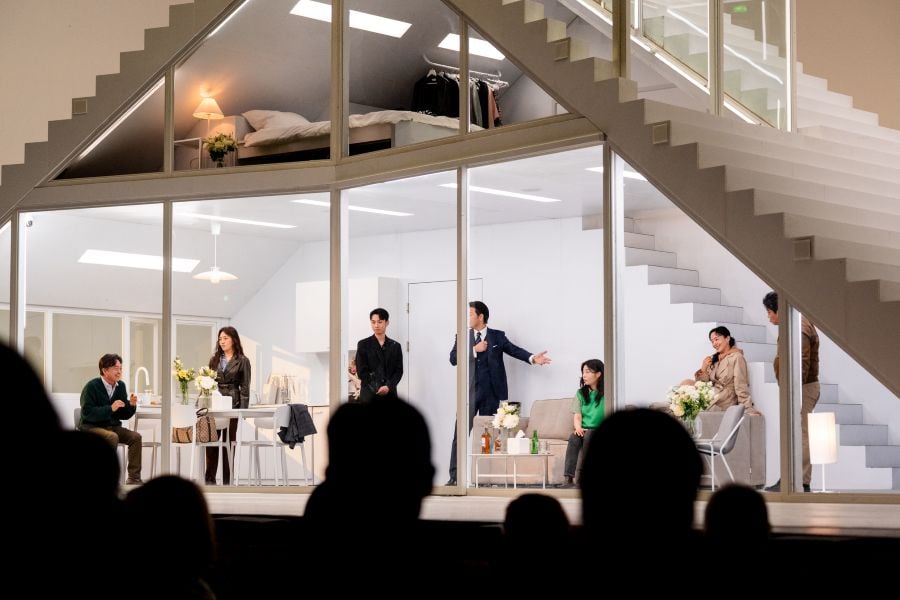
Performances were strong at the Adelaide Festival, especially Jeon as the grief-addled, alcoholic Song, whose refusal to focus on current issues doomed her family, and Park’s magnetic, charismatic Hwang.
Byunghoon Yoo as Youngho Kim, Song’s sponging, drunken clown of a cousin, and Sejun Lee as the gormless and suicidally depressed young chauffeur Yebin Shin also impressed. A serio-comic paean to the enduring design of a 1950’s record player by Doyoung’s feckless brother, Jaeyoung Song (Sangkyu Son playing Stone’s version of Leonid Gaev) was an unexpected highlight.
Production design marred Stone’s The Cherry Orchard
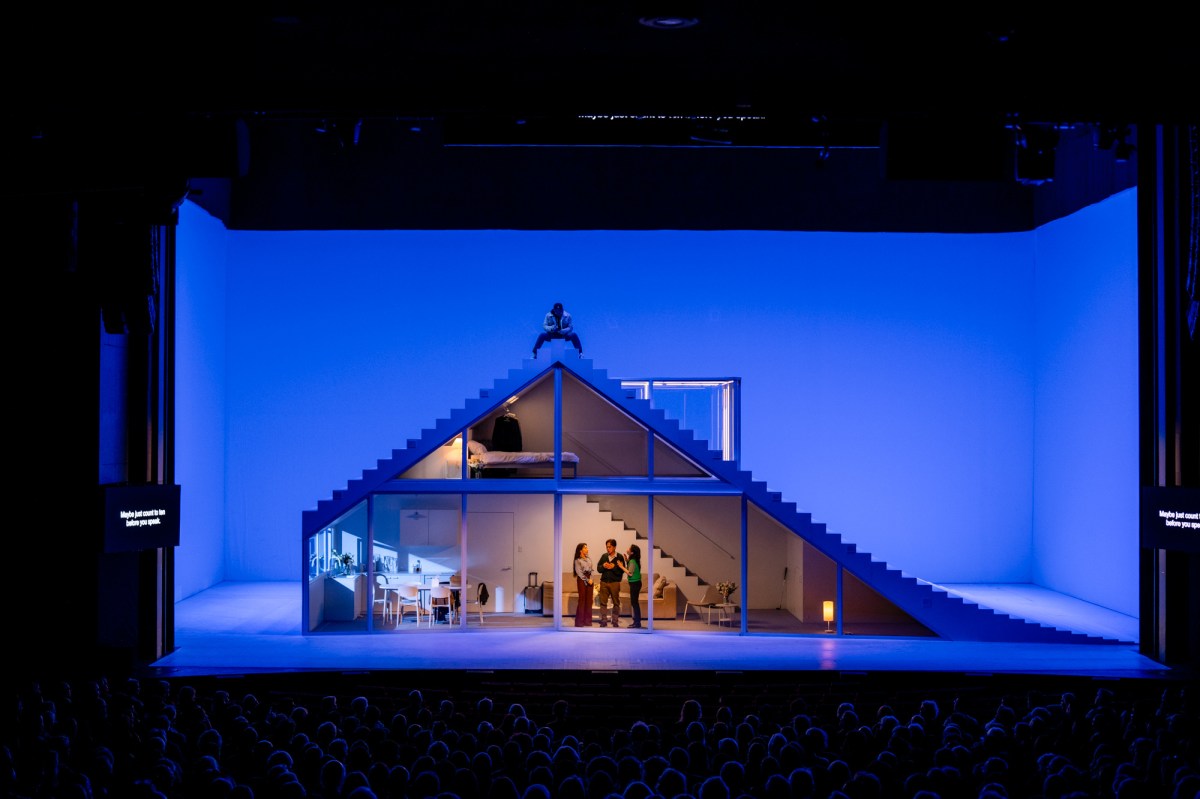
Saul Kim’s set was striking: an open-sided structure of glass and steel representing the architecturally significant house in which the action unfolds. It was also predictable: Stone is renowned for staging works inside glass boxes and behind perspex walls, including in his 2011 breakthrough production of The Wild Duck for Belvoir, his 2016 London stage hit Yerma at the Young Vic, and last year’s Adelaide Festival centrepiece opera, Innocence.
Here, while visually emphasising the hothouse nature of the family home as well as its rigid fragility, the set’s struts and beams sometimes obscured actors’ faces during key dramatic moments. Similarly, the need to amplify the actors’ voices so they could be heard from behind perspex in the cavernous Festival Theatre often nullified one’s ability to pinpoint who was speaking at any given time and distanced the drama.
ArtsHub: ‘All voices should be heard’, Pulp’s Jarvis Cocker tells Adelaide Festival crowd
Stone’s adaptation and direction were assured, although the play’s wordier passages suffered from audience members needing to constantly switch their focus between actors and surtitles, especially when sitting close to the stage, where sightlines made such shifted viewing a challenge. Consequently, one struggled to concentrate on the subtleties of performance and expression and the nuances of the script simultaneously.
Factoring in the issues of set and sound, the end result was an impressive but frustrating The Cherry Orchard; a production one observed instead of being absorbed by.
LG Arts Center’s The Cherry Orchard played Adelaide Festival Centre’s Festival Theatre, Adelaide from 27 February to 1 March. Browse all Adelaide Festival reviews.
The writer visited Adelaide as a guest of Adelaide Festival.