At the entry to his exhibition Presence, Danish-born artist Olafur Eliasson has chosen a grouping of works that centres the country that shaped his long career – Iceland. That gesture has a connection with that very strong tendency by First Nations Australians. To pause. To reflect. And to understand our responsibility for care.
Olafur Eliasson’s Presence review – quick links
Entering Olafur Eliasson’s Presence
Presence, currently at the Queensland Art Gallery & Gallery of Modern Art in Brisbane, presents over 20 artworks by the artist, spanning from 1993 to the present.
Hovering from the ceiling is the sculpture Lost compass (2013), a weathered driftwood log encircled by a steel frame with magnets. These act to align the work along the planet’s north-south axis, and plays to Eliasson’s fascination with how we locate ourselves.

Driftwood is an important resource in Iceland, where less than one percent of the country is forested. We see this in the various photographic series also presented in this room of the gallery.
Among them are a grid of nine photos that show a wisps of cloud forming over time, The morning small cloud series (2006), as well as 12 photos documenting a huge glacial block, Melting ice on Gunnars land (2008), and another series documenting the passage of evening light, The Hekla twilight series (2006).

All time-based studies, these are a literal reminder for viewers to slow down.
It is a strategic curatorial choice. Aware of the public’s rush to dive straight to those immersive ‘snapable’ installations that Eliasson is so well known for, the move attempts a reboot first.
Sadly, the room is a bit congested with the volume of visitors, and not all pause for this important message.
The model for slow collaboration
Presence has been developed in close collaboration with Eliasson’s Berlin studio. Indeed, it was in Berlin last year, where I caught QAGOMA’s Head of International Art Geraldine Kirrihi Barlow while finessing this show.
To understand the huge amount of work that exists behind the pieces we see in Brisbane means understanding his studio. It is a community for experimentation, with separate studios for each material and a team of craftspeople, architects, engineers, archivists and art historians, all vigorously working on prototypes and exhibition pieces. (There’s even a studio chef.) It’s founded on a philosophy that rewards the curious – and that same philosophy is carried into the gallery space.
In the belly of this exhibition, we get a peep into that studio world, via a small recreation of Eliasson’s maquette and model room in the installation For your circular city (2024).
It has a lovely connection with the much loved Eliasson work in the QAGOMA collection, The cubic structural evolution project (2004), which is an expansive table of white Lego pieces encouraging visitors to build a city of the future. It is presented in the long atrium gallery at QAGOMA.
While these works speak of built environments, one of the most moving pieces in this exhibition points to the repercussions of manmade construction and climate change. Thirty paired photographs of glaciers, taken twenty years apart, sit in the same room as the maquettes.
The Glacier melt series (1999/2019) forms arguably the most literal environmental record in this exhibition. As with the works presented in that initial gallery, it asks us to consider what change looks like over time. It is amazing just how strongly these images of dying glaciers trigger our emotions.
Olafur Eliasson invites us to be co-authors
The great appeal of Eliasson’s work is its capacity to make us feel not just emotionally, but physically.
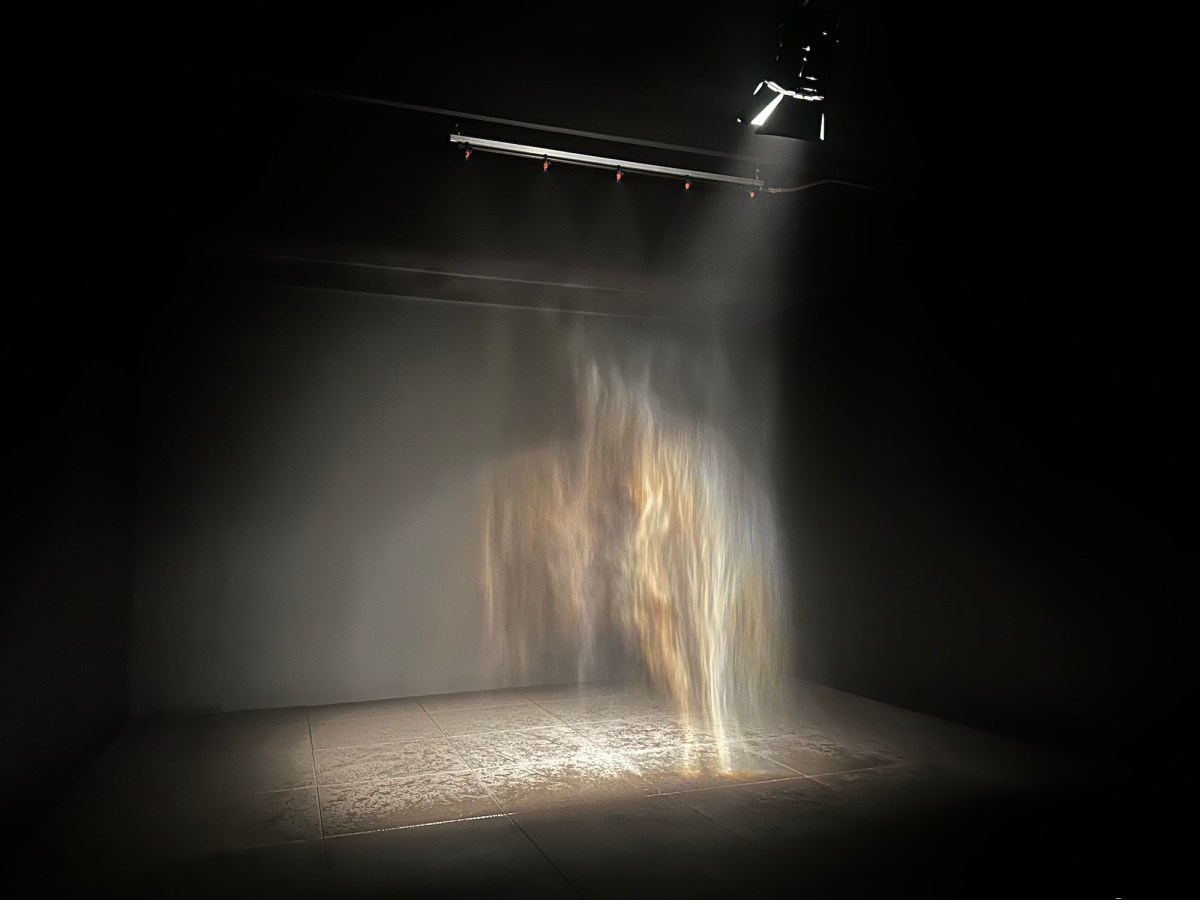
Presence delivers those big sensory works that invite us to be co-authors to see them fully realised, such as Beauty (1993) with its curtain of soft mist settling on one’s skin. The earliest work in the show, and one of his most famed pieces, it has recently been purchased by QAGOMA. With Beauty, we are invited to reach out and touch a rainbow – and depending on our position we are caught between illusion and reality.
Another such work is Riverbed (2014), which plays with precarity and hints at vulnerability. It invites audiences to clamber over a steep rise of river rocks. Despite being an OH&S nightmare (visitors are asked to sign a form first) and the much-discussed environmental footprint of this work, when it comes to exhibition making, it is an incredible achievement and loved by visitors who follow the waterflow and build towers of rocks.
As its pushes up against the gallery’s rigid architecture, Riverbed delivers the inconceivable – running water in a gallery. It invites us to physically grasp the harsh uneasiness of our environment and the rarity of water resources – recognising the need for care as we navigate it.
Read: Is Olafur Eliasson’s environmental-minded summer exhibition so green?
Olafur Eliasson’s new work for Brisbane
One of the great surprises in this show is a new suite of kinetic sculptural works. They use movement and light to activate polarising filters, which are only realised as the viewer moves around them.
In Your truths (2025), fans activate a clear PVC curtain which sits behind five over-scaled polarising filters placed so they sit at torso-level. The movement of the curtain in the air currents, and our own, orchestrate a play of light and form in real time.
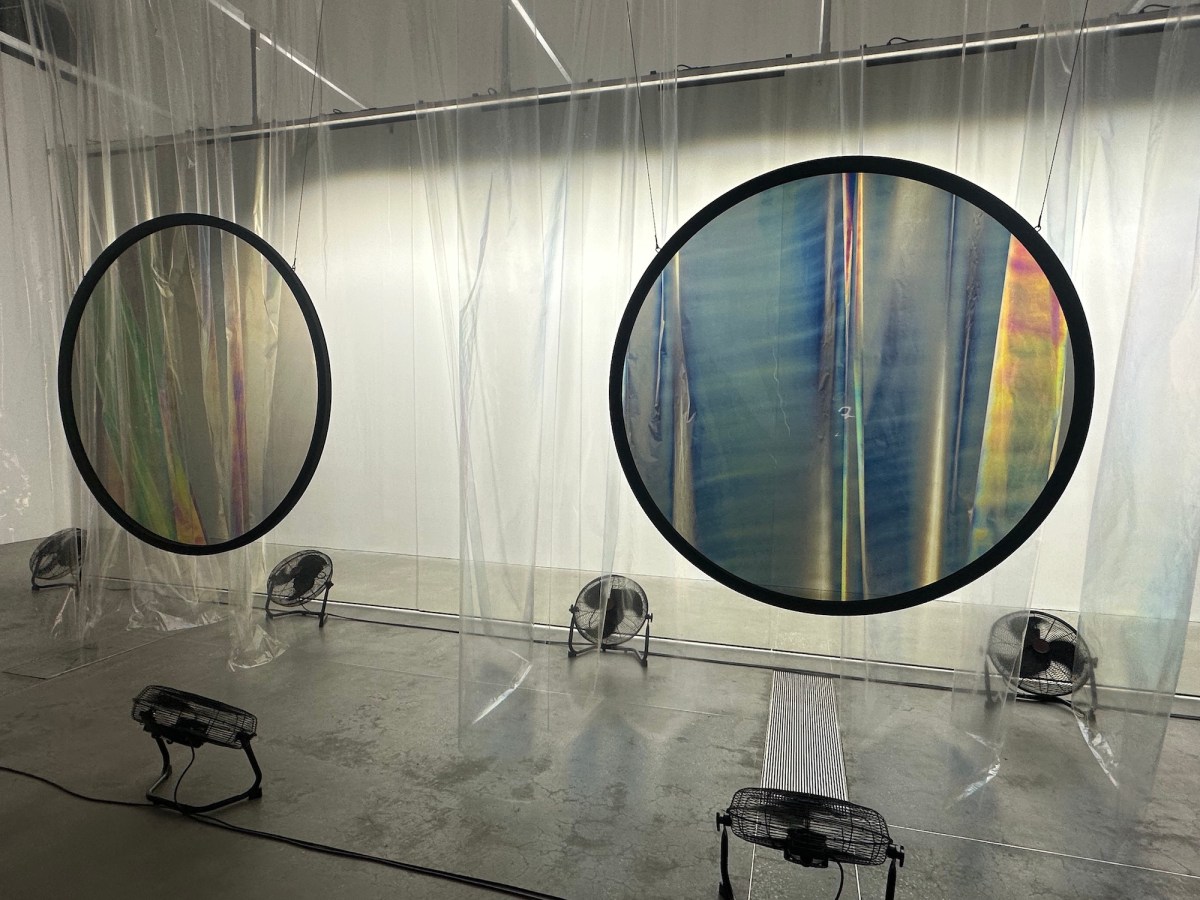
Without a viewer, the work doesn’t not exist. The experience is unique, changing from one viewer to the next. It is really a remarkable artwork and a sure highlight of the exhibition.
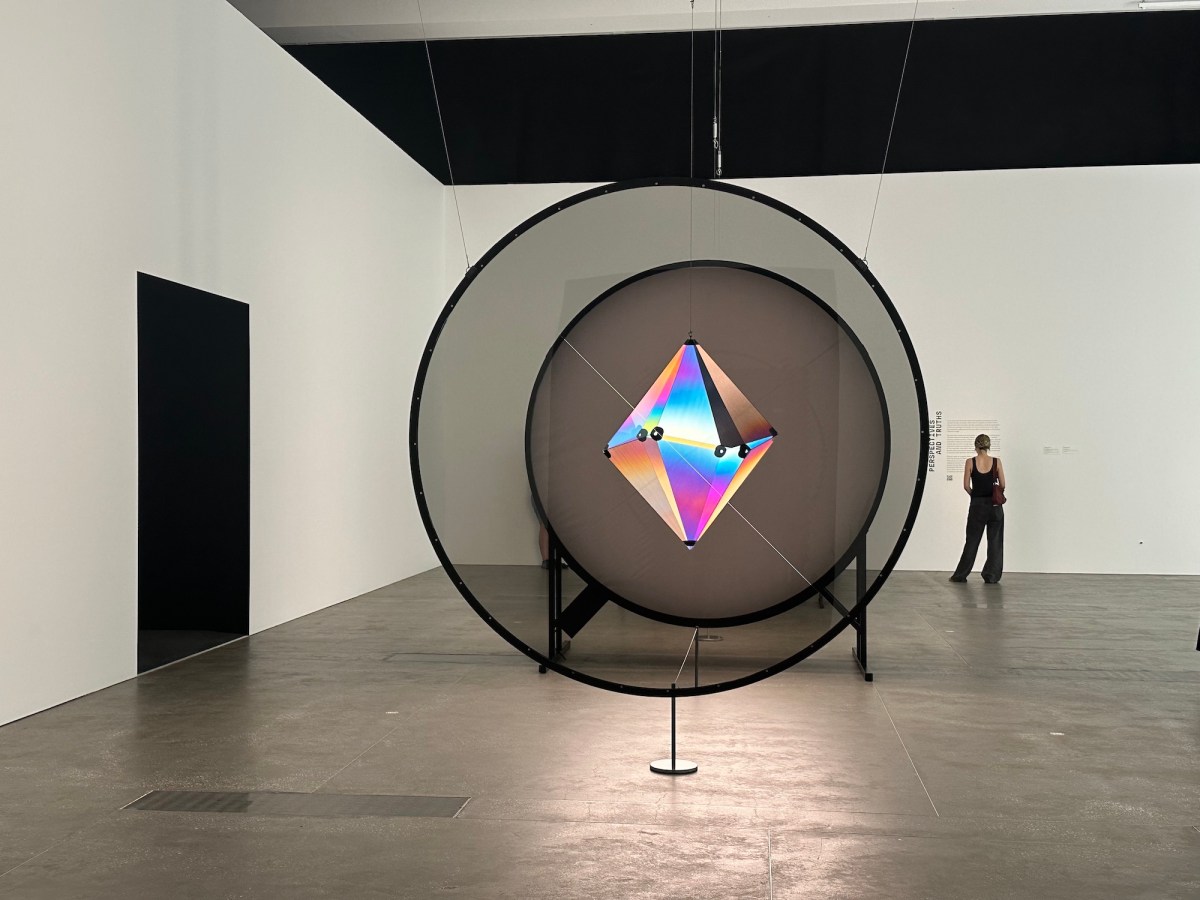
It is expanded by the two-part installation, Your negotiable vulnerability seen from two perspectives (2025), which on one side deepens this experiment of using two overlapping lenses, and on the other, sets a rotating polyhedron into play.
What Eliasson is doing is prompting us to question what we see. Together these works connect with the spectral phenomenon of Beauty, which also calls on our own senses and movement to realise the piece.
From Tate Modern to Brisbane
One of Eliasson’s most celebrated works was The weather project (2003), which transformed the Turbine Hall of the Tate in the United Kingdom. A related piece has been created for the Brisbane exhibition. Titled Presence (2025), it sits in a corner of the gallery, with mirrors carefully placed to suggest a spherical form.

Presence bathes audiences in a golden light. It was inspired by recent photographs by NASA that captured the sun’s surface bubbling, and the use of perforated aluminium sheeting over printed textiles gives the work a shimmering, moiré effect.
Yes, it is impressive, but I would have liked to have seen this installation in its own space rather than clustered with two other works. While there is a play on the spherical form here, its impact feels slightly reduced.
Read: Ron Mueck: Encounter review: empathy in difficult times
And the verdict?
Overall, this exhibition funnels our attention – through tactility – toward awareness of the state of being present. We feel this exhibition on our skin, in our movement, and in how we see and perceive a constantly changing world around us.
Yes, it does inspire awe. But it is also a heartwrenching reality check. Those images of glaciers over a 20-year cycle stay with me long after the fun of playing with Lego.
Tipping us off balance is a good thing, and in our world of saturated simulation and sameness, that is a rare achievement.
Olafur Eliasson: Presence is at the Gallery of Modern Art in Brisbane until 12 July 2026. It is a ticketed exhibition.
The writer travelled to Brisbane as a guest of the Queensland Art Gallery & Gallery of Modern Art.