The first and most constant gag in director Mark Wilson’s effervescent staging of Much Ado About Nothing comes courtesy of set designer Anna Cordingley. And it’s about as parochial a jest as you could wish for, aimed fairly and squarely at Melburnians, and south of the river Melburnians at that.
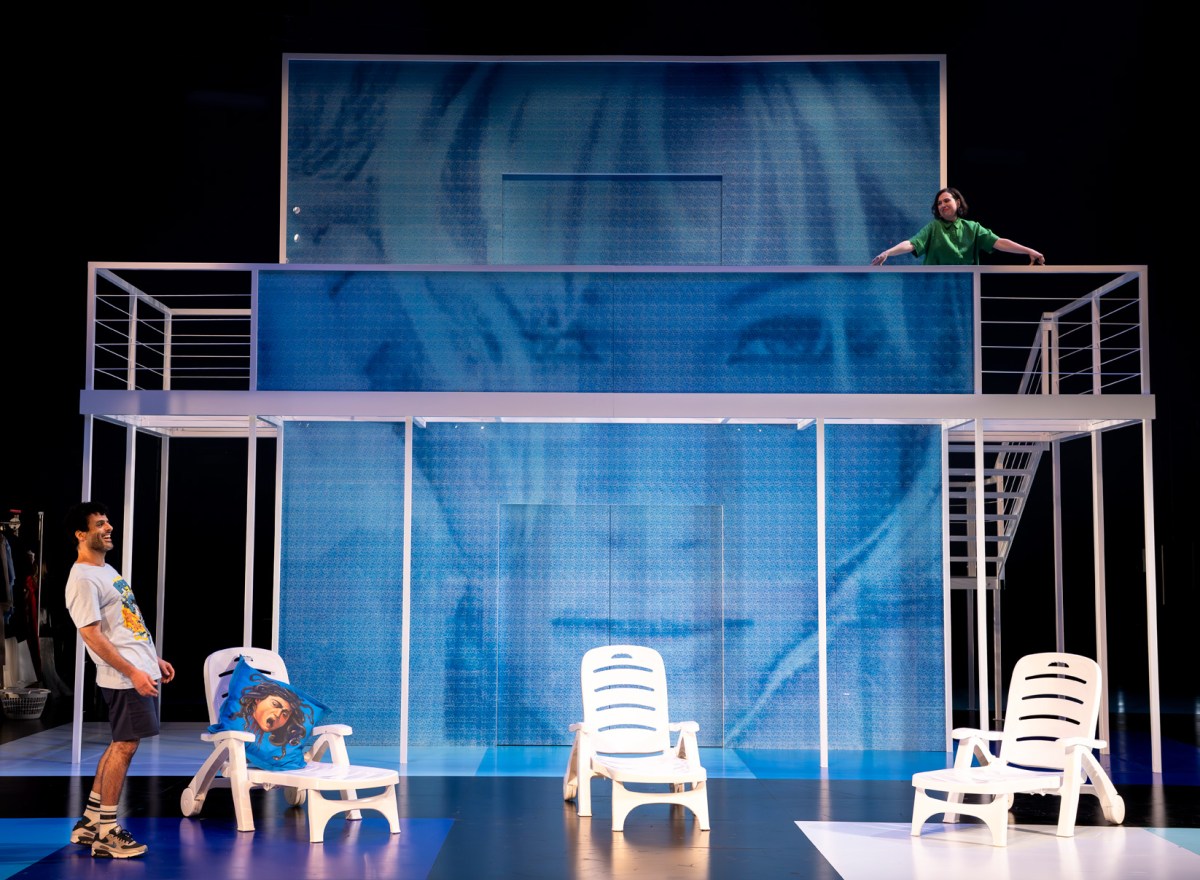
In the middle of a wide-open stage where the legs have been removed, revealing the contents of the wings – stagehands, technical equipment, changing areas, offstage cast and more – sits a large two-storey frontage with a second-storey balcony, the house of Leonato. The entire façade is covered with that familiar blue-tinged design of Pamela Anderson’s face that infamously adorned the Canterbury Road home of local AFL identity and Footy Show alumnus Sam Newman.
For a play about sexism and gender battles, it’s a wickedly funny reminder that there are attitudes and dilemmas that remain as pertinent in 2025 as they did at the beginning of the 17th century.
Wilson’s production is full of such wry humour, pointed barbs and downright slapstick, making the most of both the surface level reading of the play and the deeper intent. On the one hand, Much Ado About Nothing is literally that – a comedy where nothing of any import happens; it’s all a storm in a teacup caused by a malcontent stirring up trouble between one of the two romantic couples at the heart of the play.
Much Ado About Nothing review – quick links
Much ado about something
As many scholars will tell you, the title itself shouldn’t be taken at face value. There are puns and sexual double entendres within it and beneath the guise of a frothy comedy of errors, the play has plenty to say about gender roles, societal expectations, the nature of attraction, the deceitfulness of man – well, men to be honest – and his willingness to be manipulated, lied to and easily convinced of female infidelity.
The latter themes play out in the love story of Claudio and Hero, with the former quickly duped into believing she is not only not a virgin, but that she’s been merrily spreading her sexual wings for a goodly while.
But the biting repartee and withering exchanges of wit belong to Benedick and Beatrice – the liveliest of comic pairings and one that remains fresh enough to relish today, without the more problematic elements of a similar warring couple, Petruchio and Katherine in Shakespeare’s earlier comedy, The Taming of the Shrew.
A small ensemble tackles many roles
One of the questions that may occur to audiences regards the Much Ado About Nothing ensemble. There are up to 20 characters in the play, but all are brought to life by a cast of just eight. Cost cutting at the Melbourne Theatre Company, or purely a directorial decision? Whatever the reason, it certainly works.
The cast members who double (or treble) up all pull off their various roles with alacrity. In an ensemble as committed and multifaceted as this, it’s a pity to single anyone out, but surely Julie Forsyth would be forgiven for expecting Melbourne’s finest to be waiting for her after the curtain call. Scene stealing to this extent must surely invite a charge of grand larceny at the very least.
As Dogberry, Ursula, head of the Watch or the Friar she’s a one-woman mistress class in comic timing, larger than life characterisation and vocal skills.
Making his MTC debut, Fayssal Bazzi also displays some impressive comic timing and rubbery physicality in the leading role of Benedick.
Underneath the artifice
Fortunately, Bazzi’s work is strong enough that for Benedick’s Act II soliloquy (‘for I will be horribly in love with her…the world must be peopled’) he’s able to hold the audience despite the offstage action that threatens to distract. This is the one time when there is perhaps a danger that Wilson’s decision to leave the wings open to view could have backfired.
As it is, the juxtaposition of a play about masks, subterfuge and mistaken identities (deliberately or otherwise) with a staging that removes all pretence of reality, and shows the mechanics of ‘putting on a show’ so clearly, is cleverly done. And is fully committed to – even to the extent of stagehands coming centre stage to assist Forsyth changing costume and character in full view.
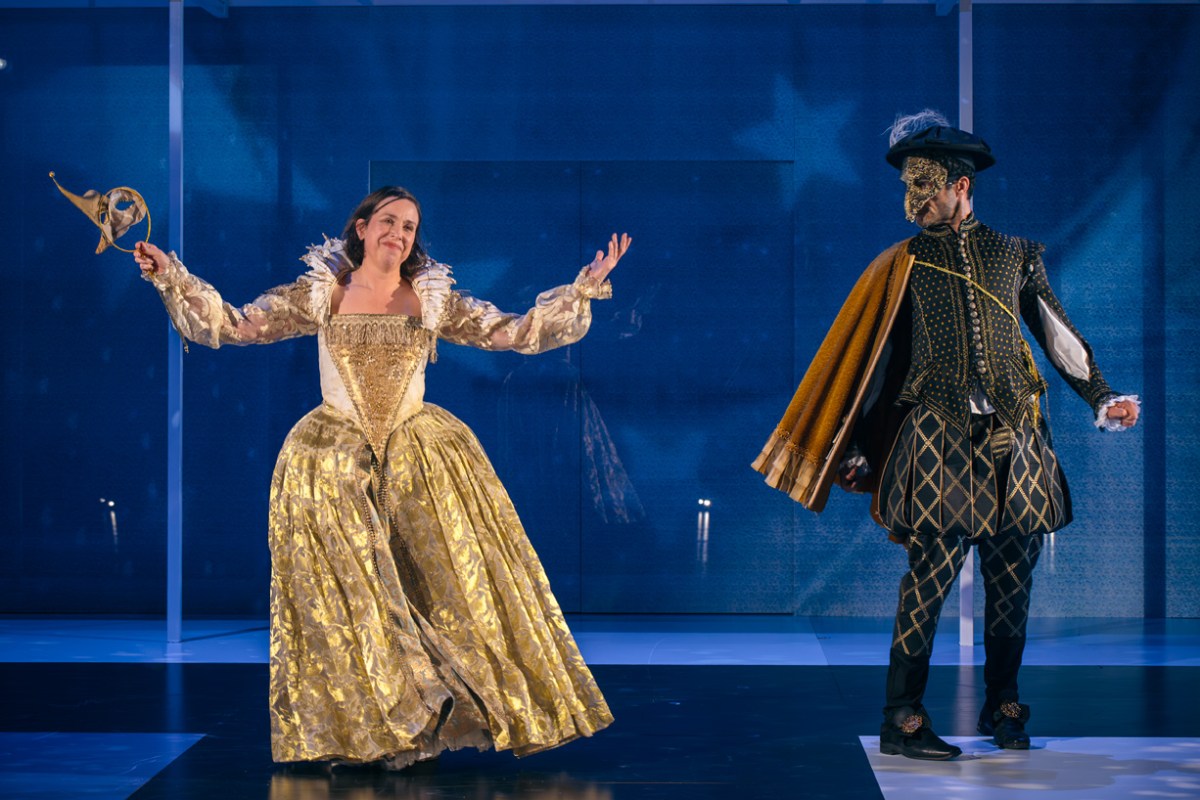
Another audience question may relate to the only time the cast don Shakespearean garb – stressing the excellent visual comedy of bare, hairy, male legs beneath elaborate padded hose and doublets – and this comes in Act II’s masked ball scene. They’re such gorgeous costumes that it almost seems a shame we don’t see more of them, but it is a diverting pointer to the play’s origins, surrounded by a much more free, easy and contemporary approach to the overall look from costume designer Karine Larché.
In the end perhaps the only unanswered question relates to the wedding scenes. Stage right are prominent collections of inflated balloons, ready for the party, but never released. Is their inclusion simply a visual note underscoring a celebration that is thwarted – the disastrous first wedding? This seems a little extravagant or unnecessary considering the modest and seemingly prudent approach to set design throughout. Or did someone simply forget to open the netting?
Perhaps it is merely that even a play as well-worn and much loved as this is allowed to have a little mystery or two up its sleeve.
Read: 2026 season announcements: our rolling guide to the performing arts
Other recent MTC offerings – including Dying a Memoir, Rebecca and Destiny, with West Gate to come in the new year – have hardly been chuckle fests. Accordingly, it would be hard to imagine a better way to round out 2025 than with this exuberant production. Early Christmas presents surely couldn’t come any more joyful than Much Ado About Nothing.