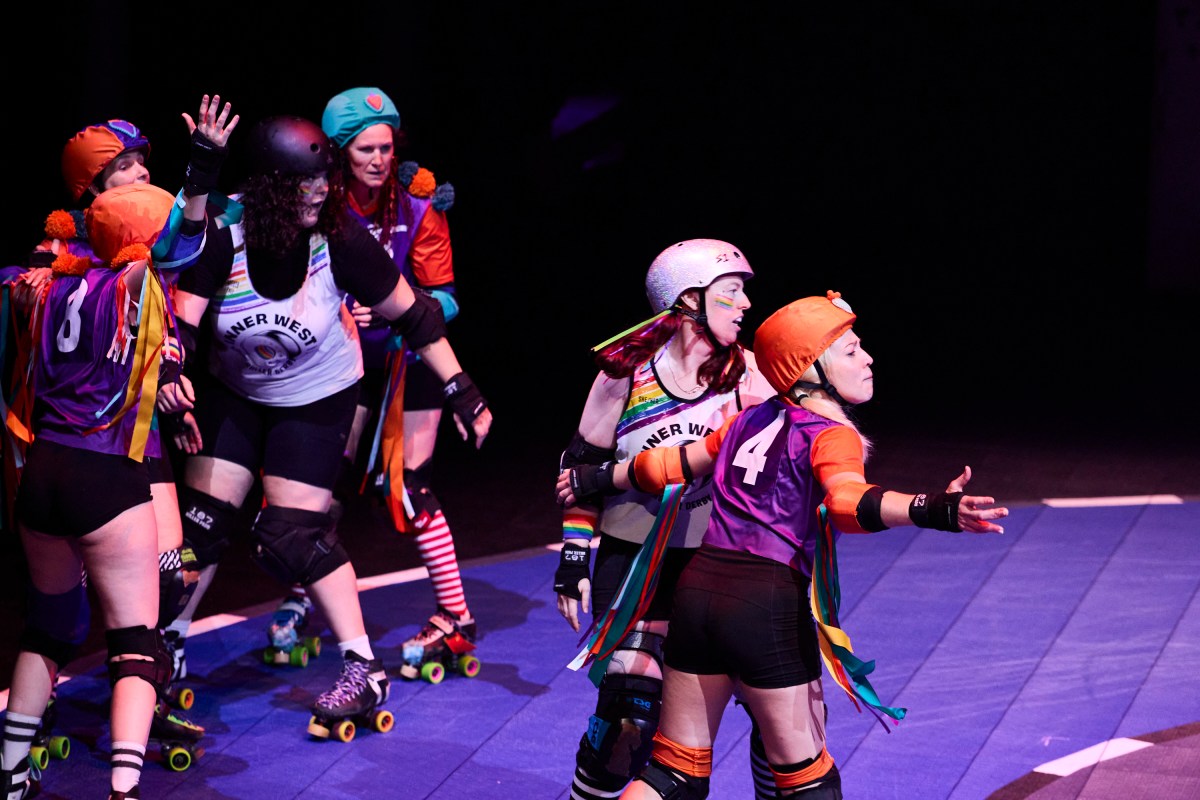
Debuting as part of Sydney Festival, Mama Does Derby is a hilarious and brutally tender production that sees Sydney Town Hall transform into a roller derby rink. Audiences are greeted with temporary tattoos and sat in bleacher-style seats, with derby players whizzing around the big blue oval on stage.
Mama certainly does do derby in this Virginia Gay-penned and Clare Watson-directed production, but the play mostly follows the relationship between Max (Amber McMahon) and her daughter Billie (played wisely by Elvy-Lee Quici).
Freshly moved to a rural suburb, Max and Billie monologue about the chaotic journey across the world that has led them to this small-town life, quickly setting up their perhaps too-close relationship.
Mama Does Derby review – quick links
Staging a complex mother-daughter relationship
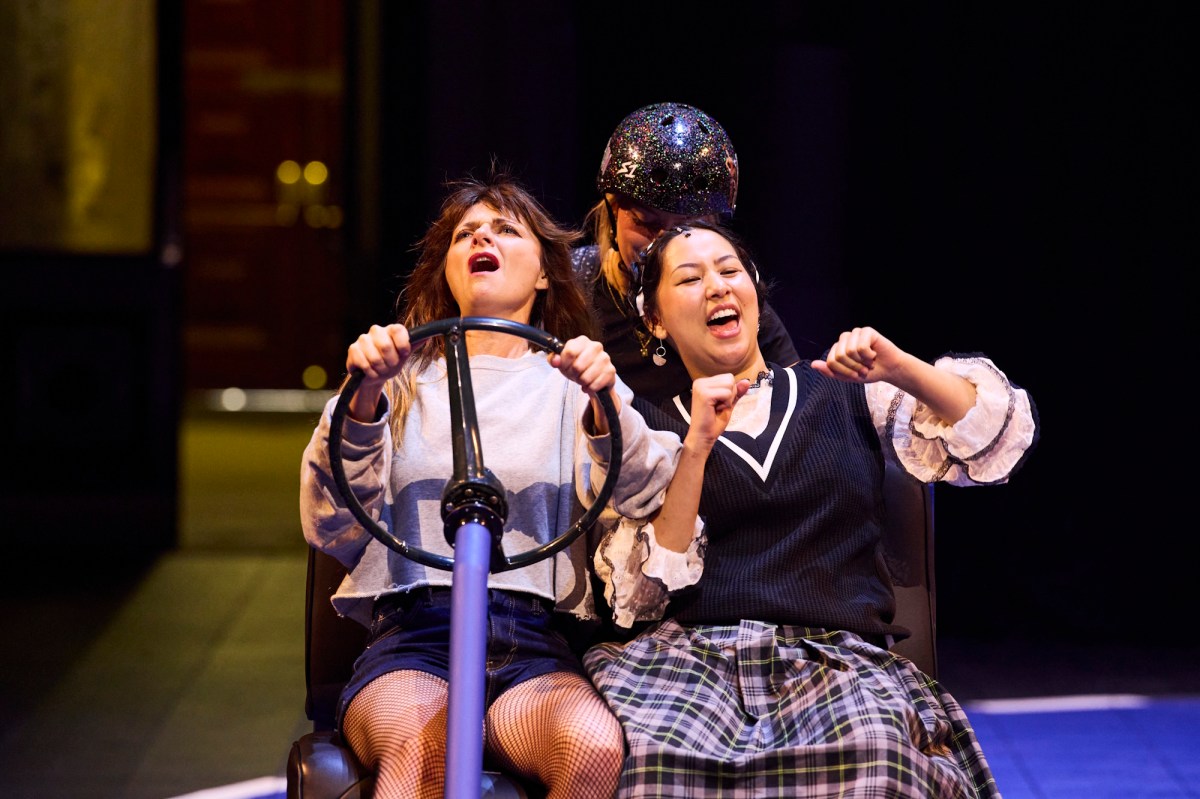
Billie struggles to adapt to the silence of her new home, and feels the need to protect her always-on-the-go mother. Quici is delightful in the role, dutifully exasperated with teenagerhood but still vibrant and passionate and earnest with emotion.
McMahon is the spinning wheel of the show, guiding the story with incredible physicality and a controlled chaos. A force of a mother, Max is abundantly loving, but also wants to be able to live her own life. Her negotiation of whether to be a parent or a friend is endearing to watch, since she clearly wants nothing but the best for her daughter.
Watson is a generous director, moving with agility through their complex mother-daughter dynamic and the uniquely open-air staging. Her vision pairs masterfully with Gay’s wit and prose, ribbing on Australian iconography (The Barefoot Investor is accused of having a foot fetish) while staying grounded in reality.
Gay’s script is full of quippy pop culture references, fresh and contemporary without feeling trite. Her handling of mental health is vivid, aware of how ‘trauma’ can feel like an overused term for those of us who are chronically online, but still remains a real and important subject to discuss.
Mama Does Derby balances light and dark
These heavier themes of depression and loneliness pair well with the show’s lightness, and Mama Does Derby is still a very funny production, especially throughout the derby scenes.
A highlight is Max’s introduction to her eventual teammates, with Annabel Matheson’s team captain Drew sharing the cheeky puns each player adopts when in derby mode. There must be a linguistic study somewhere about the fine line between drag names and derby names.
Mama Does Derby’s sound design is impeccable, a full toolkit of sound effects, radio hits and live punk music from a moveable band tactfully used throughout. The live musical trio are smashing, weaving through classic punk rock hit like the Pixies Where Is My Mind as easily as an animalistic rendering of Charli XCX’s brat staple Apple.
Much kudos must be given to Antoine Jelk, who tag-teams as the drummer and also the vaguely-European Weird Neil, a neighbour who gives driving lessons.
Read: Rock and rolling into Mama Does Derby
The one thing I wish the show had more of was room to breathe. Every song ended with an immediate start to dialogue, and hesitant audience applause became expected silence. It was not an indication of boredom, but considering the heated energy of roller derby, it would benefit the show greatly to encourage a larger cacophony from its audience. Where else, except the rink, would hooting and hollering be so humbly appreciated?
Real roller derby players deliver impressive set changes
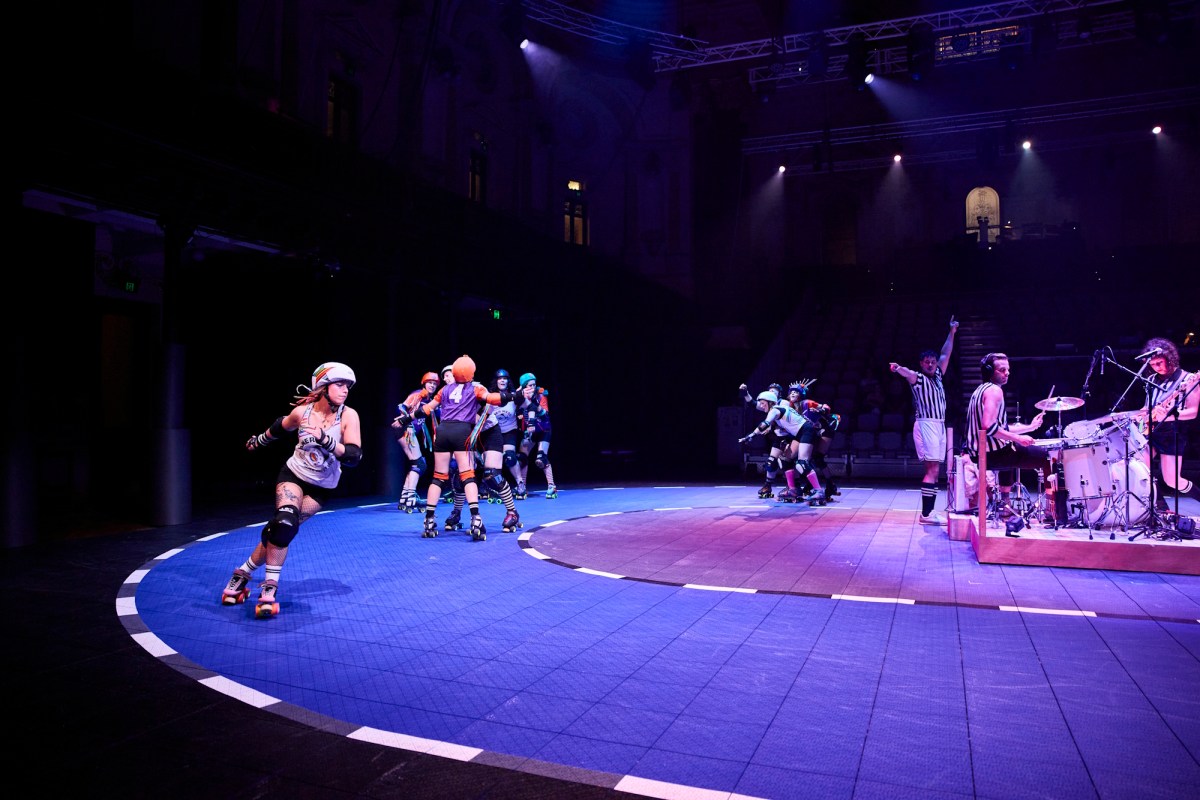
The most exciting part of Mama Does Derby was, as the title suggests, the derby itself. The incredibly creative choice to use real roller derby players throughout the show, repping the Inner West Roller Derby League, was perfect for the material. On a technical level, it meant all set changes could be made visibly and smoothly. It was also genuinely fun, and for my fellow klutz’s in the audience, very impressive athleticism.
While the scenes that take place at the derby could have been more aggressive, akin to the reality of the brutal sport, it’s also a very reasonable decision to prioritise the safety of the show’s team.
The whole cast end up on stage at a Halloween party near the end of the show. The venue is doused in UV black light, and characters wheel around, dancing and sparkling with a blue hue. At the party, Billie shares her love of Frida Kahlo with her companion Hux, played with an infinite warmth and curiosity by Aud Mason-Hyde.
For Billie, the ‘blood and flowers’ of Kahlo’s work speaks greatly to the human condition, full of paradoxes and the ability to find hope throughout pain. Next to me, my sister’s dress glowed as well, coincidently covered in Kahlo’s face. For a moment, under the black light, we were all Billie, learning how to walk alongside our glittery demons and see the flowers amongst the blood.
In the end, all we can hope is that our lives are as smooth as rollerskate wheels gliding around the rink. If not, just make sure you’ve got your knee pads on.
Mama Does Derby is at Sydney Town Hall as part of Sydney Festival until the 22 January.
This article is published as part of ArtsHub’s Creative Journalism Fellowship, an initiative supported by the NSW Government through Create NSW.