
It’s shocking how recent the rights we take for granted simply didn’t exist. The right for women to work and be considered equal to men under the law, for example. The story of Deborah Lawrie, presented on stage for the first time in Fly Girl, is a case in point.
It is the late 1970s and Lawrie – who’s wanted to be a pilot since she was knee-high to grasshopper – is applying to become a commercial pilot for Ansett. Despite having all the requirements in terms of skill, training and capability, she is repeatedly rebuffed. Reg Ansett simply won’t allow a woman to become a pilot for his eponymous company. It’s a world where women’s role in the skies is restricted to being pretty and perfumed, asking: ‘Chicken or beef?’
But Lawrie won’t take no for an answer. At the age of just 25, she takes on one of Australia’s largest corporations in the first ever case to test the sex discrimination provisions of the Victorian Equal Opportunity Act 1977.
Fly Girl – quick links
Fly Girl: comedy meets drama
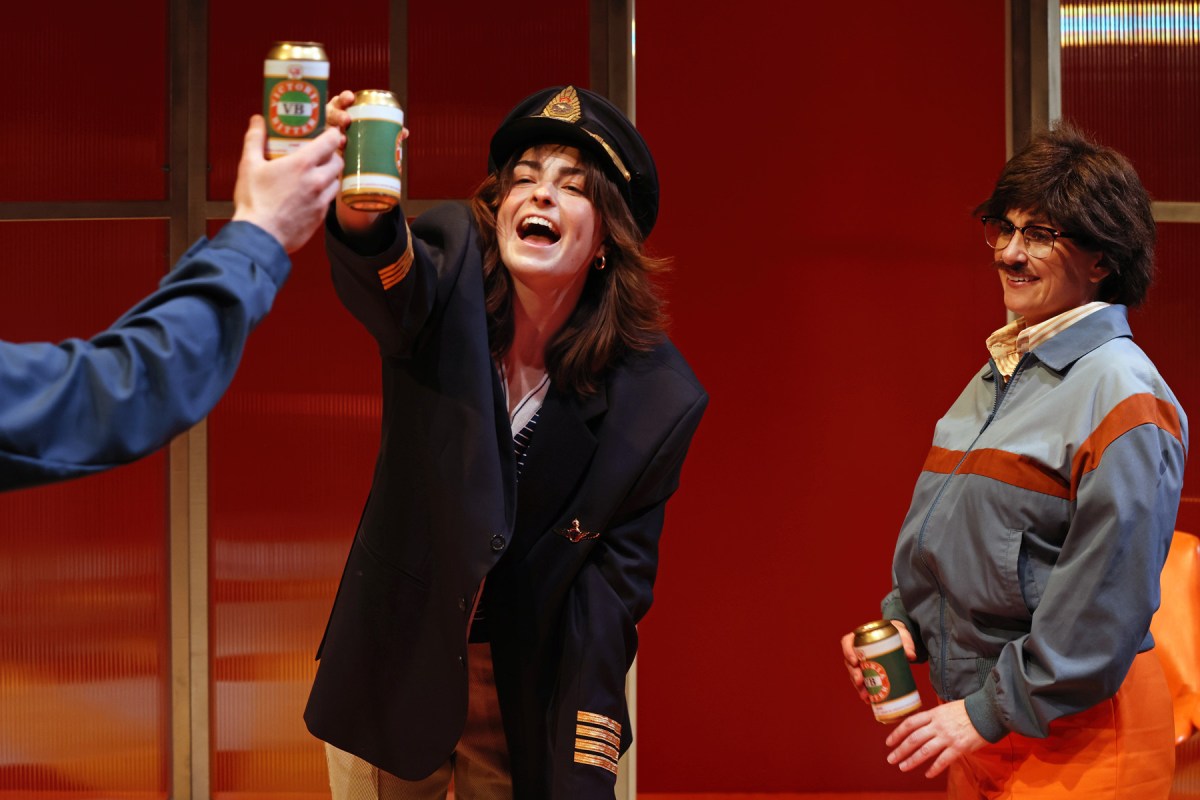
It’s a weighty topic but playwrights Genevieve Hegney and Catherine Moore (who also act in various roles) take a somewhat unexpected approach. Instead of the straight-up drama one might expect, they mine the situation for laughs.
It’s an approach that risks minimising a serious issue but it works well here; the ridiculous nature of institutionalised sexism proving fertile ground for hilarity.
Various aspects of the airline industry, especially the frivolity and campness of the cabin crew, also prove very funny. At times, the flight attendants recall the hijinks of Pam Ann, the alter ego of Melbourne-born comedian and satirist Caroline Reid.
The nostalgic appeal of air travel’s golden era
The airline setting and late 1970s era lends itself to fabulous visuals. Set and costume designer Grace Deacon excels with her creations, from crisp captain’s uniforms to air hostess outfits and the flared pants and bold patterns of the period.
Deacon’s use of an arrival/departure board over the set is a clever way to announce different times and locations, while lighting designer Morgan Moroney excels with his lighting choices, such as when flickering television sets depict news bulletins reporting the courtroom drama.
Five actors, 50 roles
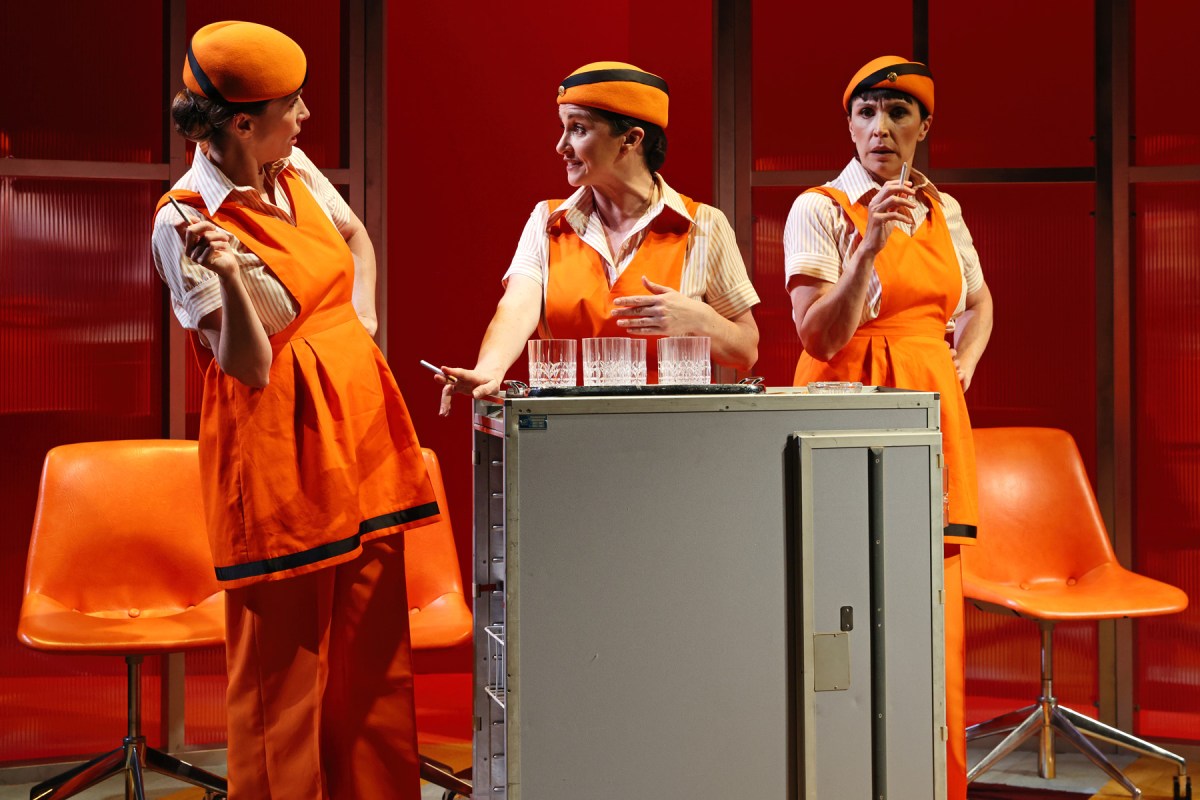
But at the heart of this tale, directed by Janine Watson, are the characters. There are an incredible 50 roles here, all played with aplomb by just five actors – Hegney and Moore, as well as Alex Kirwan, Cleo Meinck and Emma Palmer.
Meinck, who plays Lawrie, is the only actor with one role. The others play a multitude of characters, including businessmen, lawyers, flight attendants, journalists and Lawrie’s family members.
Read: Ensemble Theatre announces its 2026 season
Actors playing multiple roles can lead to confusion but that’s avoided here, with Deacon’s costumes and the actors’ talents ensuring that all roles are clearly delineated.
As the lead actor, Meinck deserves special mention. She’s onstage almost the entire time and perfectly conveys the rollercoaster of emotions as Lawrie navigates the world of courtrooms and media packs, while trying to hold together a marriage under extreme pressure.
A cinematic tale with potential
In fact, all aspects of this production excel, to the point where it is difficult to find any suggestions for improvement. The only one, perhaps, is that at almost two and half hours (including interval) it could do with some very minor trimming and tightening.
But even that’s debatable: the play remains compelling at all times, holding viewer interest throughout.
Having taken off, this world premiere production is likely to go on to achieve big things. With its timeless themes, nostalgic appeal and cinematic nature, it would be no surprise at all to see Fly Girl staged in revival for years to come, or even make the transition to become an iconic Australian film of the stature of Muriel’s Wedding, The Castle or The Adventures of Priscilla, Queen of the Desert.
You heard it here first: Fly Girl is going to travel very far and wide.