

Winner of the 2025 Tasmanian Literary Award, Johanna Bell’s Department of the Vanishing is the literary equivalent of a found-footage documentary about extinction, preservation, action and consequence.
Not quite a verse novel but something very close, this fictional archive combines poetry, documentation and imagery as crucial pieces of a wider puzzle. It begins with a [redacted] transcript of an interview between an unnamed detective and the book’s protagonist, Ava Wilde.
Department of the Vanishing review – quick links
Working in the Department of the Vanishing
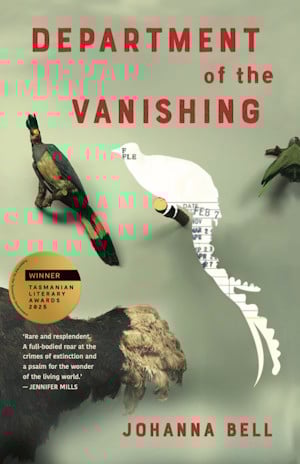
Subsequent pages reveal newspaper headlines, intra-departmental memos and restricted lists of extinct species, interspersed with Ava’s own writing. She alleviates her stress by preserving knowledge in the form of metaphor-infused poetry and an endless array of lists.
Department of the Vanishing isn’t a metaphor. It’s where Ava works as an archivist, cataloging extinct bird species for the purpose of preservation. This is a world devoid of birdsong, as more species than ever are succumbing to extinction. And yet, the Department of the Vanishing is shrinking. Without adequate resources Ava’s work feels Sisyphean, but she is determined to preserve what she can, while she can.
As a general rule, Ava is averse to sustained human connection. She prefers efficient short-term flings to anything that could threaten her contented self-sufficiency. That is, until explosive sexual chemistry acts as a combustible force on Ava’s life, reshaping the contours of her blinkered perception as she shifts from animalistic lust to dawning comprehension.
When signs of fragility appear, some people avert their eyes, but Ava holds hers open as she builds a tolerance to life, death and everything in between.
Ava in the archives
In the list-making spirit of the book, here are some facts about Ava:
- Ava writes lists
- And poetry
- She lives alone, in a single-room flat above a ‘massage parlour’
- Ava spends her days cataloguing extinction
- And experiencing climate anxiety
- Her mother is dying
- Her father is [redacted]
- What happened to the songs?
Despite the fragmentary structure of this novel, its skeleton holds firm. The beats are revealed gradually, emerging at perfectly paced plot points that deliver sustained narrative tension. Although the novel merges fact with fiction, Bell provides extensive information about her source material, which curious readers will appreciate.
Every page is a work of art unto itself, but this book is best consumed as a whole. The author expresses astute observations through the curation of her material as much as through the skilled brevity of her writing.
Some pages portray white words as negative space in a dark void. Others display impactful imagery, like a photograph of an albatross-carcass riddled with indigestible plastic. Obituary-style extinction poetry unfurls in neat newspapery columns. Cassette tapes appear as vehicles for mental time travel, or possibly conspiracy.
ArtsHub: All new Australian book reviews
Blending fact and fiction
Through Ava’s poetry, you will learn about avian co-parents who sing to their eggs. You will ponder the reflective nature of lyrebirds, and regret the utilitarian silence of canaries. You will notice the accumulation of layered meaning over the course of 300 or so pages, as you read facts about birds (that aren’t really about birds).
You will find yourself searching for clues in newspaper clippings, underlined words and circled phrases. You will become sensitive to potential double meanings, and you will trace invisible lines between the present, past and future.
To read this book is to undertake an exercise in esoteric mystery solving, in which the aim is not purely to ascertain the answers, but to ask the right questions.
There are unspoken questions running throughout Department of the Vanishing. What if we could turn back the clock? What might we do differently?
The reader’s subconscious might respond with more questions than answers. What is the present, if not the turned-back-clock of the future? What kind of future are we racing towards? What evidence will we leave behind, when the only remaining traces of us are the archival echoes of our irrevocable actions?
Department of the Vanishing does what speculative fiction does best: re-appropriates reality to emphasise core themes, which in this case circle extinction and preservation. The underlying narrative is a phenomenological exploration of real-world global consequence, squeezing a macrocosm of conceptual expansiveness into a microcosm of intricate subjectivity. And it’s beautiful.
The composition and curation of this fictional archive (the book itself) compels the reader to think factually and to recognise acts of intentional omission. Bell expertly embeds environmental influence through emotional, cognitive and affective engagement, enhanced by an aesthetic execution of unconventional structure.
Infused with sublime sadness, heartfelt humour, and an uncanny sense of precarity, Department of the Vanishing expresses ecological allegory through archival artistry. Its conceptual originality is further elevated by the emotional depth of Bell’s writing, making this book a monumentally memorable read.