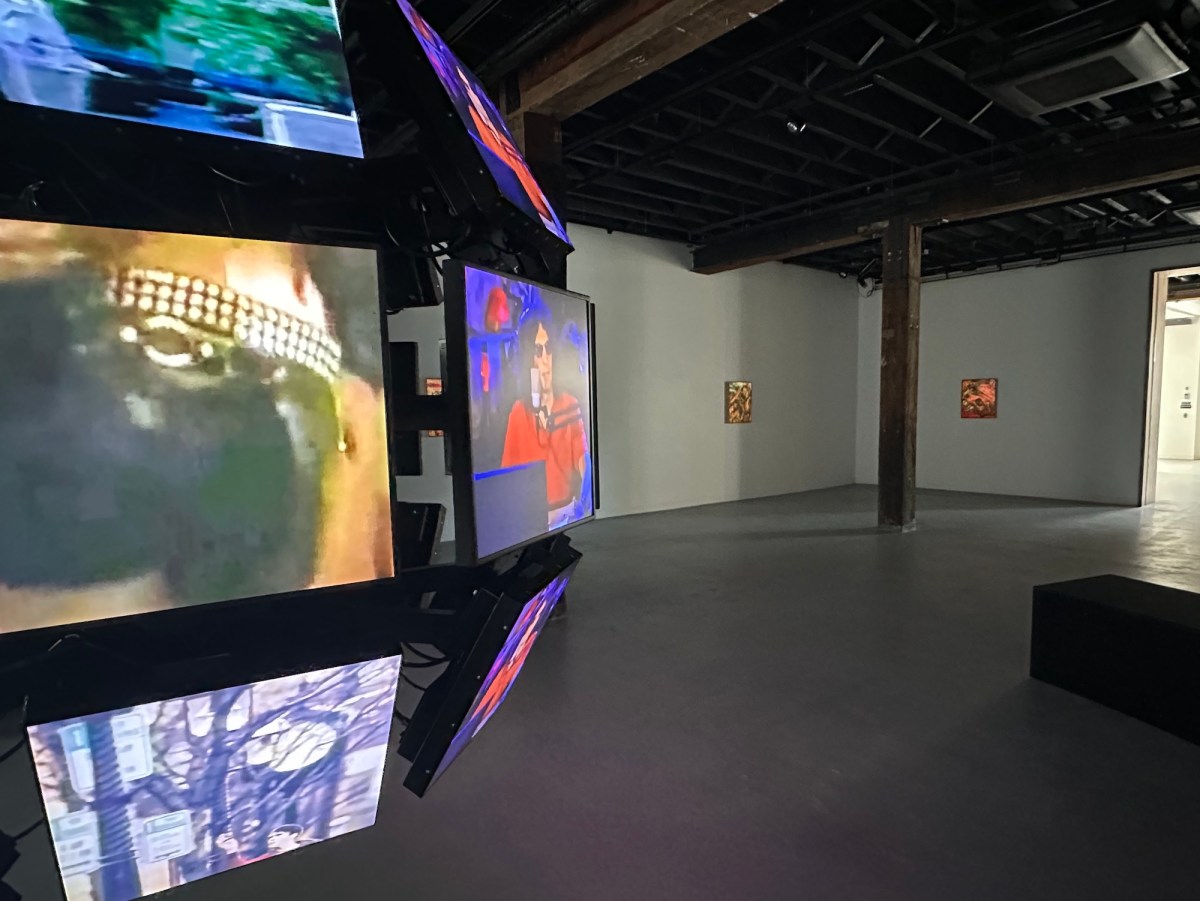
Safe Zone is a compelling exhibition that sees artist Christopher Kulendran Thomas using AI technologies to construct a rigorous narrative around thresholds of safety, jeopardy and trauma, and perceptions of usurped agency.
Sydney’s Artspace presents two bodies of work by the artist of Eelam Tamil-descent. They appear quite disparate at first, though common threads of a world unravelling and loss of control in the face of extreme trauma become immediately apparent. To our surprise the connection runs deeper and is less visceral.
Christopher Kulendran Thomas review – quick links
Questioning how we relate to history
Central in the darkened gallery at Artspace is a large hovering globe constructed from television screens. Titled Peace Core (sphere) (2024), this video work was produced in collaboration with Annika Kuhlman and co-commissioned by Artspace with WIELS in Brussels and FACT in Liverpool. It is a hugely ambitious piece that taps into a global zeitgeist – one that started in New York City just 10 minutes before 9/11 unfolded.
Around the walls are paintings that offer a similar kind of conceptual diarising, calling upon a more personal history of ethnic violence in the artist’s homeland of Sri Lanka. Both use AI technologies. The contrast is extremely considered and disarming.
While the media images of 9/11 are burned into our collective psyche, we know little of the 2009 massacre on a beach in Mullivaikkal, what is now Sri Lanka, which has been censored from recorded history, with no media accounts remaining in the public domain. Thomas asks where does truth lie between hypervisibility and undocumented accounts, especially when it comes to imperial or usurping structures of power.
It is an extremely erudite pairing, and as one spends more time in the space, these two worlds latch on to our emotions in their own way. This push-and-pull of narratives is heightened through the contrasting materiality. The paintings are heavily gestural, impasto works that tip from figuration into abstraction. They are exquisitely lit, and seeming held within their frames with an intensity of colour that magnetically holds the viewer. They almost feel hyper-real in their own way, punched into screaming hues.
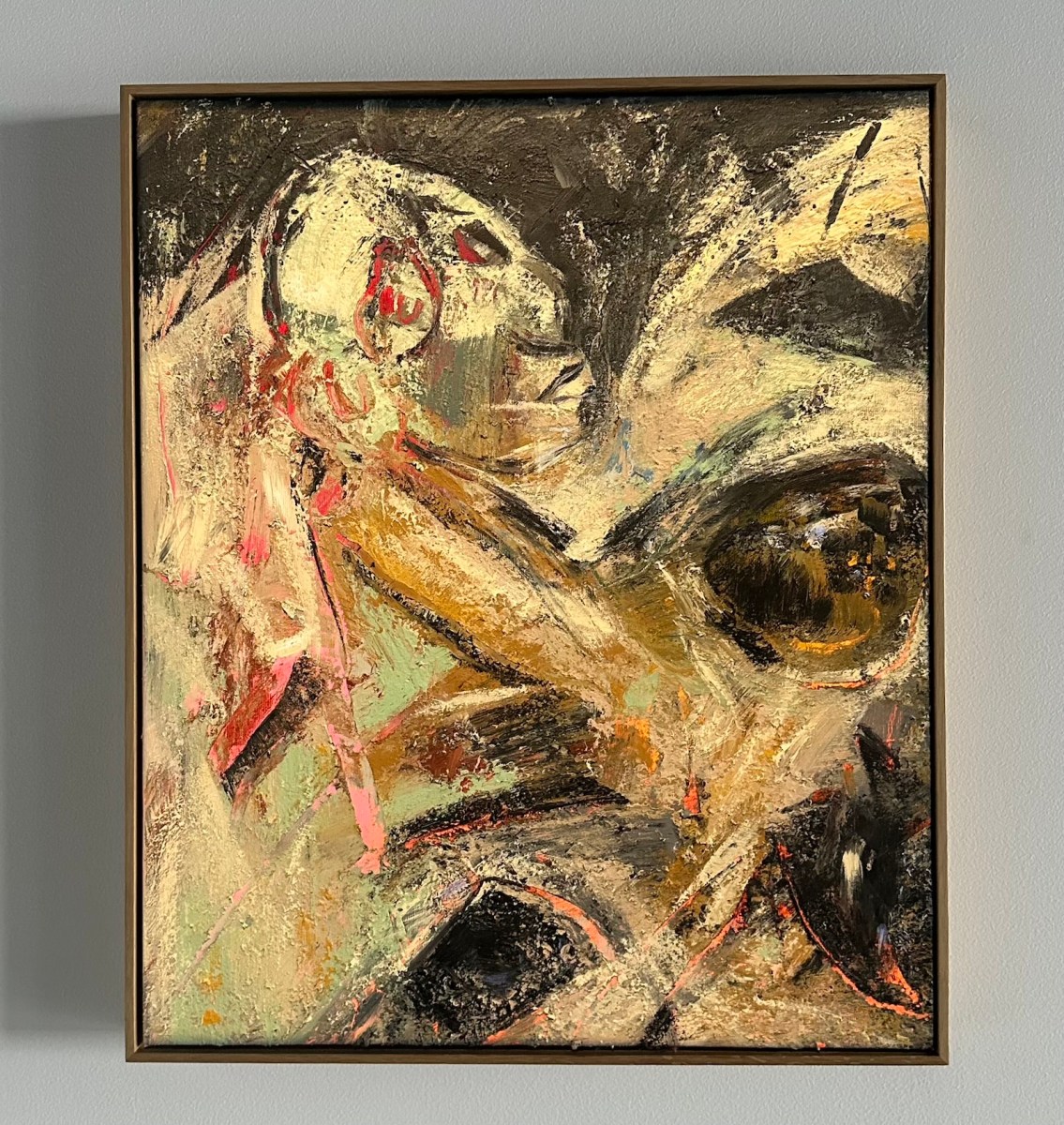
They have been composed using a neural network trained on the work of generations of Sri Lanka’s most well-known artists, who were influenced by the European modernisms brought to the island by British settlers, explains Thomas.
Read: Art and AI – 5 artworks leading the conversation this summer
He then translates those AI-generations by hand onto the canvas himself. That slide between past and present, analogue and AI, personal and public is so fabulously complex and rewarding for the viewer to consider.
In contrast, dominating the gallery’s main space, real footage from American television has been scraped for Peace Core (sphere), which is then continually auto-edited using a purpose-built AI algorithm. It is larger than life, overwhelming and hard to grasp – just like the event itself.
A portal to future thinking
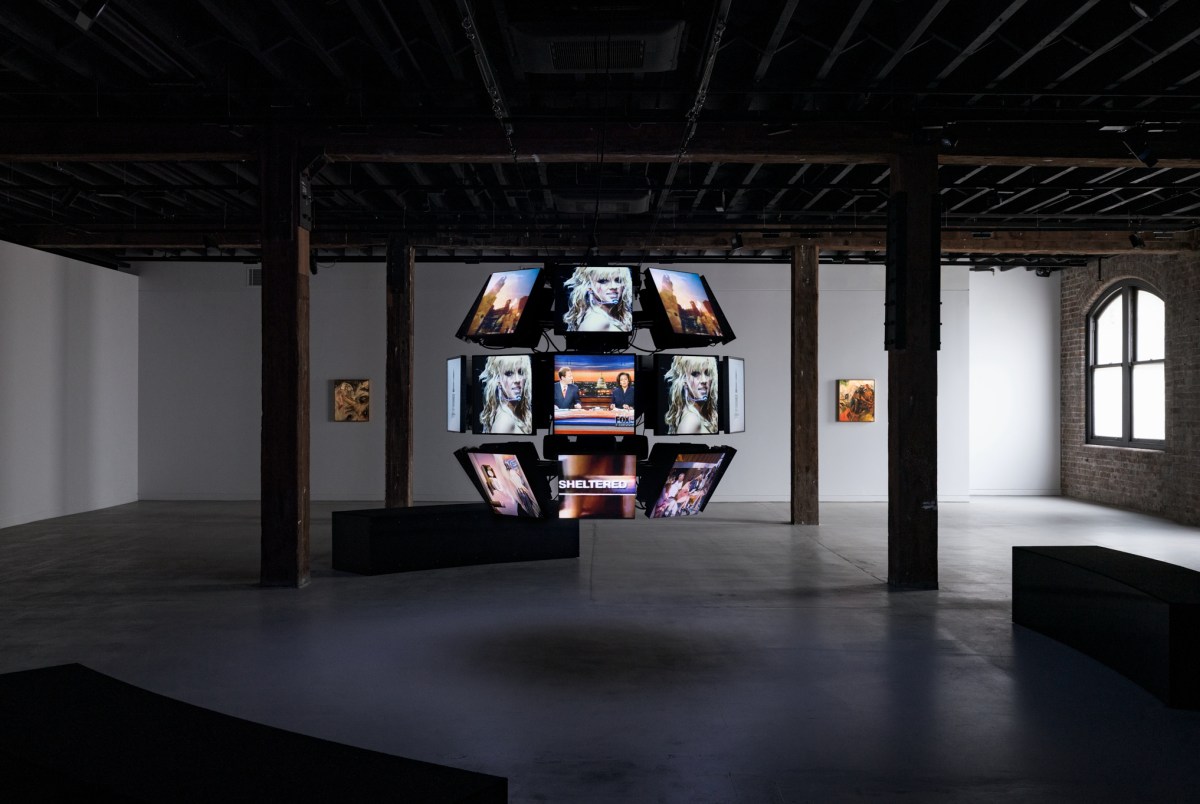
Overall, this is a highly emotive exhibition, and its sensitive display allows visitors to find their own recalibration of memory engaging with these pieces. Having lived through 9/11 as a resident in the United States, it captures the kind of hyper-tense anxiety of unknowing from that day. The paintings, similarly, are abstracted enough to conceptually play with the notions of lost memory, erasure and the suppression of histories.
Read: Clarice Beckett and Mirra Whale review: a shared vision across generations
While AI continues to dominate our conversations and critiques today, these piece by Thomas demonstrate so eloquently how one can work with the technology, while maintaining authorship and community in constructed narratives. In their pairing they also leave us questioning who gets to choose what narratives are told, and how.
This exhibition is definitely must-visit summer viewing, and offers a portal to future thinking about AI and art, without the hype.