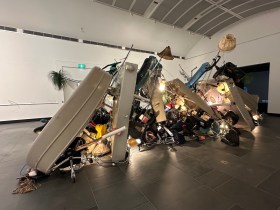
The Biennale of Sydney has never been an exhibition easily consumed. Its footprint has increasingly sprawled across the city, demanding time, travel and a willingness to move between very different architectural and curatorial contexts.
For its 25th edition, titled Rememory, that sprawl stretches further with the inclusion of Penrith Regional Gallery and Campbelltown Arts Centre – both about 45 minutes from the CBD.
On one hand, this expansion has clear benefits. More diverse audiences get a meaningful ‘taster’ of a major international exhibition, often for the first time, and that impact shouldn’t be underestimated. Yet the trade-off remains: very few visitors will see the full exhibition as conceived by its Artistic Director.
Opinions will always divide on whether such dispersal dilutes the curatorial vision or reflects responsible decentralisation in our times. But deeper concerns shadow this edition – questions about leadership, financial stability and the biennale’s broader trajectory as an exhibition model.
ArtsHub’s review will unfold in two parts. In this review, the first, we look at the city venues – the Art Gallery of New South Wales, White Bay Power Station and the Chau Chak Wing Museum at the University of Sydney. A second instalment by writer William Winter will examine the exhibition’s western outposts. Two voices, two perspectives, and several questions left hanging.
Biennale of Sydney CBD venues – quick links
Artistic Director missing in action
Rememory takes its title from Toni Morrison’s writing on the persistence of memory and historical absence. Artistic Director Hoor Al Qasimi describes the exhibition as illuminating ‘the overlooked and forgotten histories upon which the world is built’. Yet Al Qasimi herself was notably absent from the exhibition’s media preview.
The explanation offered was that the focus should remain on the artists. While admirable in principle, the role of an Artistic Director is not simply to assemble works but to articulate a framework – to direct the connective tissue between them. Without that voice, the exhibition’s intentions feel oddly distant.
This absence feels particularly strange given the significance of Al Qasimi’s appointment. As the first curator of Arab heritage to lead the biennale in its 50-year history, her perspective broadens the exhibition’s global lens, introducing many artists from the Arab world to Australian audiences.
Her curatorial premise echoes the postcolonial space articulated by the late curator Okwui Enwezor, who’s documenta11 exhibition of 2002 arguably recalibrated the biennale model. However, I am not sure whether she advances us any further with her exhibition. It’s just updated to the current day.
The exhibition reflects a broader shift across international biennales: fewer headline-grabbing installations and more practices grounded in archives, oral histories and community knowledge. Work after work engages with experiences of trauma, erasure and resistance. It’s a welcome recalibration in many respects. Yet encountered in such density, the exhibition loses a level of nuance.
Yes, these are difficult times globally. Indeed, war rages in Al Qasimi’s homelands at the time of the exhibition’s opening. But this cumulative weight can overwhelm rather than illuminate.
What stood out at White Bay?
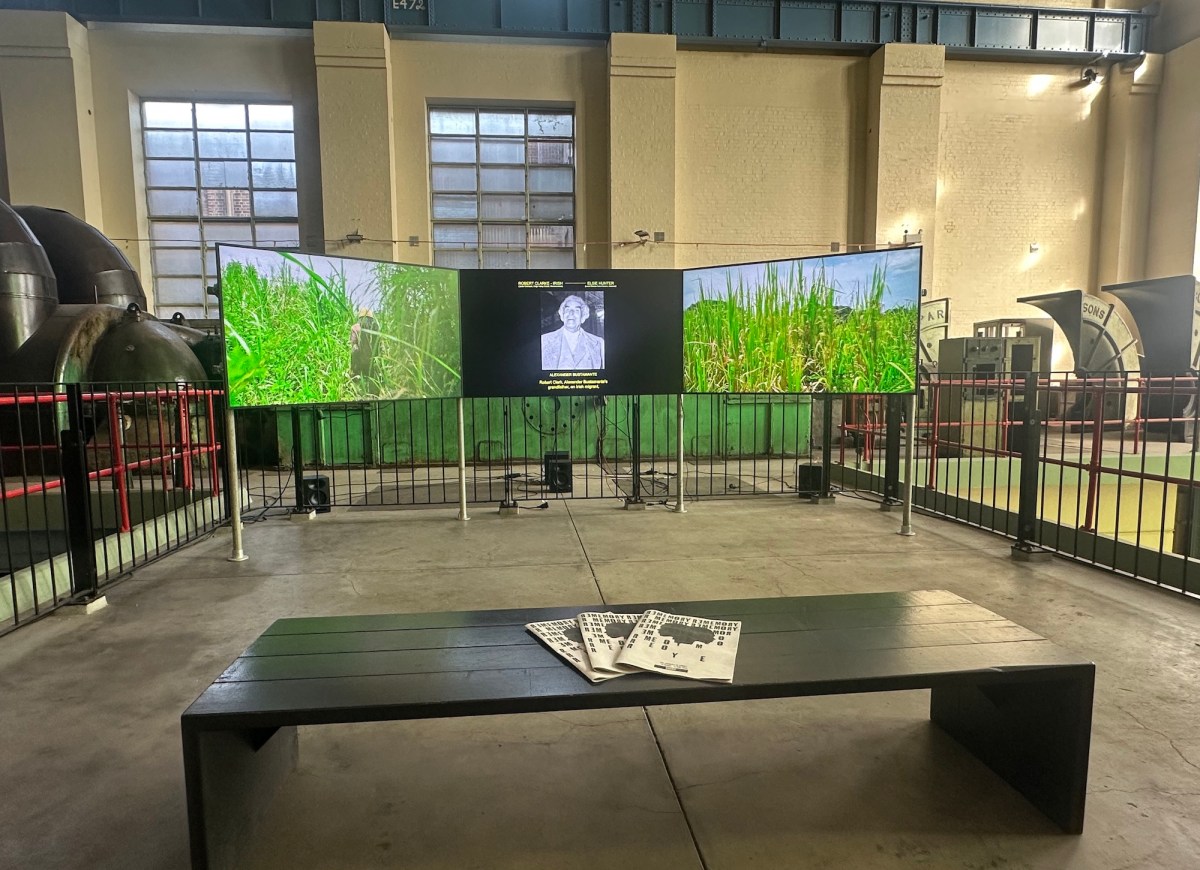
Nowhere are these tensions more visible than at White Bay Power Station. Once spruiked as Sydney’s answer to the Turbine Hall at Tate Modern, the venue is impressive but deeply difficult to curate.
Unlike the vast cleared volume of Tate’s Turbine Hall, White Bay remains cluttered with industrial infrastructure. Artworks compete with the architecture and are easily dwarfed by it.
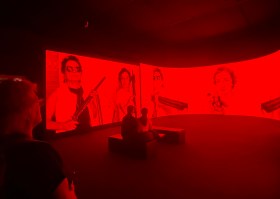
The solution here appears to be an abundance of moving image. Around 30% of the Biennale overall is screen-based work, much of it concentrated at White Bay with works by artists including Chen Chieh-jen, Natalie Davey, Frank Sweeney, Bouchra Khalili, Marianne Keating, Bertille Bak, Carmen Glynn-Braun and Emily Jacir.
Some works run close to an hour and their content is dense. For audiences, that’s a significant ask. Screen-based works are an economical way to occupy space, but the cumulative effect can be fatiguing, and partial viewing is not enough for many of these works.
What’s missing are the large-scale works that once defined the biennale – those moments of visual astonishment that reset the viewer’s senses. Walking through White Bay, one wonders whether financial constraints have quietly reshaped the exhibition, and whether the persistent push to use raw industrial spaces is doing the event a disservice?
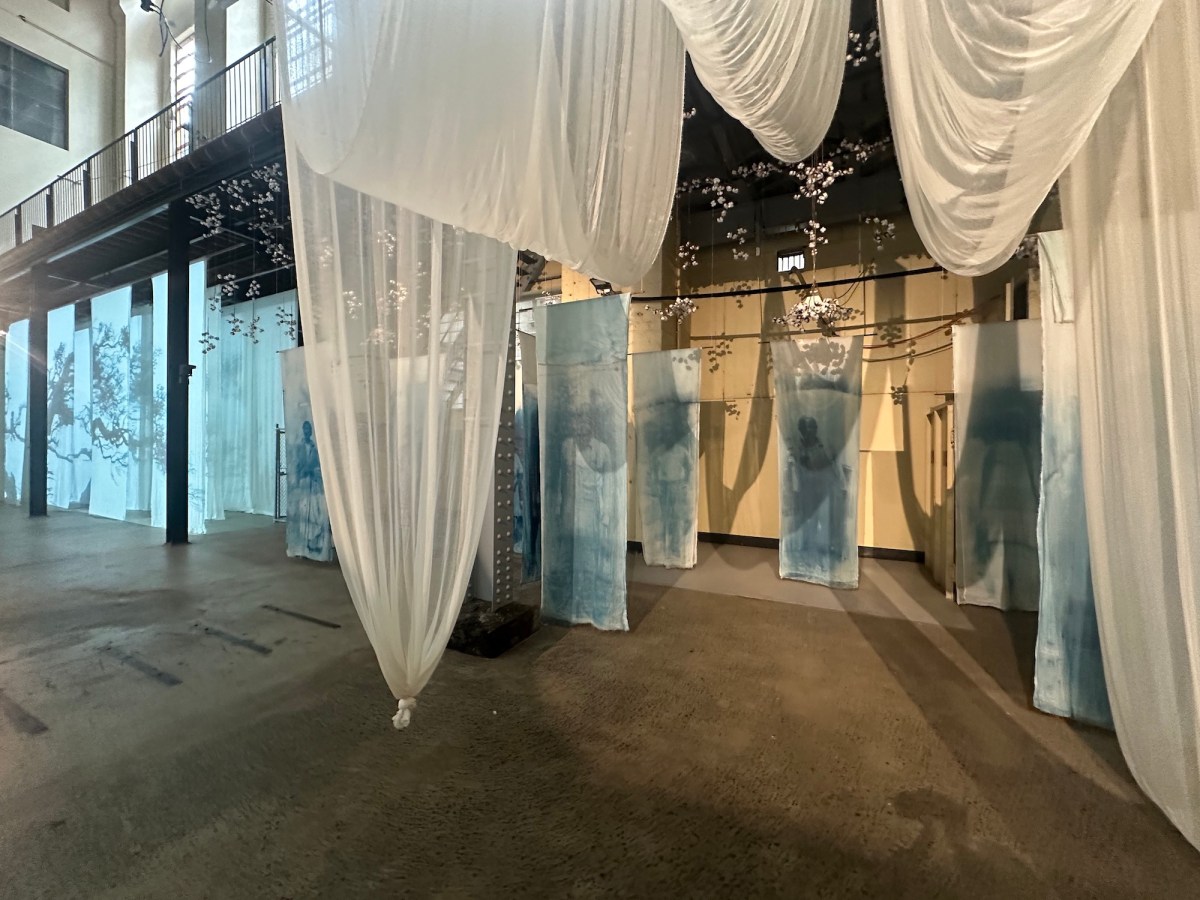
Yet there are standouts here. Nikesha Breeze’s expansive installation Living Histories anchors the double-height space with quiet authority. A towering fabric column referencing the African baobab tree stands amid ghostly projections on translucent scrims and a small timber shack evoking the fragile architecture of memory, drawing on firsthand accounts of enslaved African Americans.
Peter Kennedy’s layered installation, incorporating sound, objects and historical records, rewards slow looking and resonates with the site’s industrial character.
Other works benefit from more intimate spaces. Cannupa Hanska Luger’s VOLUME III (2026) positions dramatically lit ceramic skulls within bunker-like cavities. Daisy Quezada Ureña’s porcelain and fabric lanterns hover like fragile suspended memories. Guatamalan artist Edgar Calel’s 18-metre golden textile also brings a sense of hand and humanity into this venue.
Elsewhere, the presentation of Yolngu artist Gunybi Ganambarr’s work feels awkward, placed on freestanding white walls that mimic the neutrality of the white cube but are also dwarfed within the cavernous space.
AGNSW delivers the biennale’s ‘wow’ moment
If White Bay feels raw and restrained, AGNSW provides a more familiar gallery experience. Spread across its two buildings, the exhibition finds its strongest footing in Naala Badu, while the old building feels more like a secondary addition. Centralising the exhibition would have offered a stronger impact.
Among the highlights are Eritrean artist Nahom Teklehaimanot’s airbrushed assemblages, This Is My Silence, You Name the Sound, which map the psychological terrain of migration through floating fragments of bodies and archival imagery.
Nearby, Australian artist Abdul Abdullah revisits the Cronulla riots, two decades on. His paintings stage their violence with deliberate intensity. Abdullah frames the works as acts of memorialisation, yet the imagery offers little space for reconciliation. Instead, the canvases confront the viewer with unresolved anger – a reminder of how recent and raw those tensions remain.
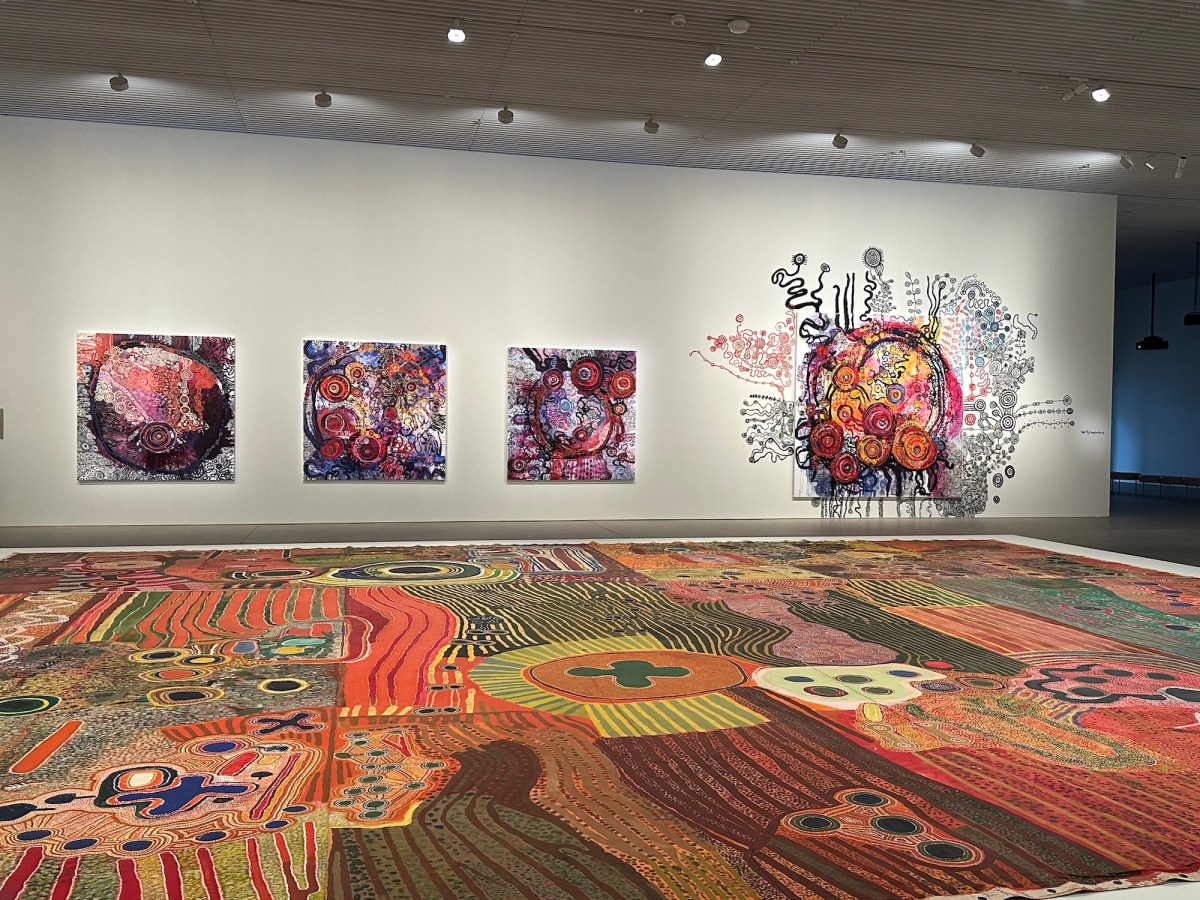
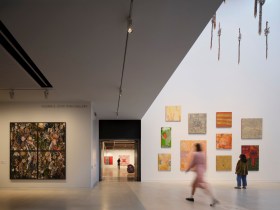
The gallery’s new building also hosts a powerful concentration of First Nations works. The monumental Ngurrara Canvas I, by the collective Ngurrara Artists fills the space with extraordinary scale. Visitors walk around it, unable to take in its entirety – much like the layers and collective narratives that underly Country. Its viewed with a painting by senior Amata woman Yaritji Young that pushes beyond the edges of the canvas.
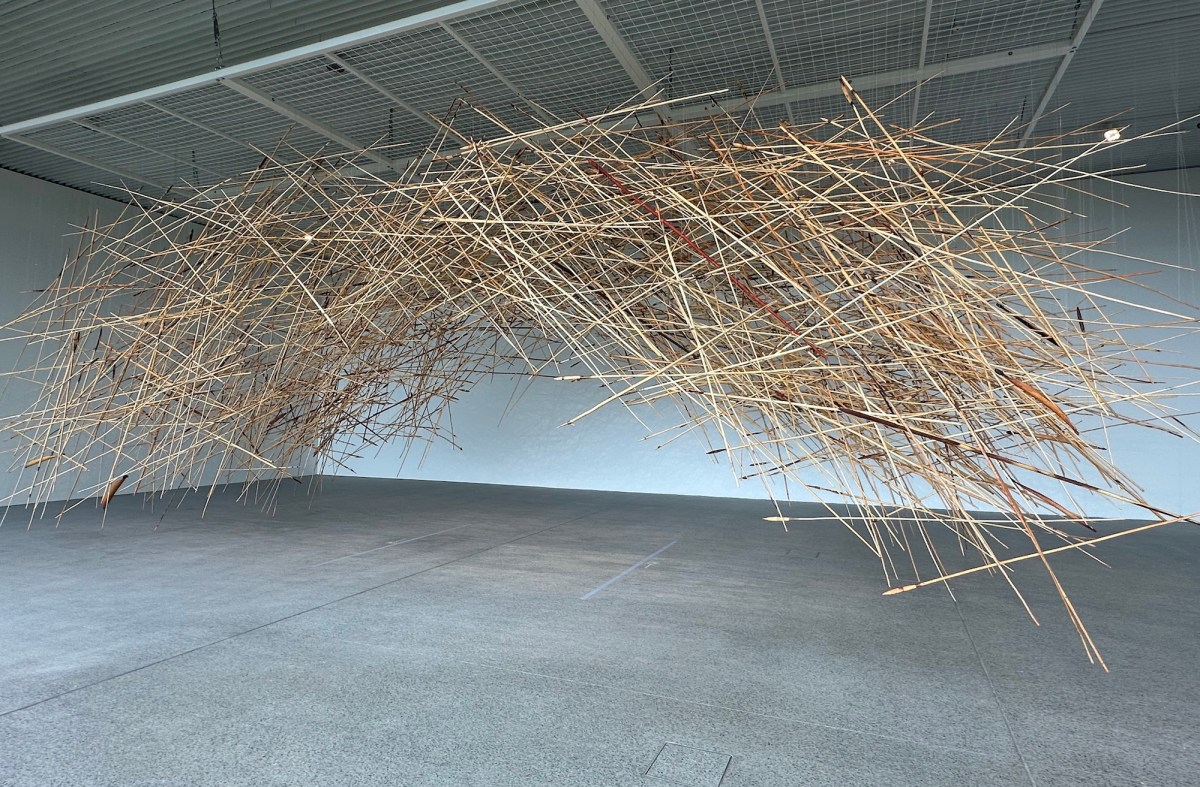
Nearby, the collaborative work Kulata Tjuta (many spears) returns 15 years after its first presentation at Tarnanthi in Adelaide. More than a thousand handmade spears hover in suspended formation, referencing both hunting traditions and the ongoing struggle for sovereignty.
The current display, however, lacks the controlled dramatic lighting that has made this piece so powerful in past presentations. Here, it’s washed out by natural light coming off the harbour, offering its own symbolic charge.
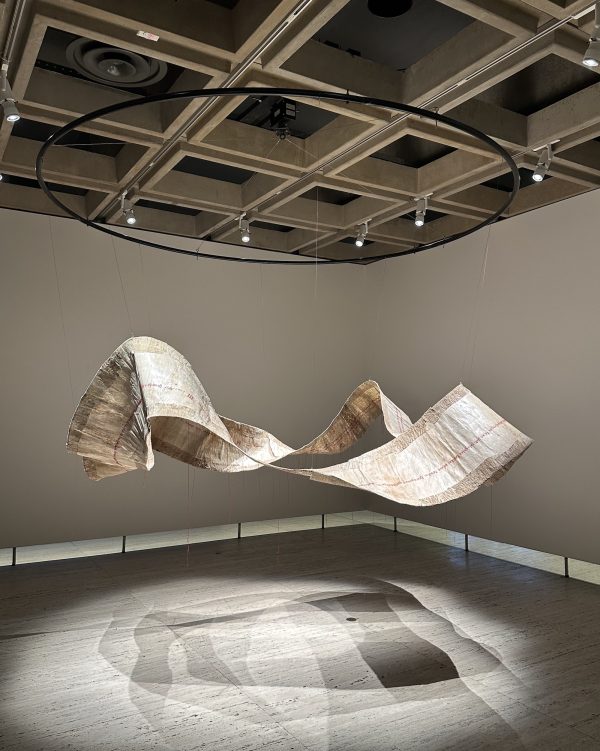
In the old wing, Taiwanese artist Chang En-Man’s The Future Is the Past, the Path to the Ancestral Spirits (2026) suspends a circular ring of mulberry bark embroidered with Palwan Indigenous texts. Slowly rotating in the air, the work casts shifting shadows that invite quiet contemplation.
Nearby, Palestinian artist Taysir Batniji presents an installation of olive-oil soap bars stamped with an Arabic phrase of comfort, translated ‘No condition is permanent’. Visitors are invited to take one away, turning the work into a small gesture of shared fragility while quietly pointing to histories of displacement and erasure.
Sensitive placement makes sense of museum context at Chau Chak
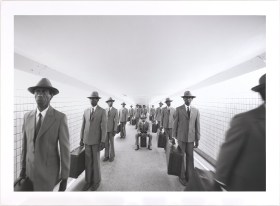
At the Chau Chak Wing Museum, the Biennale of Sydney finds some of its most thoughtful dialogues with institutional history. Pieces are presented across three floors, though two strong video works on the lower level are easily overlooked: Michael Rakowitz’s Special Ops Cody, where a toy action figure breaks into a museum vitrine to meet its ancient inhabitants; and Niamh McCann’s performative video Hairline Crack.
Upstairs, Warraba Weatherall presented wall-based sculptures resembling church confessionals, whose latticed surfaces obscure Indigenous cultural materials within. Painted a muted suburban grey, they quietly critique institutional control over cultural knowledge and are well placed in this museum within a learning institution.
Palestinian artist Khalil Rabah’s textile Common Threads also disrupts the museum narrative. Recreating the design of a Byzantine church mosaic floor discovered by Australian soldiers during the first world war, Rabah renders it in Palestinian tatreez embroidery – reclaiming a fragment of cultural heritage displaced by colonial collecting.
The work resonates strongly in this context. The floor was removed from Palestinian land and now forms part of the Australian War Memorial’s collection in Canberra. Rabah quietly exposes how museums continue to hold evidence of contested histories.
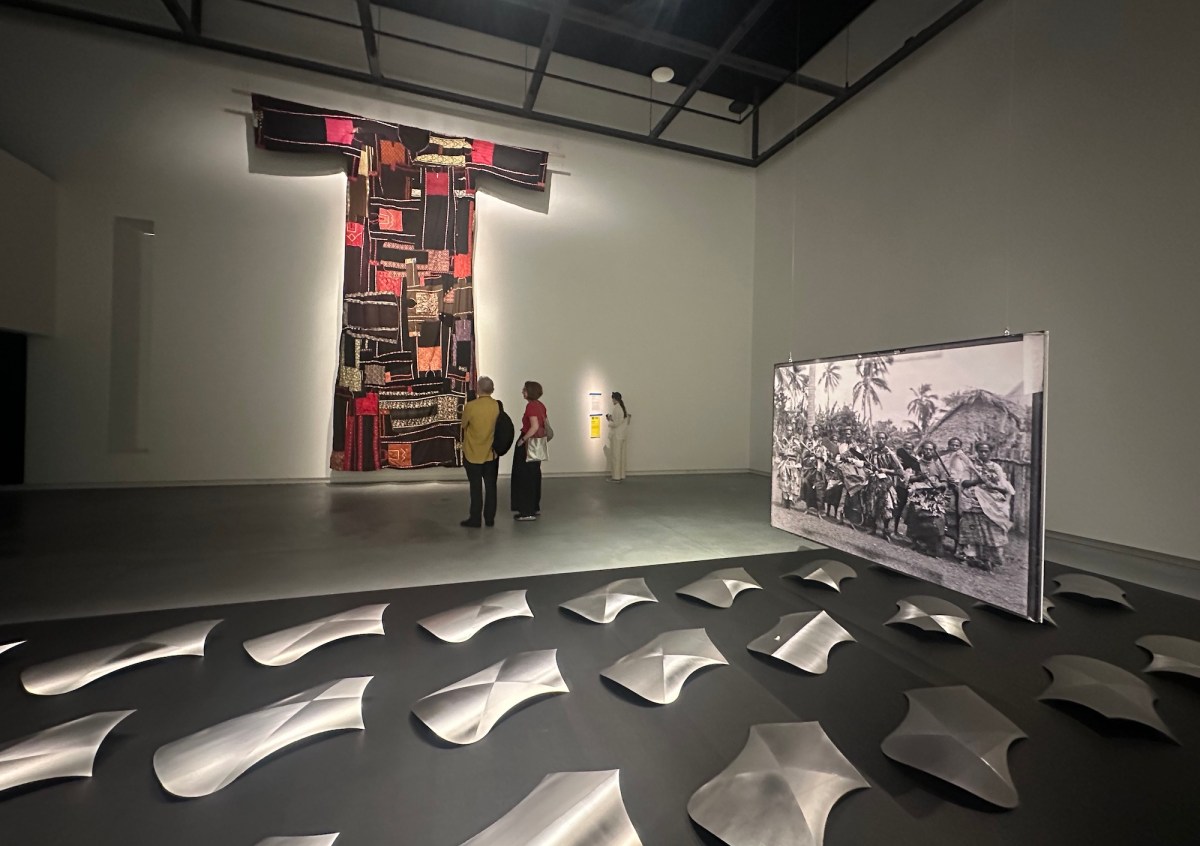
Nearby, Aotearoa artist Benjamin Work’s PÁPAAKI (2025) arranges tin dance paddles across the floor according to ancestral choreography. Suspended above them is an archival photograph showing a fusion of traditional and Western dress. Together the elements speak to the persistence of culture even as it adapts to changing worlds.
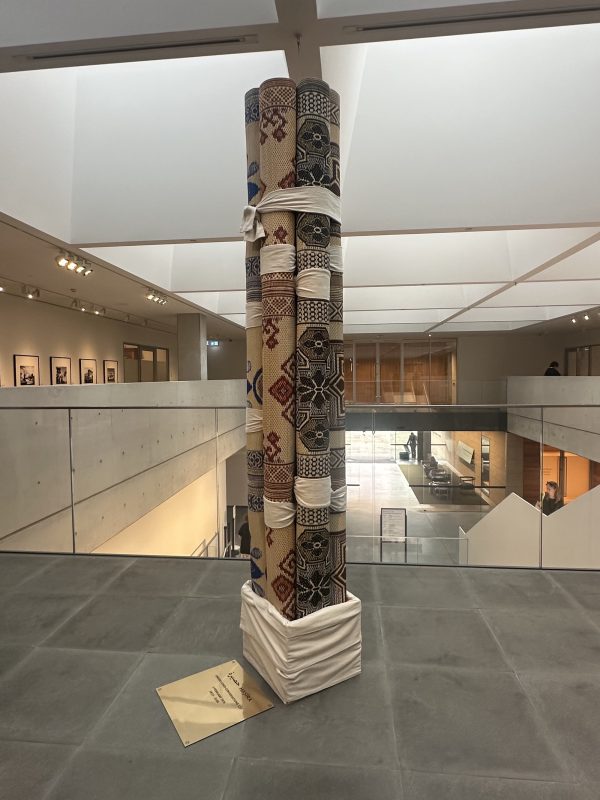
Also notable is Hașĩra by Sandi Hilal and Alessandro Petti (founders of Decolonizing Architecture Art Research), comprising columns of woven mats used for gatherings. Each is marked by a numbered ‘undisclosed conversation’, held in Sydney. It is a reminder how objects carry memories and histories that run far deeper than their surface engagement.
A fragmented future?
The Biennale of Sydney increasingly feels less like a single exhibition than a constellation of scattered fragments. Its political commitments are clear and often compelling, but encountering them in such density can be overwhelming.
Perhaps this reflects our moment: a world saturated with histories demanding recognition. Yet questions remain about whether the biennale format can sustain this model without losing its ability to engage audiences – and funders.
The impression lingers that the Biennale of Sydney might benefit from contracting into a smaller, more focused project rather than stretching across an ever-expanding set of challenging venues.