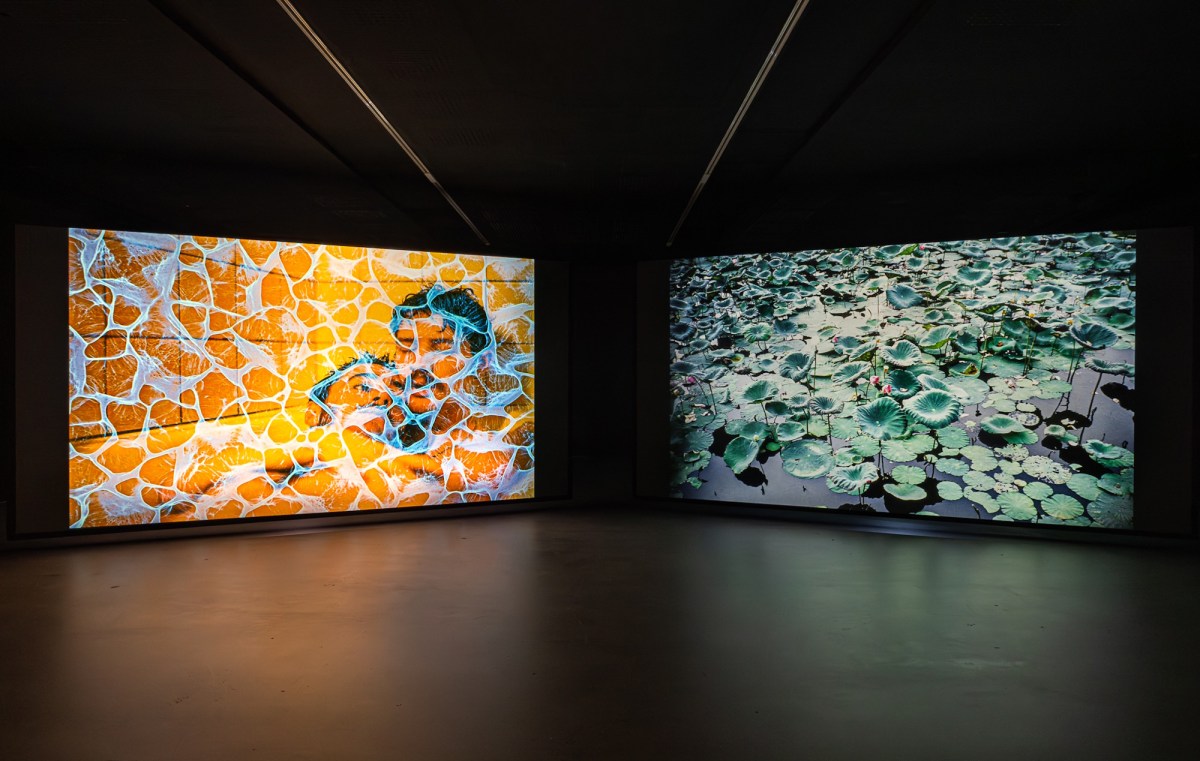
Recording our memories is ‘a battle against death’. At least, that’s according to the narrator of 1956 French documentary Toute la mémoire du monde, which the UNSW Galleries exhibition All The World’s Memories has taken as its namesake.
Curated by UNSW Galleries Director José Da Silva, the show of 10 artists from Australia and Aotearoa New Zealand asks essential and engaging questions around this battle.
What do we choose to remember and to forget? Do we each choose, or is it chosen for us? How reliable are our memories, and what is lost when human experiences are abstracted into an archive?
All the World’s Memories review – quick links
Personal, cultural and institutional histories
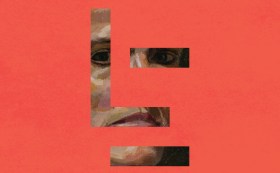
All the World’s Memories takes place across both floors of the art school’s Paddington exhibition space, with a large scale typographic paste-up by Nick FitzPatrick dominating the foyer while screens from the printing of Desmond Woodforde’s symbol-laden artworks draw one’s eyes up the stairs.
Across nine rooms and foyers, most artists have their own space to explore ideas of memory – and they do so with unique perspectives, whether looking at institutional, cultural or personal histories.
It would be easy to be cynical about an exhibition centred around the idea of memory, which has the potential to be so vague as to mean nothing at all. To Da Silva’s great credit, the show is a cohesive and thoughtful journey, as each artist takes on the complicated, imperfect nature of memory.
Who decides what makes history?
In the short film that Da Silva takes as a jumping-off point, the French national library is a site where memories are abstracted from reality and then presented back to the public through an institutional authority. As a monument to the ambition to document and record, the library is also an affront to the totality of human experience. That can’t be all there is.
If the library is memory as dictated from above, All the World’s Memories presents our understanding of the past as a negotiation at the grassroots level, comprising multiple perspectives that don’t pretend to be authoritative.
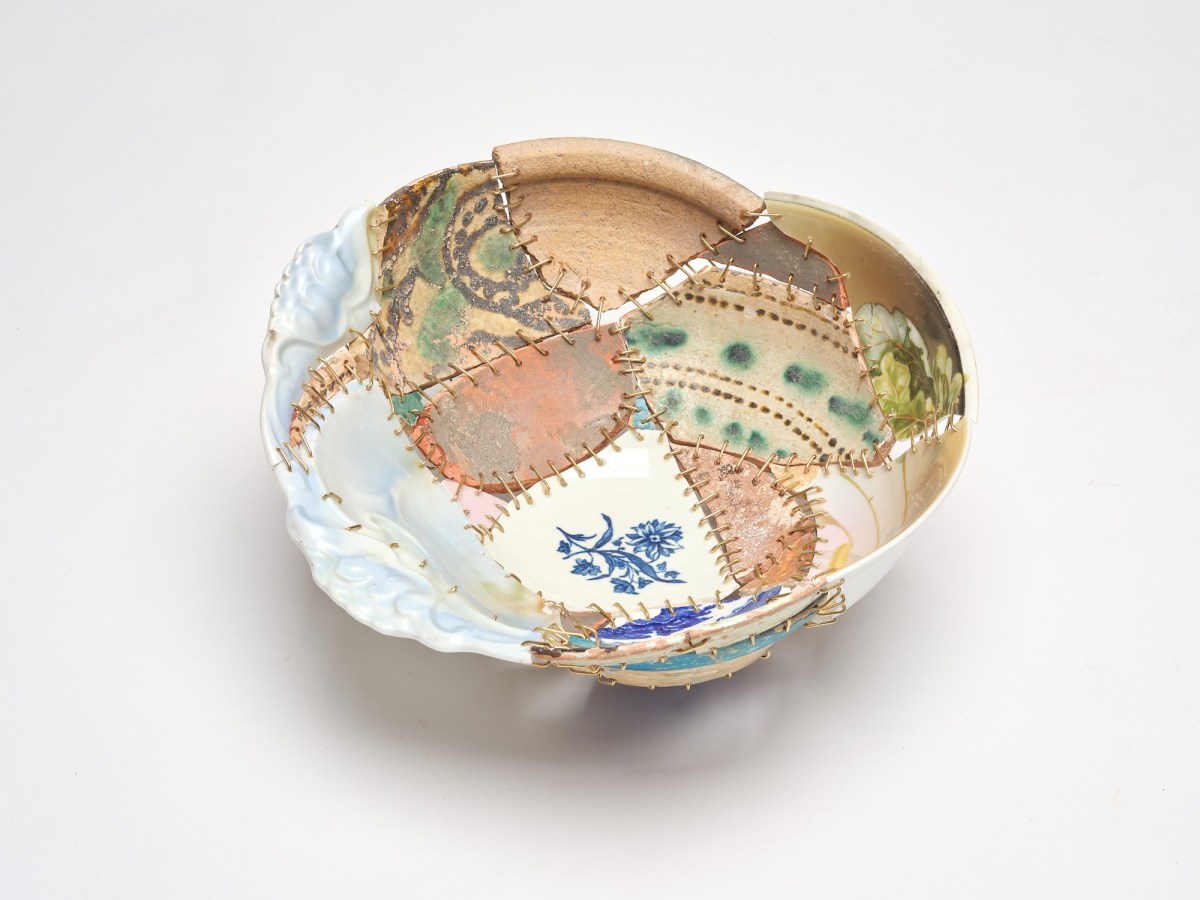
One of the first rooms viewers encounter in the show houses the work of Auckland-based artist Zac Langdon-Pole, whose ceramic pieces are a patchwork of histories. Brass staples hold together fragments of bronze age pottery, 1930s German porcelain and shards from a 7th century Islamic caliphate.
The three bowls on display are imperfect and full of gaps, but you see a more broad and deep history in each one than any of the original ceramics would have held on their own.
Langdon-Pole’s works feel like a reclamation, and stand in stark contrast to the historical amnesia highlighted in Matthew Harris’ seven-part canvas series Consigned to Oblivion (2023). Harris’ work reads as a mass of archival boxes of differing sizes, neatly organised and entirely unlabeled.
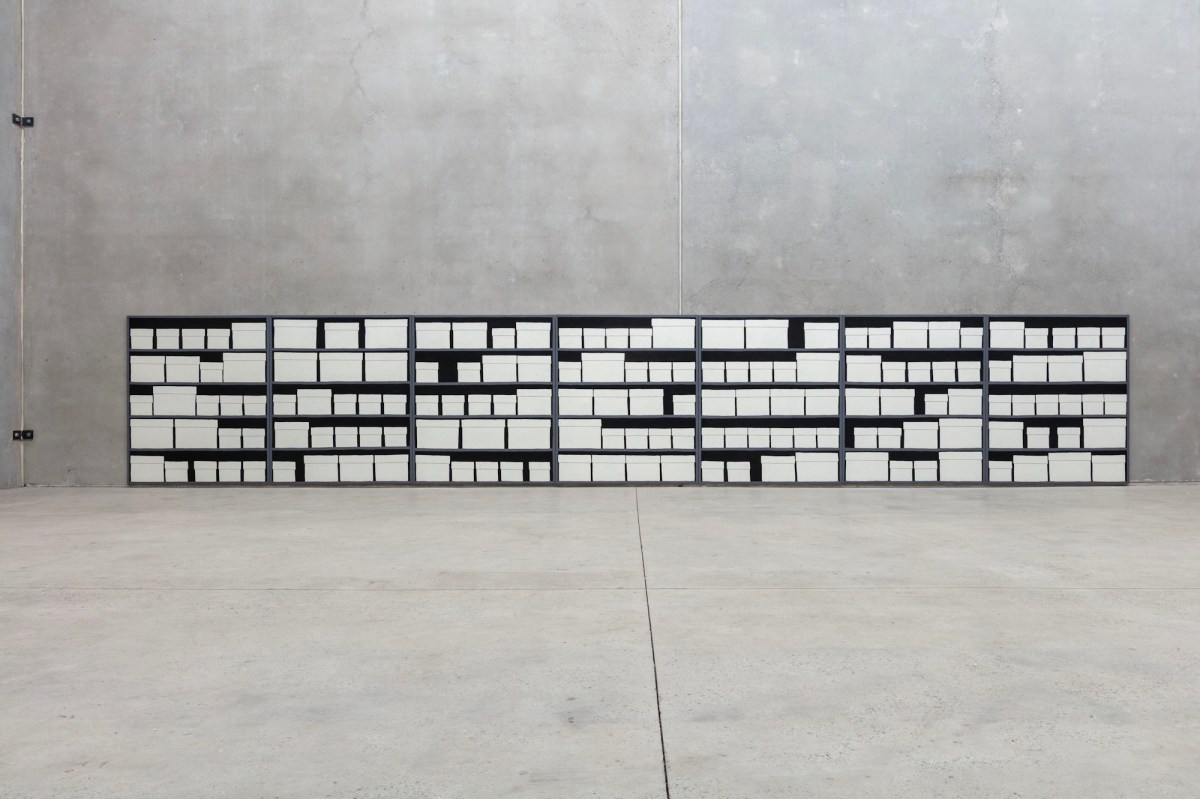
The canvases, flush against the floor to give the impression of shelving units, present institutional archives as entirely inaccessible. In Consigned to Oblivion, ‘history’ is understood not just as the past, but also through one of its secondary definitions: something finished, gone.
Refusing to forget
The personal and collective memories of the show’s artists claw back control over history in a rejection of this amnesia.
In the gallery’s largest space, almost two dozen prints from Pat Hoffie depict horrific scenes all too familiar from newspapers and newsfeeds. Through her etchings, Hoffie says she sought to ‘decelerate’ images of death and destruction in Gaza, which seem to constantly be overlaid in our minds and on our screens with fresh scenes of horror.
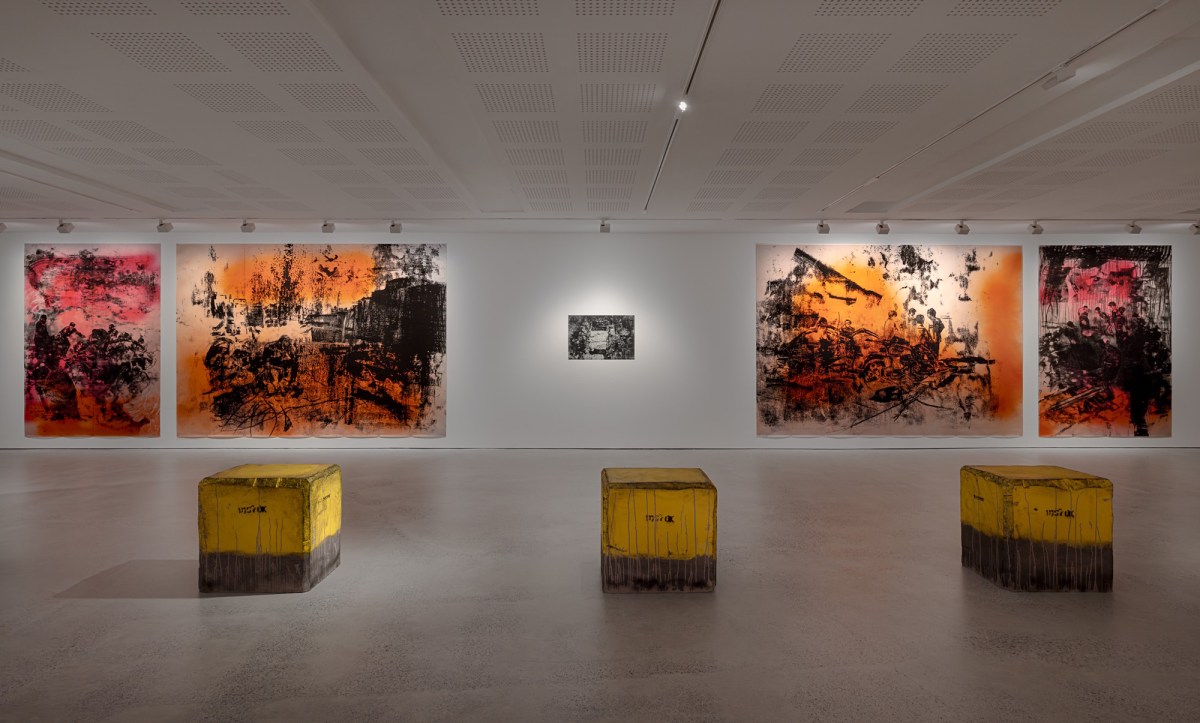
Hoffie’s scratchy rendering of each scene forces the viewer to slow down and identify each element: bombed building, children, body bags.
Remembering and forgetting are political, and the photomontages of J Davies echo this sentiment on the personal sphere. Across two screens in a darkened room, a series of what feels like hundreds of intimate flash photos are presented in alternating succession.
The life of Davies and the queer community around them is shown in all its playful glory, from sex toys and unmade beds to white powder and rolled-up notes, arms wrapped around bodies in bedrooms and on dancefloors.
The confessional scenes feel like a privilege to be given access to, reading as photos taken by someone in love with their community and who wants the world to know. All the World’s Memories is an impressive exhibition in the scope, depth and emotion of its memory, and will be very hard to forget.
All the World’s Memories continues at UNSW Galleries in Paddington, Sydney until 3 May. Entry is free.

This article is published as part of ArtsHub’s Creative Journalism Fellowship, an initiative supported by the NSW Government through Create NSW.