
Some years ago I was living in Copenhagen when a colleague took me out one lunchtime and introduced me to a new vice.
One of the local antiquarian book dealers was selling hundreds of 18th- and 19th-century books in a ‘Dutch Auction’: all the books are the same price, and every day the price goes down a little. Buy too early and you might miss a bargain. Wait too long and you might miss out altogether.
My shelves are still full of books I picked up at these sales. I’ve not read most of them, but what of that? The thrill was in the finding, not the reading.
I suspect these were mostly books that nobody wanted, but which were too good to simply throw away. Around the world, old book shops, libraries, and warehouses are full of books like that.
Lately, however, some of these books are being put to a new, highly controversial use.
AI training destroying old books – quick links
The great AI book buy-up
It takes a vast amount of training data to put the first ‘L’ in Large Language Model. But the internet is now so full of AI-generated text that scraping websites to train LLMs results in a sort of cannibalism, and ultimately ‘model collapse’.
So AI companies have begun buying up old books to train their bots. That’s controversial enough, but what’s really causing angst is that they do this in a way that destroys the book. Anthropic’s ‘Project Panama‘, for example, bought up two million books and then literally sliced them up, scanned the pages, and pulped the remains.
This practice strikes many of us as the worst kind of sacrilege. But is it actually wrong? (Spoiler: yes, but I’m not going to make it easy.)
Recycling or vandalism?
Authors know the thrill of handling that first copy of their book. Months or years of effort suddenly arrives in the mail crystalised into an elegant physical object. Books have weight and take up space – and that’s exactly as it should be.
Yet books have to go somewhere. Many languish in op shops and other places where cheap old books come to die. We might think every book deserves to live out its days in a library somewhere, but there will always be more books to store than most libraries have space to keep them. A working library collection needs to be ‘weeded’ from time to time to ensure it can still meet its mission, even if doing so often causes an outcry. And while some retired books can be rehomed, many cannot.
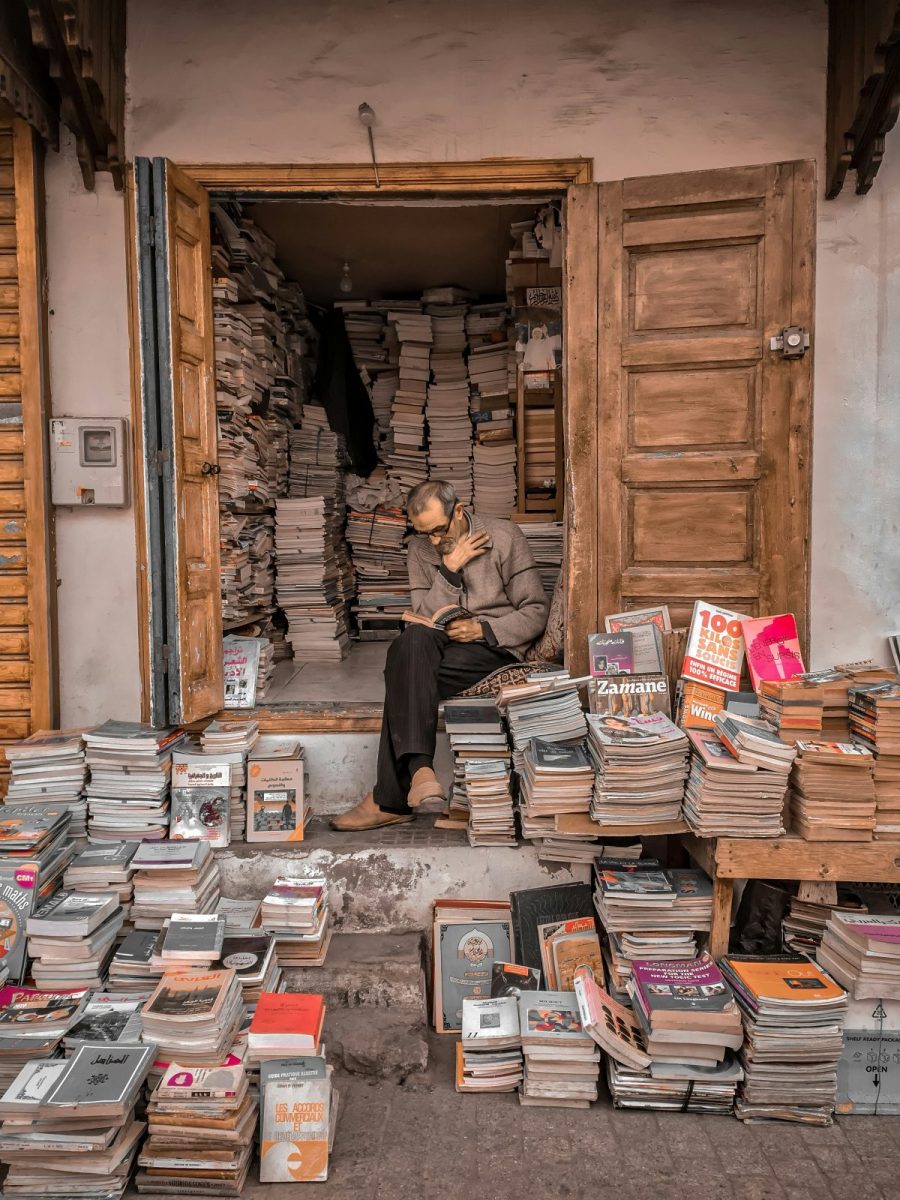
If you can somehow set aside all the other ethical problems with AI, using at least old books for AI training could be considered better than simply throwing them out. At least the book gets some final use before it’s recycled. And in an era when bookstores are increasingly endangered, AI training has been a sudden financial fillip for booksellers – even if, as one company facilitating the practice puts it, ‘the optics problem is real‘.
Valuing books
The question here is not simply one of ‘optics’, however, but of symbolic value.
We do need to be wary of the fetishisation of books. I have colleagues who scribble notes in their books, highlight and underline them, bend the spines back. It makes me wince. How can you treat these sacred little objects with such disrespect? But books are meant to be read, and reading a physical book is always at least mildly destructive. Only unopened books are pristine, and nobody writes books so they can stay unread.
The problem with destructive scanning is not that books have a special charismatic magic to them (even if for many of us they do) but rather the reason why it’s done. Project Panama didn’t destroy the books because they had no further use otherwise. It destroyed them to ensure their actions were legally protected. If they didn’t destroy the books, legally Anthropic would not be engaging in ‘transformative fair use’ but mere copying.
That, we might well argue, is simply not a good enough reason to destroy a book. Doing so for the sake of a technology as antithetical to writing as GenAI just adds insult to injury.
ArtsHub: More news on AI in the arts
The (very) long run
Moreover, the long-term value of a book, or indeed any artefact, may not be apparent for a very long time.
Before the advent of tree-based paper in Europe, books were written on vellum, a material made from the hides of cattle. These codices were often beautifully illuminated, and the scribes who wrote them were likely aware that they were preserving knowledge that would otherwise be lost to the world. Yet not even the savviest medieval monk could have foreseen that one day the vellum in their books could be DNA tested, to help historians learn more about animal husbandry and trade routes in the Middle Ages.
In other words, given long enough, even things that seem like junk can turn out to have a use. (Most of the things on my bookshelf are there because one day I might need them.)
This issue is compounded by the question of which books are being pulped for AI. Destroying a single copy of a mass-market paperback might not be a disaster; many other copies will still exist. But the rarer the book being destroyed, the greater the risk that each destruction will bring the book closer from disappearing from the earth altogether.
Even if the book survives digitally after it’s been scanned, the loss of that physical copy still matters, both because we can’t tell how it might have been useful in future, and because, again, books deserve to take up space, if even not every individual copy can or should be preserved.
We don’t need to treat books as sacred talismans to think that destroying physical texts for the sake of training AI models is a very bad idea. The question is: who should, or can, stop it?