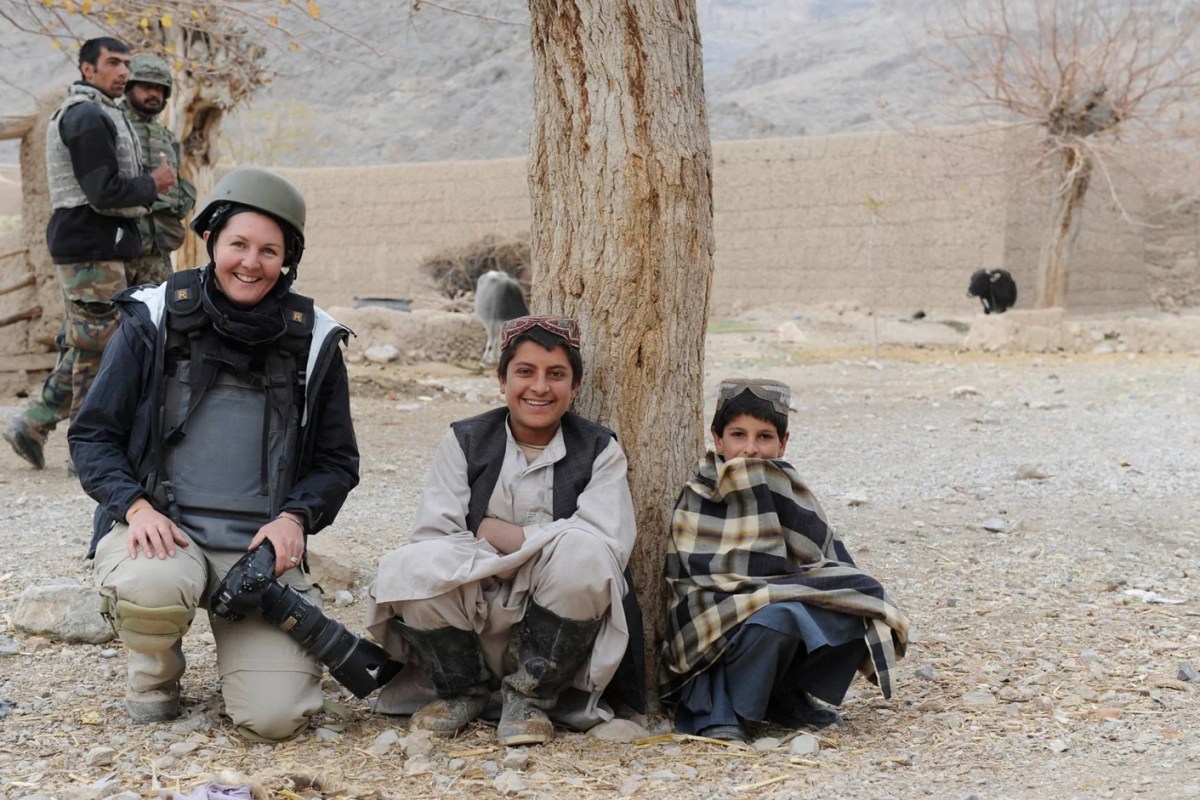
Melbourne photographer Penny Stephens explains that being a photojournalist is not all glamour and fame. It’s hands-on, fast-paced and takes doses of tenacity and perseverance.
Stephens’s work is currently in the spotlight as part of the Ballarat International Foto Biennale, which takes a look at daring and influential photojournalists of the 20th century, and continues through October.
Jump to career advice on:
In an interview for your job, what skills or qualities would you be looking for?
Stephens: Firstly, an innate, burning curiosity about the world and its people. You have to be able to talk to people from literally all walks of life. You have to be able to stand up to people, to not be easily intimidated, but equally you have to blend in, be almost invisible. You have to be so incredibly gentle and quiet at times. Equally you have to be able to stand in front of a crowd and boss them around, tell them where to stand and take charge. You have to gain someone’s trust in a very short amount of time, and have so much compassion. You have to be relatable and charming and serious and smart and funny. You have to be a chameleon. You have to be able to really feel people’s energy and proceed accordingly. Absolute strangers will share their most intimate secrets with you. It’s an honour.
Your integrity is everything. Other skills you’ll need are adaptability, be able to wing it, physical strength and fitness, punctuality, the ability to work under pressure.
How would you describe photojournalism to a non-arts friend?
I’m a photojournalist, but I wear a few hats. I work in media as a news photographer for The Age and The Guardian, which basically means driving around all day going into people’s homes and into places most people don’t get to go into photographing whatever the news of the day is, or whatever I am assigned by the “picdesk” to do. Google maps is my friend.
No day is ever the same. My car is often my office, as well as where I eat one or two meals a day. I know… gross. I’m out in all weather conditions every week, mixing with every echelon of society. Then, I also have corporate clients. The biggest are in the health sector. I also work on personal projects when I can.
How did you get your start as a photojournalist?
I have a Diploma of Illustrative Photography. I did some casual work for some suburban papers in Melbourne then started working on Saturdays for The Age. My job was to bring the films that had been left downstairs at the Lonsdale St entrance of The Age by the couriers and put them through the machines ready for the pic editors to choose shots to print up for the paper.
This is all pre-digital when everyone used film. Then one day, they were short of photographers, so I got sent out to cover the lawn bowls.
Photojournalist: How collaborative is this job?
I’m a freelance photographer. I don’t usually use assistants, occasionally I’ll work as a 2nd shooter, or someone will do the same for me, but generally I work alone.
Photojournalists usually only work together on big breaking news jobs. I have a community of photographers who are friends doing similar work. We call each other for advice on everything from gear questions, tech questions, rates questions, basically anything and everything, or just to debrief from a heavy job or to celebrate a win.
I think the nature of being a photographer is intrinsically collaborative. The pictures you make are going to be pretty rubbish if you, and the person you are making portraits of, are not collaborating. It’s all about connection. Even in news media, we collaborate a lot more than in the bad old days.
What is the most challenging aspect of being a photojournalist?
Witnessing people’s trauma up close. I would say also trying to continually make something out of nothing, but that’s also the joy of the job. Or, perhaps it’s needing to find a toilet when you’re out working, it could be anywhere… Me and my mates know all the best public toilets in Melbourne and can walk into any building with purpose, acting like we’re meant to be there when we need a loo in a hurry.
What’s the most common misconception about your job?
It’s not really a misconception, but most people want to know who is the most famous person I’ve photographed, whereas what’s more interesting to me, is meeting everyday people in their homes, sitting with them and listening deeply, making a real connection in a short space of time, while also making decisions on what’s going to work in terms of background lighting, where to place them etc.
All of us have taken photos of heaps of famous people, but it’s not something we chase. I guess another misconception is that it’s glamorous. I’m often sitting on a curb or on a footpath sending news pictures, or I might be up ladders or in mud or lying on the ground.
People who see us working get quite hung up on the camera gear, and though it’s incredibly important (a shout out to the incredible support I get from Nikon Australia… ), the gear is a tool, and that’s just the beginning of taking a great shot.
How competitive is photojournalism?
Incredibly. But really, it’s more about will, drive, tenacity, perseverance and really hard work to get this kind of work in the first place. Once you’re in, and you’ve made contacts, it’s easier.
But you’re only as good as your last good picture. Having said that, if you’re passionate about it, and it’s what you really want, go for it. If I can do it, you can too. Even when I started, people said there’d be no jobs or work and I’m still doing it full time decades later.
What’s changing in your professional area today?
The splintering of mainstream media means the industry is continually shifting and morphing. Big institutions, like universities and hospitals, are beefing up their public affairs, media and comms teams to get their stories out there.
AI is here, which means, more than ever, that truth in storytelling and authenticity will be sought after. Use AI tools to help edit and process work, sure, but not in the photojournalism work. I can see why there’d been a real resurgence in shooting film – I think that will only grow.
Read: So you want my arts job: Photography Curator
What about gender balance and diversity in your industry?
I wish I could say it was different, but in photojournalism and newspaper work, it’s still very male dominated. It changed for a little while, but it seems to have gone back the other way.
There’s a new younger, more diverse crew shooting the protests at the moment, which is great to see, but there are still few full-time photographers who aren’t men. There’s a much more even spread amongst photo editors.
What’s an average week like as a photojournalist?
No week is ever the same. Often at the start of the week, it will look quiet and before I know it, I’m booked for something every day. My jobs can be anytime of the day, and also evenings and weekends and public holidays. I might do a job for The Guardian, do a couple of shifts for The Age and fit in a corporate job with one of my clients like the Australian Nursing and Midwifery Federation or Western Health. The corporate clients usually book in advance so the other work can fall in around them.
What’s the weirdest thing that’s happened to you in this job?
So many things, but one that comes to mind is this: on a random Sunday night shift for The Age in 2006, I had my lens focused on the soon-to-be announced winner of the Comedy Festival Raw Award, and I got a text from the picdesk to say get to Essendon airport. News had come through that some miners were trapped, but alive, in the Beaconsfield mine in Tasmania.
Next minute I was on a walnut and leather lined private jet heading to Tassie with Bill Shorten who was still with the AWU, his secretary Ainslee and journo Andy Rule. And yes, I did buy undies and a toothbrush in Tassie.
Discover more arts, games and screen reviews on ArtsHub and ScreenHub.