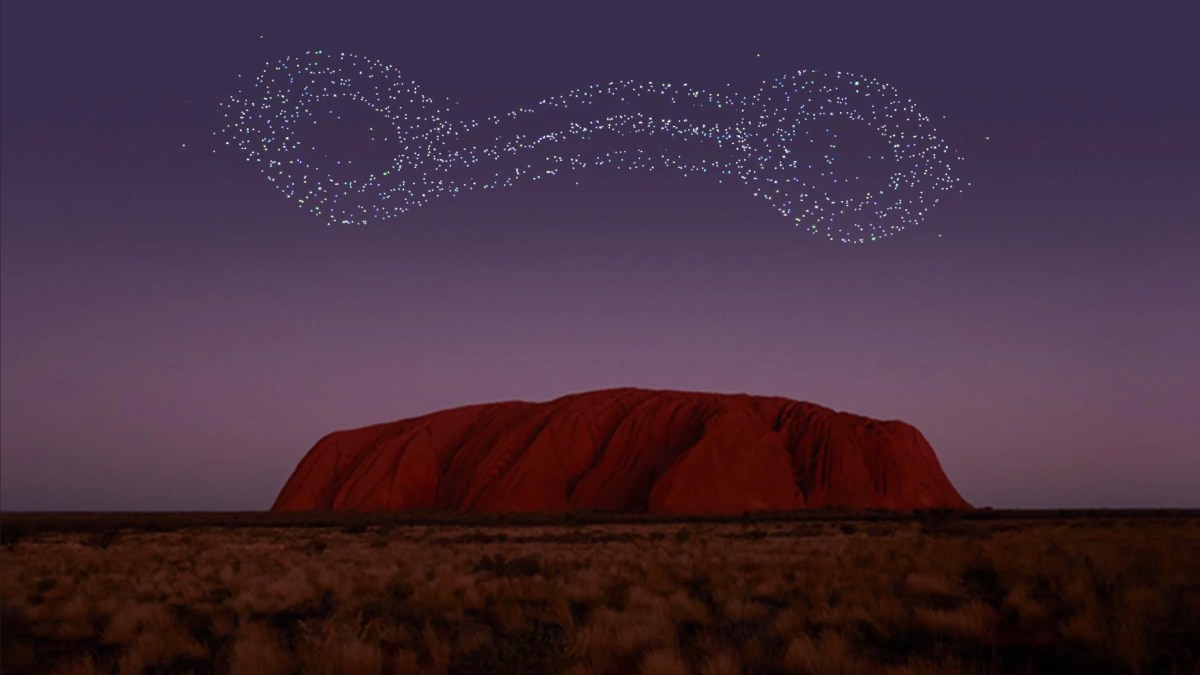
Wintjiri Wiru has been years in the making. Getting it right has been crucial. When you choreograph 1000 flow drones to tell, ‘a story that’s been told in the sand for over 70,000 years, and will now be told using cutting edge technology for the world to see,’ as Matthew Cameron-Smith, CEO of Voyages Indigenous Tourism Australia explains, ‘it is important to us that we honour culture in every step of the process’.
Announced today (Thursday 2 February), the cultural experience will be launched in May over the Central Desert, making it the largest ongoing drone show anywhere in the world. It has been designed and produced by media architecture studio RAMUS, based in Melbourne, which is headed up by Canadian-born light artist Bruce Ramus.
Voyages builds upon its success presenting British artist Bruce Munro’s Field of Lights, which enters its fifth year in 2023. Wintjiri Wiru will not replace it; but rather is viewed as a value-add experience.
Cameron-Smith says: ‘Some years ago, we realised that we can’t rest on our laurels; that we need to keep investing, and that we have to keep searching for the next amazing experience, and really focus on how we bring these incredible [Indigenous] stories to life.
‘With that in mind, we searched the globe to find cutting edge technology… and where we got to with that was the use of drone technology as a way of telling stories.’
He says they took the concept to the local communities and traditional owners of the land upon which Wintjiri Wiru will be presented. ‘This consultation has taken years in terms of getting it right. And it’s important for us on a couple of points: it must be culturally appropriate, and it must be ethically sourced.’
Translated as ‘beautiful view out to the horizon’, Wintjiri Wiru will be a combination of choreographed drones, lasers and projections in an open-air desert theatre setting, with views of Uluru and Kata Tjuta.
Cameron-Smith continues: ‘I think experiences are everything. When it comes to travelling here, people don’t come for the bed that they sleep in; they come for the experiences that they’re going to have. The work that we are doing just makes the experience more interactive and more meaningful for people.’
He adds: ‘It’ll be the largest single investment in an Indigenous tourism experience this country has seen in decades. We’re incredibly proud to bring it to life.’
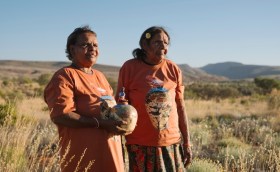
The show will bring to life a chapter of the Mala ancestral story, which sits between Kaltukatjara (Docker River) and Uluru, and is considered important Tjukurpa. It has been developed in close consultation with the Anangu custodians of this chapter of the Mala story. The experience will also include music and singing in language.
Cameron-Smith says: ‘We pay the community for using this story, and that money will go to community and help fund projects that actually assist the community, from health to social welfare, education and other initiatives… It really is about everyone working together for the benefit of the community.
‘This is a game-changer for Indigenous tourism in Australia,’ he adds.
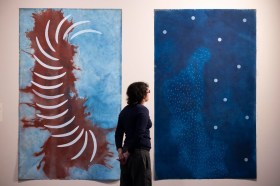
Visitors will sit on a platform that is built on stilts, hovering over the land. No concrete pylons are used, ensuring a lightness of footprint and a sustainable environment. Ten backlit laser-cut Corten steel panels will extend the narrative along the platform, decorated with designs by local Anangu artist and community member, Christine Brumby.
The platform will accommodate 130 people at any given time. It is fully wheelchair accessible, with a paved passageway that is built above the sand.
Phillipa Harrison, Managing Director of Tourism Australia, says: ‘We know that Australia is just a dream destination for so many people around the world. But when they come here, they want to be welcomed by our people. They want to be immersed in our culture, and they want to experience our incredible natural landscapes.’
Harrison says that the interest in our Indigenous stories is growing at 6% a year, ‘which is faster than the rate that overall tourism is growing, so in marketing Australia to the world, we have an opportunity to share our First Nations stories and cultures and it does give us a unique selling point in a global market.’
This is a game changer for Indigenous tourism in Australia.
Harrison explains that projects such as these also play an active role in helping to preserve culture. ‘That’s why it’s so important for us, that we hero our First Nations cultures in our campaigns.’ She says that she has witnessed great change in the kinds of Indigenous experiences being offered.
‘They’ve become more and more diverse over the years. Now you can scale Sydney Harbour Bridge, snorkel on the Great Barrier Reef or go crabbing in Port Douglas with Indigenous guides, telling you what it’s like through their eyes… this great experience is going to sit alongside those to tell that story in a more authentic way.
‘We’ve seen the take-up of Indigenous experiences across both our domestic and our international markets, pretty much at similar rates… It’s been really heartening to see our domestic tourism get more and more into Indigenous experiences,’ she says.
2023 will expand upon those immersive cultural experiences alongside the natural ones, with Wintjiri Wiru opening in May and a new light experience by Bruce Munro, Light Towers, scheduled to open in April at Kings Canyon Resort (Discovery Group) – about 324 kilometres away.
‘We see this as the next evolution of experiences,’ says Cameron-Smith. ‘I guess the difference here [with Wintjiri Wiru] is the storytelling component, and the way we’re bringing culture to life in a way that’s not been done anywhere else in the world.’
There will be two shows nightly for this all-weather experience – a two-hour premium show with an Indigenous-inspired hamper and wines at $385 per person, and a second one-hour show for $195 per person, which includes snacks and a hot beverage.
Wintjiri Wiru will be launched in May. It has been developed in consultation with traditional owners of these lands, by Voyages Indigenous Tourism Australia.