
Beaker Street Festival’s Margo Adler: ‘You can buy some Emergency Antarctic Underwear’

Director and founder of the Beaker Street Festival, Dr Margo Adler, discusses the science-inspired event in Hobart this August.
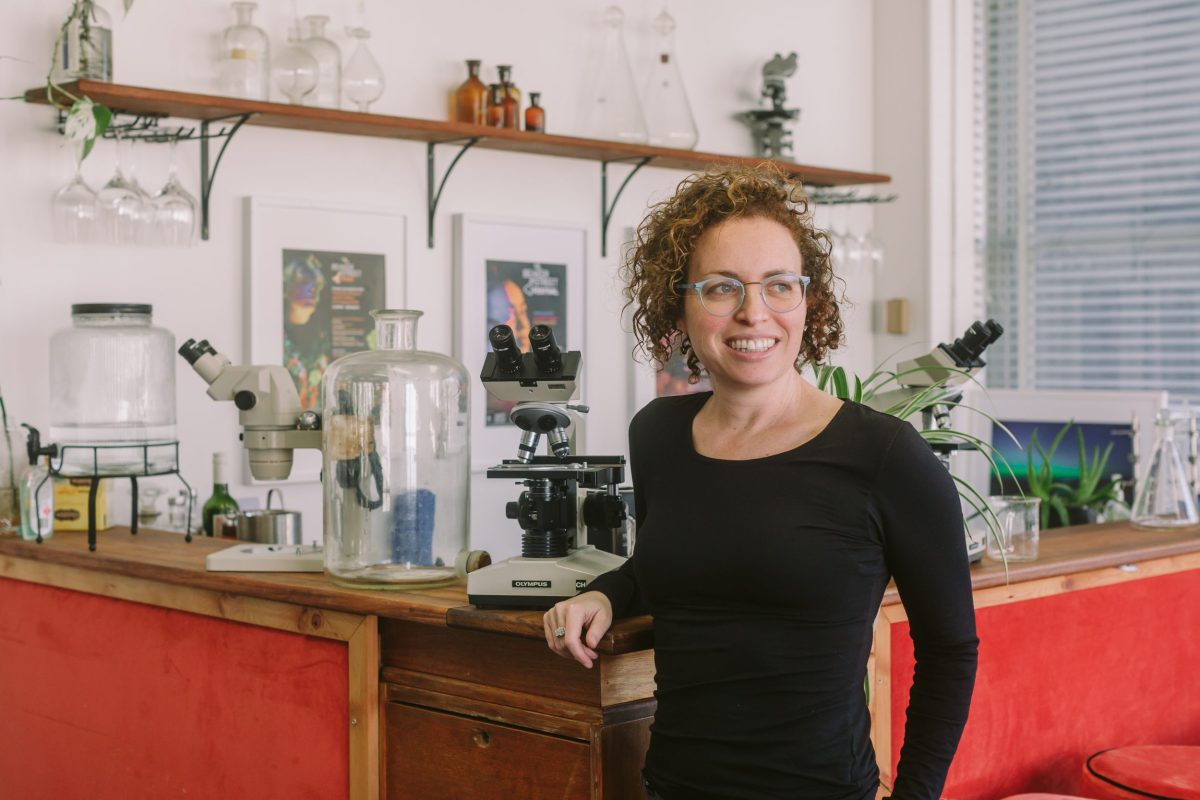
Director and founder of the Beaker Street Festival, Dr Margo Adler. Photo: Fred and Hannah.

A wedding, a slime mould exhibition, dates with scientists, and stargazing in the crisp Tasmanian Winter sky – this August’s Beaker Street Festival is a chance to explore the things you didn’t know you wanted to explore.

A festival centred on science, it works through collaboration, galleries, museums, farms and theatre, allowing often mind-muddling concepts to be digested and absorbed in fun, engaging, and dynamic methods.

In Hobart alone, there are more scientists per capita than any other Australian city. The festival offers a curated itinerary to see Tasmania through the lens of science – to explore iconic environments with ecologists who’ve been studying them for 30 or 40 years, sip Tasmanian whisky while chatting about the science of distilling with some of the state’s best producers, or just sit opposite a bar table for a mind-expanding conversation with one of nearly 200 participating scientists.     

For its tenth year, the festival takes the theme of The Second Act, thinking about the next ten years of the festival, what’s been great, and what they will let go of, so it stays innovative and exciting.

Beaker Street: Dr Margo Adler

Director and founder of the festival, Dr Margo Adler, has seen events grow far beyond the simple premise of meeting scientists.

‘We’re all about testing out new formats and ideas each year,’ says Adler. ‘It’s a big part of our values to continually experiment, and to say “how do we get this new audience, or how do we try to bring together these different ideas or different people?”‘

For the opening weekend of the festival, Hobart waterfront becomes ‘Hobartica’, a mostly free and family-friendly program that showcases Hobart as one of the five Antarctic gateway cities in the world – host to the largest community on Earth of Antarctic researchers and logistics staff.

‘In winter, most of them are based in Hobart rather than in Antarctica,’ Adler says. ‘We have this opportunity to bring them out and have them engage with the public.’

An Antarctic night market offers locally made crafts, freeze-dried ice cream, warming dishes and drinks for cold climates, and all sorts of quirky supplies one might need for heading to The Ice.

There are geodesic domes with scientists. Celestial Sessions with musicians playing durational performances paired with projected Antarctic and sky imagery. And a polar plunge pool in the middle of everything.

‘It’s going to be hilarious,’ says Adler. ‘You can do an icy polar plunge in front of everyone… And even have your Polaroid photo taken! If you’ve forgotten your swimmers, you can purchase some Emergency Antarctic Underwear.’

Beaker Street: party time

For the second weekend, Beaker Street Festival takes over Nipaluna/Hobart’s cultural precinct, including a Market Place Street Party for a weekend-long celebration for their tenth birthday.

On the main stage at the Hobart City Hall, a range of talks and events keep visitors on their toes with The Second Act guiding the themes. From the rapid advancements in the digital world, AI and social media, Beaker Street Festival wants you to consider the second act for humanity.

Beaker Street Festival. Photo: Supplied.

‘Can’t Look Away: How Our Technology Keeps Us Hooked’ exposes how tech companies use insights from the gambling industry to keep us addicted to our phones.

An AI session, ‘Meet Your Replacement,’ looks at what AI can do to potentially help us or hurt us. And the annual debate returns, questioning whether the social media ban should extend to adults as well. A TikTok star on each debate team joins scientists to examine all views on this controversial topic.

At the Theatre Royal, the mystery of dark matter is transformed into a performance composed by Tasmanian-born, Amsterdam-based Constantine Koukias for the VAST Australian premiere — delving into the discovery that the universe is expanding and accelerating based on the work of Professor Brian Schmidt (who visitors have a chance to listen to directly as well!).

‘I was first drawn to the unsettling mystery of dark energy, a force that seems to shape everything yet remains unknown,’ Koukias shares.

The large-scale concert features 120 recorded voices and 80 instrumentalists to create a 360-degree sound experience that evokes the way particles move, collide and swirl. Each seat hears a different journey, offering an experience exclusive to Hobart in 2026.

Beaker Street Festival. Photo: Supplied.

‘Bringing VAST home to Tasmania feels deeply personal, like returning these cosmic questions to the landscape and night sky that first formed my listening,’ says Koukias. ‘[It] opens a new sonic horizon from the very place where my own sense of vastness began.’

Beaker Street: field trips

The program features unique ‘field trips’, such as ‘Expanding The Cosmos’ at Mount Gnomon Farm, in the northwest with Wiradjuri astrophysicist and science communication star Dr Kirsten Banks and Dr Martin George, the chief astronomer at Hive Planetarium.

‘We’re going to bring out the Astronomical Society of Tasmania with telescopes for an opportunity to stargaze in a beautiful dark spot with food and drinks,’ Adler shares.

Dr Banks is also at the ‘Dark Sky Dinner’ at Frogmore Creek in the Coal River Valley, for a candlelit dinner curated by Head Chef Mark Burne, talks by UTAS Senior Indigenous Scholar Theresa Sainty on the Palawa connection to the night sky and the Dark Sky movement, plus insights from Nobel Laureate Professor Schmidt.

‘It’s such a cosy and eye-opening experience, coming together next to a log fire, sharing stories and learning new things while we stargaze,’ says Banks. ‘I’m excited to share star stories from my Wiradjuri heritage, hopefully opening the minds of the curious people coming along into appreciating just how much science is woven into our culture and stories.’

Beaker Street Festival. Photo: Supplied.

Beaker Street: Science Photography Prize Exhibition

As a judge of the Science Photography Prize Exhibition at Tasmanian Museum and Gallery (TMAG) – alongside Australian Geographic 2025 Nature Photographer of the Year, Marley Butler – Banks saw firsthand how images from science can blend the realm of fine art photography and be a useful tool for understanding how the world works.

‘A lot of my work, talking about space with audiences across the globe, involves looking at beautiful imagery,’ says Banks. ‘[The judging] process opened my eyes to more than just space imagery. I loved how it allowed me to see through the eyes of the photographer to get a sense of what they find beautiful and fascinating to snap a picture of.’

Beaker Street Festival. Photo: Supplied.

In its tenth edition, the Prize has a focus on Lutruwita/ Tasmania, the Southern Ocean, and Antarctica; the prize shortlisted 25 photographs from over 100 entries, with the exhibition featuring 12 finalist images.

Banks adds: ‘I love how art and photography can reveal details of the natural world that others may not take the time to stop and investigate themselves. Some of the finalist photographs did just that for me; for example, Mandy Cotman’s Living with the Dead photograph had me peering closer than I ever would at a small section of a headstone in a cemetery that’s teeming with life.’

The entire festival first started within TMAG and has now grown statewide. Along with the photography prize, the museum will host the CoLab exhibition, which sees research scientists paired with high-school art students to inspire new artworks that communicate scientific concepts and ideas.

Both exhibitions, plus a deep dive into the scientific collections, are open in ‘TMAG After Dark’ – where, for two nights only, the museum stays up late with live music, bars, and the museum’s scientists leading interactive activities. 

Beaker Street: wedding celebrations

In celebration of the tenth year, a real celebration will take place in the form of an actual wedding – with cake, music, and a talk on the science of brain plasticity and the science of starting over, reinventing yourself.

Adler says: ‘For the couple, it’s both of their second marriages, so it’s their second act. The wedding will open with a conversation on the neuroscience of reinventing yourself, with Tegan Taylor from Radio National interviewing neuroscientist Dr Matt Kirkaldie about how to get yourself out of a rut and start again.’

Some of the festival’s most popular events from the last ten years are reinvented for 2026, including the Enchanted Slime Mould Forest by Sarah Lloyd, who lives in the north of Tasmania and has a cult following as an international slime mould expert.

‘This year we’re bringing it back at the  Barn at Rosny Farm,’ Adler says. ‘Visitors can explore Sarah’s amazing photography and hundreds of matchboxes with her collected slime moulds. You can even search through logs and leaf litter to discover the tiny, beautiful slime moulds hiding just out of sight.’

Adler shares that 58% of their audience don’t come from a science background, proving that Beaker Street Festival is a festival for everyone. It’s a perfect excuse to come to Hobart and explore Tasmania in the winter, for an immersive and potentially life-changing exhibition. You never know where science might take you…

Beaker Street Festival runs from 6 to 17 August 2026 in Tasmania.

Discover more screen, games & arts news and reviews on ScreenHub and ArtsHub. Sign up for our free ArtsHub and ScreenHub newsletters.