‘A stronger legal safety net’: Fair Work proposes clearer recognition for arts workers

NAVA welcomes proposed changes to a federal award while warning that minimum rates still fall short for skilled arts workers.
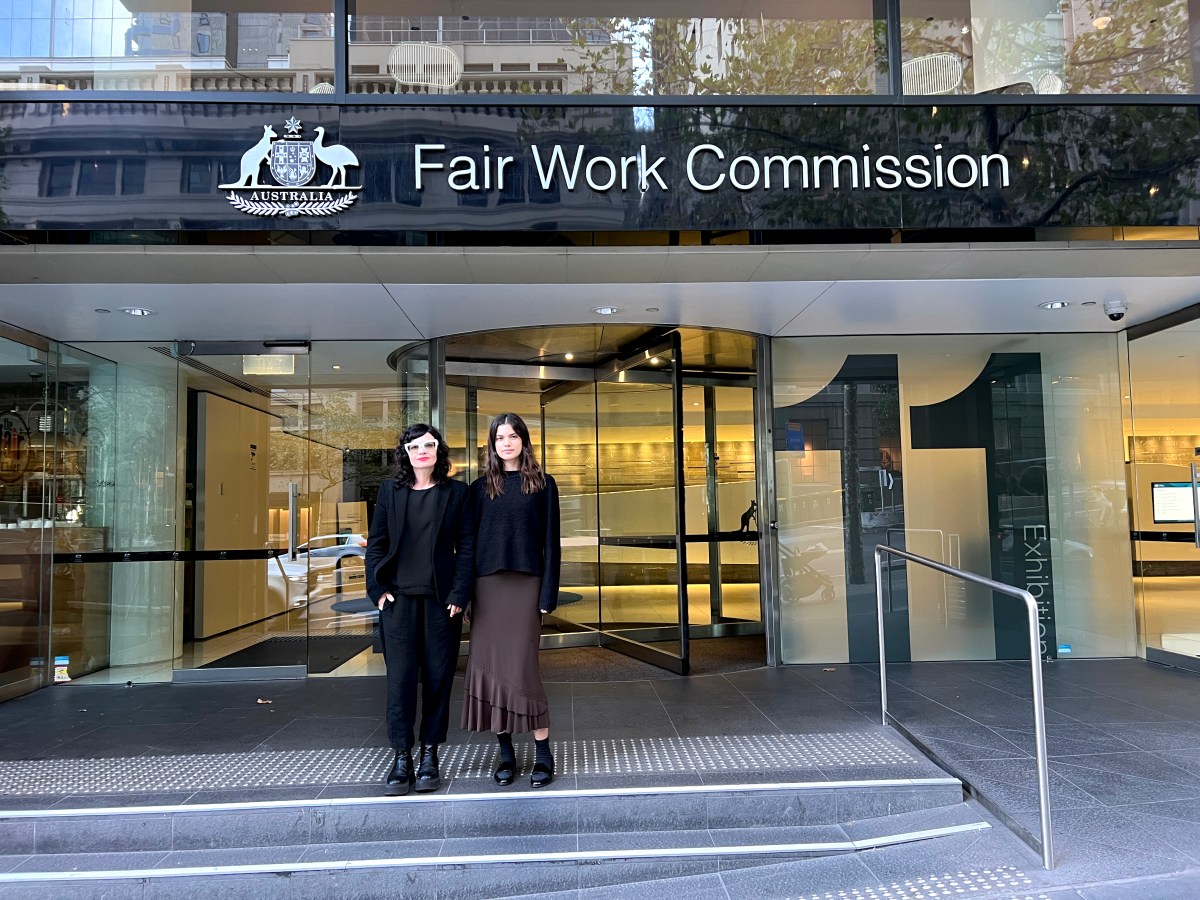
NAVA's Penelope Benton and Leya Reid outside the Fair Work Commission for the Case Management Hearing for Variation on the Commission’s own initiative – Amusement, Events and Recreation Award 2020 (AM2024/37), 2025. Photo: Supplied / NAVA.

The National Association for the Visual Arts, the peak advocacy body for the visual arts, craft and design sector, has welcomed a provisional decision by the Fair Work Commission that would see the arts explicitly recognised in the title of a federal modern award, and visual arts work more clearly reflected in its classifications.

The decision seeks to rename the Amusement, Events and Recreation Award 2020 as the Amusement, Recreation, Events and Arts Award (AREA) 2020. Released on 14 August, it follows more than three years of advocacy through the Fair Work Commission’s review.

Arts workers could gain clearer award recognition

The proposed changes would not create a standalone visual arts award. Instead, they would broaden and clarify the existing award so that arts work is more explicitly recognised within its coverage and classification structure.

The current Amusement Award covers a wide range of workplaces and employees across amusement, events and recreation, including museums, galleries and cultural centres. However, the Fair Work Commission’s review found that its existing classification structure does not adequately reflect the work performed by arts workers.

In a statement released on 17 August, NAVA Executive Director Penelope Benton said the decision was an important moment in a much longer history of advocacy to improve working conditions in the visual arts.

‘For decades, the visual arts sector has been trying to address the confusion and inconsistency that comes from fitting arts work into awards that weren’t designed for it. These problems were identified in the Myer Inquiry more than 20 years ago and NAVA’s advocacy for fair pay and conditions goes back even further,’ she said.

‘Having the arts named in a federal modern award, with visual arts workers and workplaces more clearly recognised, is a significant achievement. It gives arts workers and employers greater clarity about minimum pay and conditions, and provides a stronger legal safety net for people working across the sector.’

A long-running campaign for fairer conditions

Key findings from the Fair Work Commission’s Modern Awards Review 2023-24 report, which was in part facilitated by NAVA, indicate that the classification structure in Schedule A of the Amusement Award does not effectively cover the work performed by arts workers.

Speaking on the findings of this report in 2024, Benton explained: ‘Many visual artists work long hours for less than minimum wage, often as independent contractors or sole traders. The FWC report notes that a significant proportion of artists fall into this category, highlighting the need for broader reforms beyond the scope of the current award system.’

That distinction remains important. Modern awards provide minimum standards for employees, meaning artists working as sole traders or independent contractors may remain outside those protections. The proposed changes therefore address one longstanding gap in the employment framework without resolving the broader challenges around remuneration across the visual arts.

What the proposed changes would mean

The 14 August decision includes provisional views on adding arts-specific duties and visual arts workplaces to the classification structure. It would also recognise that knowledge and expertise in the arts can come through cultural and broader experience, as well as formal training.

The Fair Work Commission noted NAVA’s detailed submissions on the duties performed by arts workers, which provided the foundation for the joint submission made with the Media, Entertainment & Arts Alliance and the Australian Museums and Galleries Association.

NAVA has welcomed the recognition, while stressing that inclusion in an award is only a baseline protection.

‘While these changes would provide an enforceable minimum safety net of pay and conditions, minimum award rates remain too low for much of the skilled and specialised work undertaken across our sector,’ said Benton.

‘NAVA will continue to advocate for higher wages and better conditions, and maintain the payment standards in the Code of Practice for Visual Arts, Craft and Design as the industry standard.’

What happens next?

The changes are not yet final. NAVA is working through the Fair Work Commission’s decision and draft determination and will respond to its provisional views by 4 September 2026.

If adopted, the proposed changes would mark a significant shift in how arts work is formally recognised within Australia’s federal award system – the culmination of years of advocacy for a sector that has long argued its work has not been adequately reflected in existing industrial protections.

Discover more screen, games & arts news and reviews on ScreenHub and ArtsHub. Sign up for our free ArtsHub and ScreenHub newsletters.

Alannah Sue is a journalist, writer and theatre critic with a passion for arts and culture and all that glitters. She relocated to Melbourne in 2025 after spending over a decade embedded in the Sydney arts landscape and finishing up her tenure as Arts & Culture Editor at Time Out. In addition to contributing to ArtsHub and ScreenHub, her freelance portfolio also expands to editorial and copywriting for lifestyle and arts publications such as Limelight and Urban List, cultural institutions like the Sydney Opera House, and marketing and publicity services for independent artists. She is always keen to take a chance on weird performance art, theatre of all kinds, out-of-the-box exhibitions, queer venues, and cheap Prosecco. Give her half a chance, and she will get on a soapbox when it comes to topics like the magic of musical theatre, the importance of rigorous arts criticism, and the global cultural implications of the RuPaul’s Drag Race franchise. Connect with Alannah on Instagram: @alannurgh.