There’s a sad neatness to the fact that Adelaide theatre company Slingsby is preparing to cease operating in 2026, its 20th anniversary year. Fittingly, the company’s final production, A Concise Compendium of Wonder, encapsulates many of Slingsby’s modes of presentation in a triptych of works exploring humanity’s evolving relationship with nature over time.
The three new works are being staged in a regeneratively designed, custom-built, transportable wooden theatre dubbed The Wandering Hall of Possibility, erected in Adelaide Botanic Garden for the 2026 Adelaide Festival.
Slingsby’s last hurrah – quick links
Going out with a bang
By the time Slingsby learned it had been unsuccessful in its application for 2025-28 operational funding from Creative Australia, A Concise Compendium of Wonder was already in its third development and had received financial backing from six separate commissioners. Consequently, says Slingsby’s Artistic Director and CEO Andy Packer, the twin decisions to wind up the company and go out with a bang by staging the A Concise Compendium of Wonder in a custom-built theatre, went very much hand in hand.
Packer tells ArtsHub: ‘We had some incredible philanthropy, and an incredible circle of commissioners who’ve put a significant amount of money into [these works].
‘And then when we didn’t get that four-year funding, over that first two years it meant we were down to $600,000. We had a look at the bank and went, “Well, we should just do this”.
‘And once that money’s gone, we are no longer financially viable – we’re certainly not viable financially to take risks, which is what we do. So we went, “Well, let that be it. Let that be the end of the company”.’
A Concise Compendium of Wonder feels like ‘a summation of what we’ve been trying to achieve right from the start of the company,’ Packer says.
‘Everything that we’ve always set out to create and deliver for audiences is bound up in this project, on a scale that we would have liked to have been funded to deliver into the future, but where we’re deciding to give ourselves and our audience the gift of what we can be now and what we could have been.’
Finding hope in the darkness
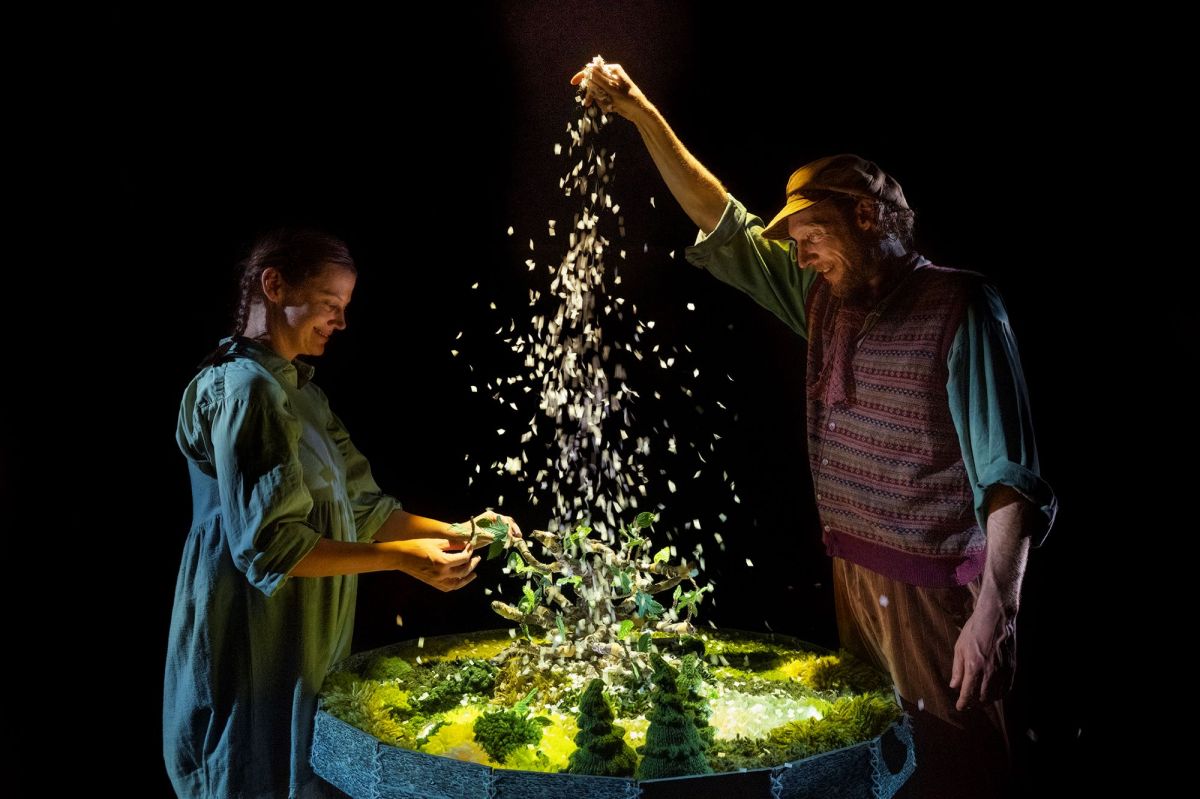
Three Australian writers have crafted the three separate stories for Slingsby’s A Concise Compendium of Wonder, with each work presented using Slingsby’s signature staging techniques of shadow-play, atmospheric lighting, miniatures and original music.
Jennifer Mills’ The Childhood of the World is inspired by the Brothers Grimm’s Hansel and Gretel and takes place in the medieval period; Ursula Dubosarsky’s The Giants Garden riffs off Oscar Wilde’s The Selfish Giant and is set in the late 1800s; and Ceridwen Dovey’s The Tree of Light is set in the far future and takes inspiration from Hans Christian Andersen’s The Little Match Girl.
Collectively, the triptych explores humanity’s shifting relationship with nature across an epic timeframe, from living with nature in a forest, to a period of land clearances and private gardens, through to a future where humanity has had to leave Planet Earth far behind.
‘These stories are about young people fighting for nature and to have access to nature – and winning that fight in each of those stories,’ Packer explains.
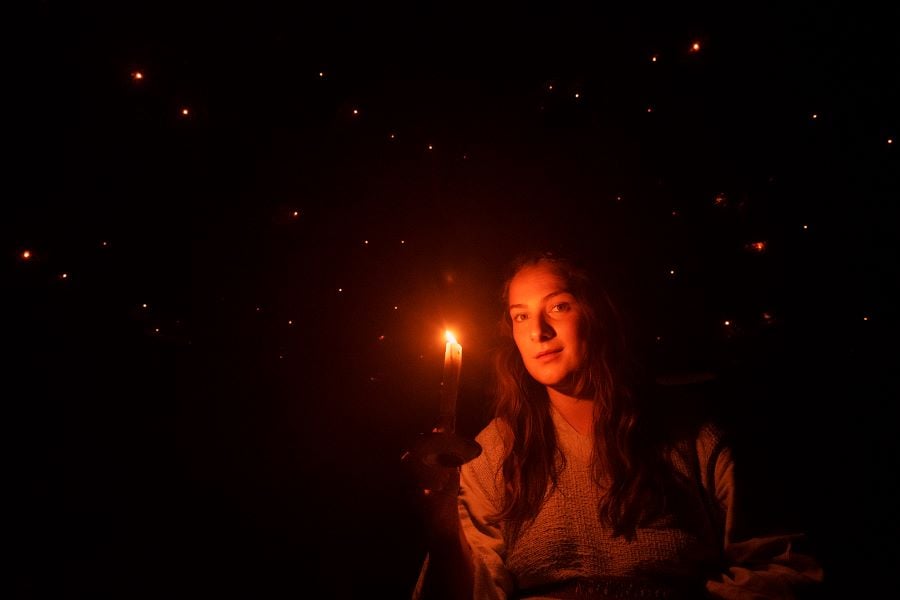
Another theme connects the three works, he adds – one drawn directly from young people’s contemporary concerns.
‘We’re very much responding to the climate crisis; a theme that we know from our workshops with young people is absolutely top of mind for them. Climate anxiety is real for young people, and so we feel we should use our art making to address that,’ Packer says.
‘But we should always – as we always sought to, it seems – not be afraid of the darkness of that issue, but insist on leading our audience back to a sense of hope … Our job as a theatre company – especially for young people – is to prepare those young audiences for the future, not to protect them from it, because we can’t protect them from it.’
Slingsby builds The Wandering Hall of Possibility
Slingsby is modelling hope for its audiences – especially its young audiences – through the intimate, bespoke venue created to house the three plays, The Wandering Hall of Possibility.
Over multiple tours, interstate and overseas, the company measured its carbon footprint and designed both A Concise Compendium of Wonder and The Wandering Hall of Possibility in response to their findings – creating an environmentally-focused model for sustainable touring in the process.
The three productions are performed by one cast with one evolving set, enabling longer seasons, deeper community engagement and a dramatically reduced carbon footprint. Every component of The Wandering Hall of Possibility has been designed so that it can fit on a single truck; it can also be repurposed at the end of its touring life, including the props and sets designed for each part of the triptych. Constructing the theatre out of ethically grown and sourced timber also means the structure itself has had a previous life as a carbon sink.
‘We can say to a young audience, “Here’s three beautiful productions and a beautiful building. And by the way, we’ve created this, and we’ll tour it, with reduced carbon use from the way we used to travel as a company”. So I think that’s a story of hope as well, and also a model that we’ll leave behind at the end of the company for other organisations to consider that mode of touring as well,’ Packer says.
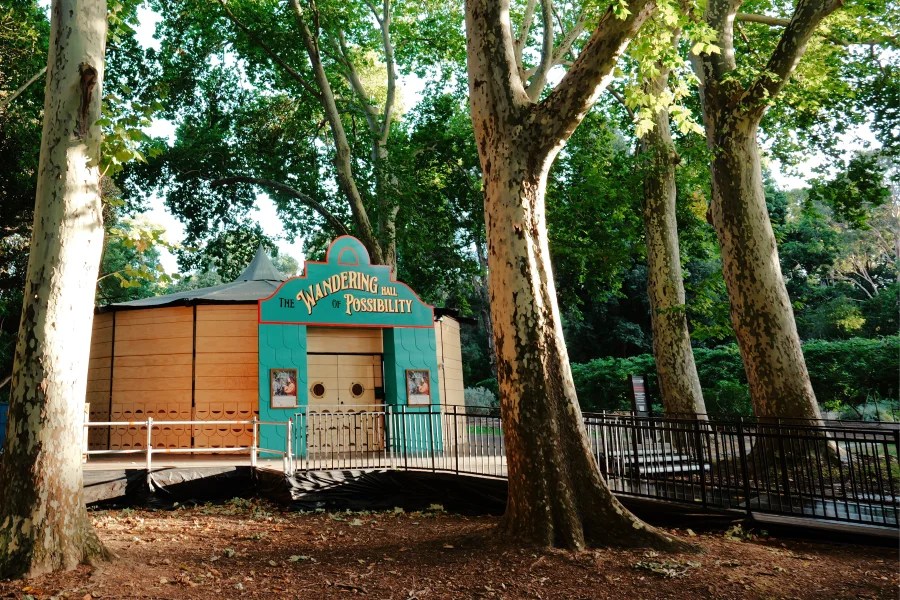
Such tours will initially be in Australia – Slingsby’s largest carbon footprint in the past, unsurprisingly, was generated by international flights, though the company does see potential for international touring of the project utilising sea freight. Indeed, a regional tour of A Concise Compendium of Wonder to Whyalla is already planned.
‘And most companies that tour to Whyalla would go to Whyalla for maybe two days; maybe a day to get in two performances, and then move on. But when we go there in May [and] June this year, we’re there for a month with 23 performances, and that’s a radically different way to connect with the community, because there’s time for word of mouth to spread … The building also carries with it the idea of reciprocity, where we invite the local community into performing in our venue as well. We’re creating an ephemeral public house in that community as well, so people can come and perform and meet each other in a new space.’
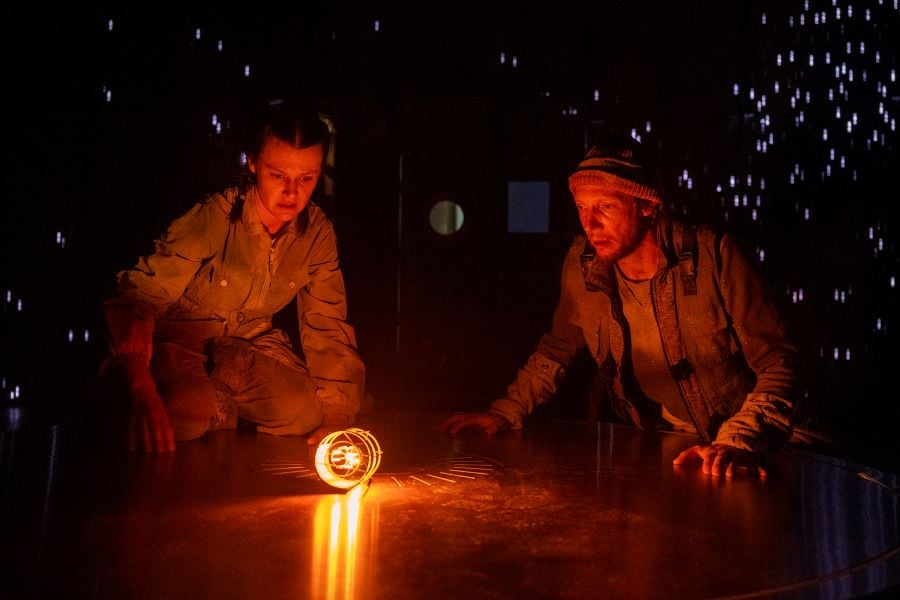
Equally importantly, the stage design of the 110-seater The Wandering Hall of Possibility will always be exactly the same in every town and city it tours to – a boon to actors and the production crew.
‘Quite often, if you’re working in theatre that’s as technical as ours – what I love is that people always see our work and go, “It’s such beautiful, simple storytelling,” but it’s always very complex, technically.
‘And when you go into different venues, when the performers are interacting with light or interacting with projection, then in every venue, the wings are different. The position of that projector is different. So often, performers are performing in an environment which is unfamiliar to them, where they have to go on stage and be vulnerable and precise. So this also provides a solution to that [challenge]. This light is always going to be there, that projector is always going to be there,’ Packer explains
‘And it does mean, now that we’ve made these shows and are returning to them, that the lighting plot is always exactly the same … So when we move this [production] to another city, you know, that day and a half of replotting the show [technically] is gone, because the lights are in the same spot, and they remember where to point. And so it saves time from that perspective, too.
‘And this is knowledge you only gain from 20 years of working in, I don’t know – we’ve been in 140 different venues or more around the world – and distilling that into this one building.’
Slingsby in 2026 and beyond
Slingsby has already rejected an offer to tour to another capital city immediately after the conclusion of their Adelaide season. Packer sums up the discussions around doing so as, ‘That’s just crazy. It’s just too much pressure.’ Instead, if A Concise Compendium of Wonder does tour beyond Whyalla in 2026, perhaps even extending the company’s life into 2027, it will do so slowly, at a comfortable and leisurely pace.
ArtsHub: Constellations: Not Writers’ Week – Adelaide’s alternate book festival gets ready
Packer himself has ‘absolutely no idea’ what he’ll doing next, once the production has toured and Slingsby is wound up.
‘I’m going to be quite creatively sated by this project. Like, it’s just an absolute dream to be working with your friends and favourite collaborators, and favourite actors as well, in the Botanic Garden for a couple of months. I mean, it’s just a beautiful thing, but I have zero idea what I’ll be doing following this, right?’
All that’s certain is that Packer is contentedly drawing a line under Slingsby as a company – while also acknowledging that it could have continued with adequate Creative Australia funding – and wrapping up its production history within a bespoke theatre that echoes the company’s origins 20 years ago.
‘In many ways, it’s the ultimate expression of what we tried to do with our first production. Our first show, The Tragical Life of Cheeseboy, invited people into a tent. And now that tent is a wooden building, and we are inviting people into a very comfortable wooden structure with excellent sight lines, padded seats, air conditioned – it is the home for these three works, but is also a gift to the future. This building will have a life beyond the company, I’m quite certain of it,’ Packer concludes.
Slingsby’s A Concise Compendium of Wonder is now playing The Wandering Hall of Possibility in Adelaide Botanic Garden until 18 March as part of Adelaide Festival 2026.
This article was edited after publication, on 26 February at 7:24am, to correct the details of Slingsby’s unsuccessful funding request from Creative Australia, and to clarify the company’s potential plans for future international touring utilising sea freight.