How to explore menopause and its effects on First Nations communities in a culturally appropriate way? That was the animating question behind Goodbye Aunty Flo, staged by Melbourne’s ILBIJERRI Theatre Company at Melbourne’s Malthouse Theatre over the weekend.
Written by Nazaree Dickerson, the play was commissioned by ILBIJERRI in 2021 as part of a collaboration with the Department of Health.
If that sounds more ‘health campaign’ than a recipe for innovative theatre it’s not: Goodbye Aunty Flo is a heartwarming and laugh-out-loud funny play about menopause and learning to accept change that celebrates the special combination of sisterly sassiness, silliness and steadfastness that characterise women’s friendships.
Aunty Flo: Liza Maza
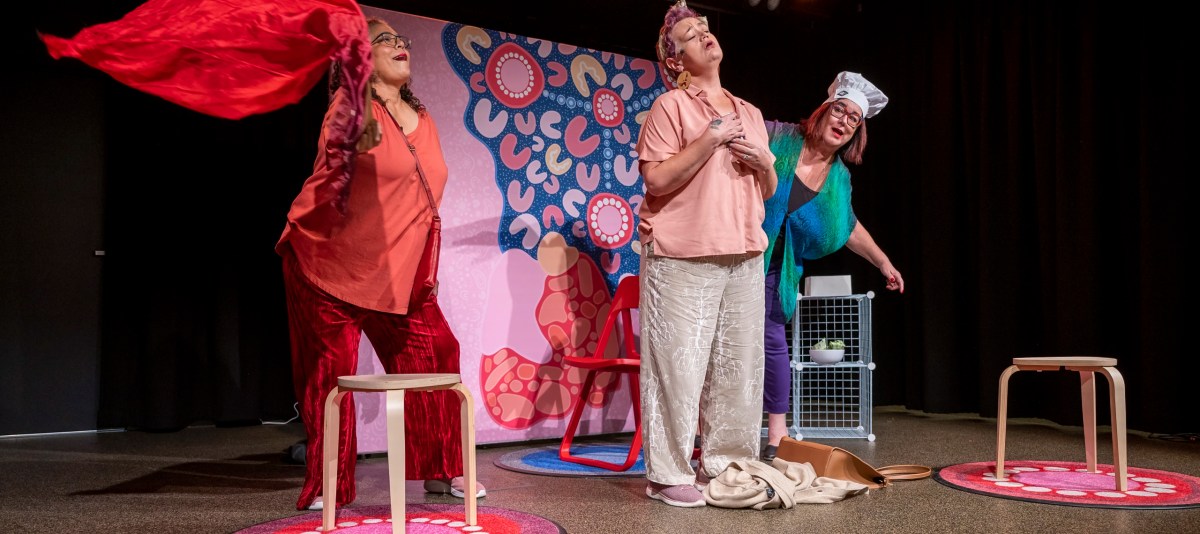
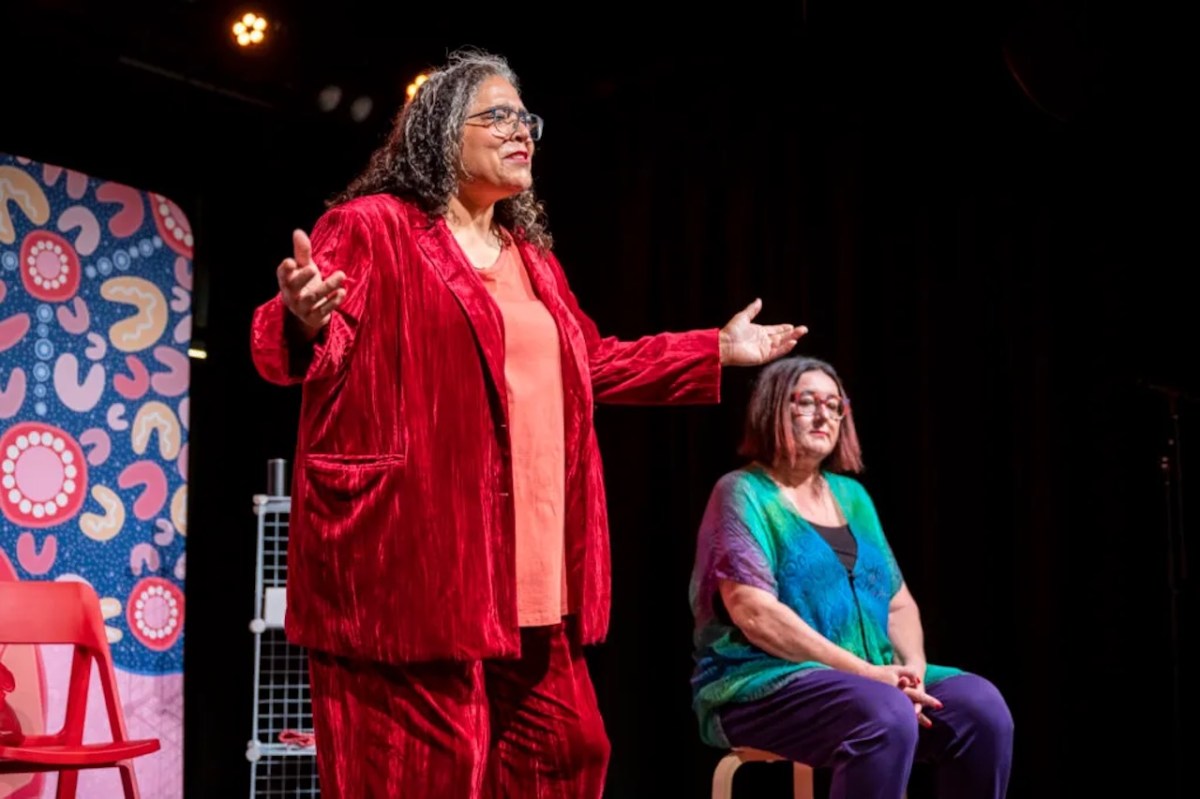
Aunty Flo is personified by a larger-than-life Liza Maza, clad head-to-toe in a red crushed velvet suit. Waving about her fan of flowing silk, she is regularly popping by to pay a visit to Sharon (Georgia Macguire) – a woman on the verge of menopause who is embarrassed about her peri-menopausal symptoms, and in denial about what’s happening to her body.
In contrast to Sharon is Jules (played by Melodie Reynolds), Sharon’s old school friend. Straight-talking, karaoke-loving and quick with a quip, Jules runs a support group ‘Pause Preppers’ for women to prepare for menopause, although no one ever shows up. Jules cannot wait to give the boot to her period, but Aunty Flo just keeps dropping in.
When Sharon shows up at Jules’ support group at the advice of her doctor, the pair begin to rekindle their friendship, but old jealousies flare. Sharon’s high-school sweetheart husband (who Sharon indicates has been disinterested in learning about menopause) suddenly becomes very interested in joining Pause Preppers, but Jules (who has thought Sharon’s husband is a drop-kick since high-school) is adamant that it’s just women’s business.
And as Jules gets ditched by Sharon for a date-night with her husband, it feels like she’s back at high-school, losing her friend all over again.
Aunty Flo: engaging with First Nations women
In writing Goodbye Aunty Flo, Dickerson engaged with communities of First Nations women, running yarning circles as part of the play’s development. The result is a play that talks candidly about this stage of a woman’s life, with humour and heart.
The play contrasts the embarrassment that peri-menopausal symptoms can cause (Sharon’s response) with a radically positive acceptance for menopause (in Jules’ case) and raises questions about how families and men can also support women going through menopause.
Humour is used as a tension-breaker, enabling the audience to laugh at what can be considered embarrassing moments for women. Sharon’s experience of a hot flush while at the bakery leans into panto silliness, as she desperately grabs two cans of cold drink and the scene switches to slo-mo – Sharon gyrating in bliss at the relief the cool cans bring.
Aunty Flo often directly addresses the audience – the only one of the actors to break the fourth wall – and in one scene, she talks to us like a nature documentary narrator about Sharon’s experience of menopause as a human Koorie woman, while stalking around the set hiding behind a tiny pot-plant in her hands.
Aunty Flo: reducing stigma
Goodbye Aunty Flo was written specifically to talk to First Peoples communities about menopause and reduce stigma about this stage of life. The simple set design, featuring two pink room partitions with traditional Aboriginal art motifs of meeting places, two circular rugs, movable stools and some multi-use shelves, and the limited use of different lighting states or other complex technical set-up, makes for an efficient touring show.
Goodbye Aunty Flo could be put on in a community hall, just as readily as a black box theatre such as The Malthouse.
Despite the very real First Nations community and health objectives for making Goodbye Aunty Flo, it’s refreshing to see a play for which menopause is the focus, and its relevance is universal.
After the runaway success of Miranda July’s 2024 novel All Fours, which explored one woman’s peri-menopausal-induced life crisis, hopefully the (crimson) tide is turning – and this experience that all uterus-owning women go through becomes more commonly seen as a source of inspiration in popular art.