Tucked between the bustling pubs and eateries of Surry Hills, Velvet Lobster is one of Sydney’s freshest up-and-coming galleries. Intimate in scale but ambitious in vision, the gallery has quickly become a home for emerging artists and tightly curated shows. The current exhibition, Shrimp Show, marks the gallery’s first anniversary and presents a vibrant celebration of young painters, whose works seem to shimmer and swell with the heat of a Sydney summer.
Founder of Velvet Lobster, the Iranian-born painter and curator Bahman Kermany, has a sharp eye for rising talent. The gallery’s first appearance at the Sydney Contemporary art fair showcased the dream-like snapshots of Shanti Shea An and the sketch-like bursts of Erin Murphy. Both artists also feature in Shrimp Show, alongside Kermany himself.
Curated around a loose thematic focus on painting, Shrimp Show brings together a small back catalogue of works from around 10 emerging contemporary artists, many who have shown at Velvet Lobster before. Subtle stylistic threads run between the pieces, with a shared smoothness linking the works across the gallery space.
Shrimp Show review – quick links
Shrimp Show presents contemporary approaches to painting
Kermany’s practice has been gaining momentum, with finalist selections in the 2023 Lester Prize, the 2024 Darling Portrait Prize and the 2025 Mudgee Portrait Prize. His work Player IV (2025) serves as a curatorial anchor for Shrimp Show, its bold strokes and bright wisps of colour echoing across the surrounding works.
The painting recalls the density of Cézanne’s still-life brushwork and depicts a traditional Iranian musician playing the ney, a recorder-like instrument. The figure’s blue and yellow brows are furrowed, his moustache billowing as if caught in the wind of his own tune.
Tucked away in the second gallery space, which is also used as a bar, the figure in Player IV feels almost sentient, positioned like a watchful guardian surveying the wines and steady flow of visitors.
In contrast, Shea An’s portraits embrace a deliberate flatness. Her figures, shaped in muted tones, feel like fleeting glances caught in one’s peripheral vision. Her work has attracted growing attention, with pieces now held in public collections including the National Film & Sound Archive and the ACT Legislative Assembly Art Collection.
Murphy brings a crisp clarity to the exhibition. Her Radishes (2025) is exactly as titled – with deep pinks and greens blushing against a pastel blue ground. Its simplicity invites close inspection. Murphy’s practice continues to build, with finalist positions in the 2025 Sulman Prize, the 2024 Brett Whiteley Travelling Art Scholarship and the 2023 National Emerging Art Prize.
Material echoes and conversations
The space itself felt sparse. On one hand, the smaller works invited intimate, focused engagement, with each painting given plenty of breathing room. On the other hand, the overall bareness left the gallery feeling slightly underutilised. A more inventive hang or bolder use of the walls could have made use of the space more fully.
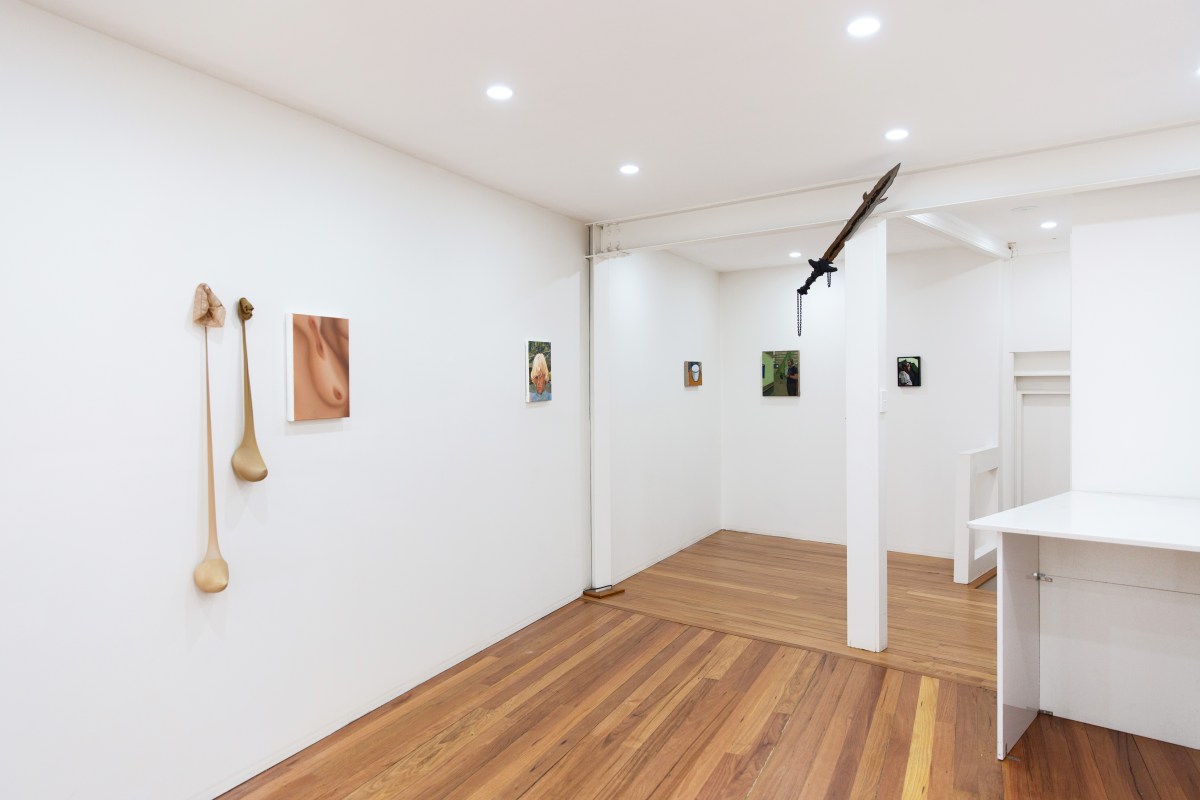
The works I felt most drawn to worked beyond the canvas. Rachel Mackay’s Support System #1 (2025) oozed down the wall. The pointy nipples of the boobs hanging in stressed nylon stockings almost look back up at the viewer.
Exhibited alongside is a small painting of morphing or melting boobs, her airbrushed oil painting technique smoothing them within a blur. Mackay’s works capture movement, and I can only begin to imagine the sagging nylon stretching further as the clay boob inside drags it to the floor.
With everything else on view being a painting, I almost missed James Little’s sword sculpture, a matte black blade slashing into a support beam just above head height – but once spotted, it delivered exactly the dynamism the space had been craving.
The darkened steel seemed to swallow light. A blackened chain coiled around the handle like a trapped gesture. Positioned on the beam, it subtly sliced through the sea of paintings below, creating a sharp spatial interruption.
Little’s practice challenges fabricated masculinity born from fantasy worlds, and here he does so by quite literally fabricating it.
I also enjoyed tracing Tim Price’s painted pigeons as they migrated between the gallery spaces. His landscapes are built through improvisation, rather than the static precision of painting from a photograph, and this process means the viewer is invited along on a suburban walk. That spontaneity gives his scenes a vivid, lived-in quality – a sense that the paintings are not just depicting a place but actively remembering it.
The walls were also graced with works by other painters who have regularly exhibited at Velvet Lobster throughout the year, their pieces sharing a quiet resonance with other works in Shrimp Show, as demonstrated through muted palettes, softened edges and oil paint blurred into gentle murmurs of shape and colour.
With over 10 artists showing works of similar scale, that continued stylistic softness began to blur the boundaries between the artists themselves. Kermany’s curation finds harmony in these material echoes, weaving the exhibition into a cohesive reflection of the gallery’s first year.
It feels intentional: a nod to past shows, a consolidation of the voices he’s championed and a subtle blueprint for what Velvet Lobster hopes to cultivate moving forward. In this way, Shrimp Show becomes both a celebration and statement of direction.
Shrimp Show is at Velvet Lobster in Sydney to 20 December.

This article is published as part of ArtsHub’s Creative Journalism Fellowship, an initiative supported by the NSW Government through Create NSW.