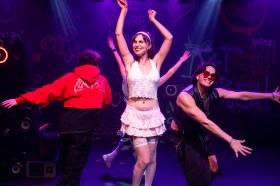
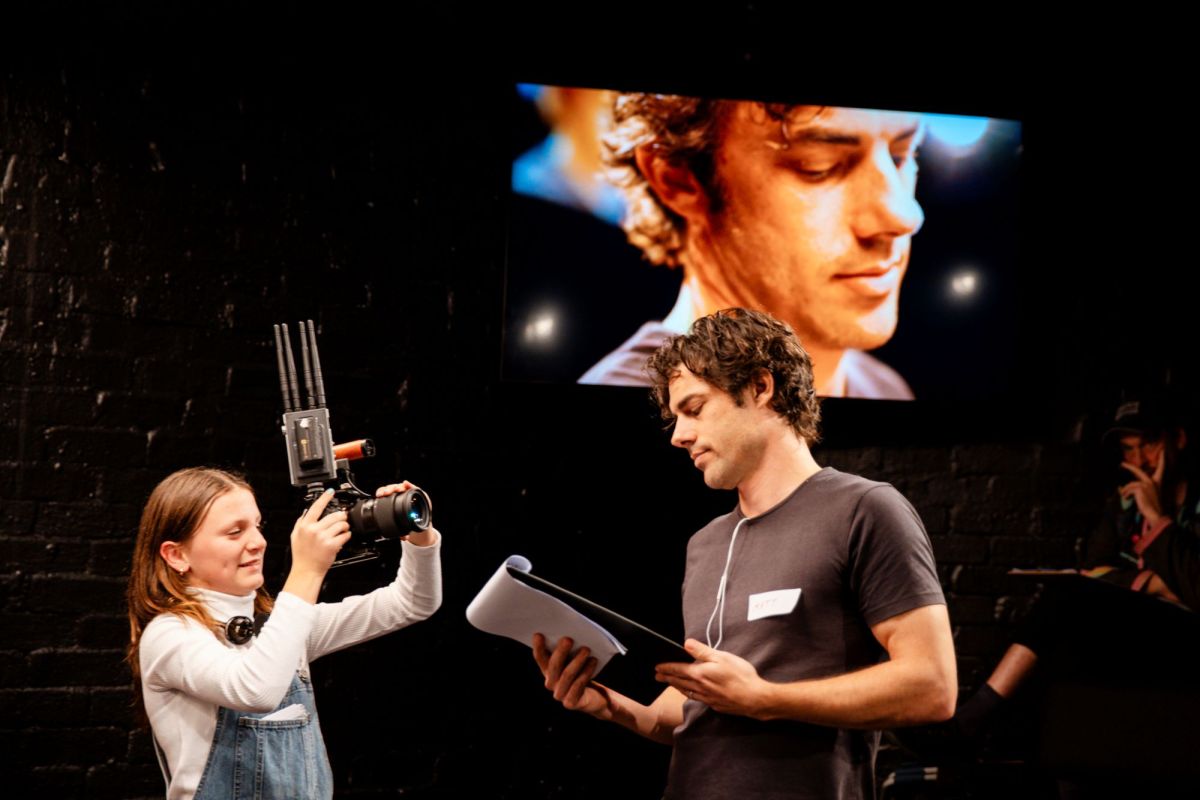
POV is a play staged as a documentary being filmed live by an 11-year-old girl and starring her parents, who are played by a different pair of actors every night. The adult actors have not read the scripts they are about to perform, and so must respond to each new line and revelation spontaneously, in the moment.
Adding an additional and fascinating layer of complexity to proceedings, the child actor – unlike the child they are playing in POV – has all the power in this production. The adult actors are directed by them; she instructs them where to sit, where to stand, and also provides them with pages of the script incrementally – sometimes with directions on how to deliver their lines.
POV review – quick links
Stand-ins and gradual developments
On this particular night at Perth Festival, 12-year-old, Sydney-based performer Yuna Ahn (alternating in the role with Grace Tione) played Bub, the 11-year-old daughter of Penny, a ceramic artist preparing for an important exhibition and who is always tired, and her husband Michael, a nerdy microbiologist who listens to Icelandic post-rock and paints Warhammer figurines in his spare time.
Bub is filming a documentary about her mum as Penny prepares for her exhibition. Penny is avoiding being interviewed, to Bub’s dismay. Her dad gently tells Bub that its ‘not a good time to be filming mum and me’.
After Bub informs the audience about some of the key features of documentary filmmaking – including interviews, observational footage, the B-roll of cut-away footage to add visual poetry to the documentary, and reenactments of key scenes where firsthand footage is not available – we gradually discover why she has cast two unrehearsed local actors to reenact her parents’ scenes in the performance that’s unfolding before our eyes.
Early in the show, a slowly developing Polaroid photograph of performers Chris Isaacs and Haydon Wilson (who played Penny and Michael in this performance) was held in front of Bub’s camera until its image becomes clear – part of the opening credits of Bub’s documentary, projected live, as was every camera shot in the show, on multiple screens around the theatre. In this way, the story at the heart of POV was revealed to the audience scene by scene and shot by shot.
It’s a story that’s sadly far too common in Australian homes, given that 45% of Australian adults will be affected by mental illness at some time in their life, but it was told here with tenderness, insight, humour and skill – and in a way that an 11-year-old child might understand.
Sometimes scenes required multiple takes, resulting in levity early in the piece and heartfelt, deeply moving responses later in the night. The actors’ voices caught and almost broke over later lines and quiet sobs were heard in the audience.
Child safety and Werner Herzog
Actor Yuna Ahn is only 12, and productions involving child actors must adhere to rigorous guidelines. Early in this performance of POV, we learned just how rigorous the guidelines are when Isaacs read aloud from the Child Safety in Performance manual, which stipulates the appropriate working hours for children, the need for regular breaks and what young performers can and cannot be exposed to.
The guidelines were soon enforced: Yuna’s stage-right chaperone asked her to don headphones so that Bub would not hear her parents’ heated, expletive-filled argument.
Later came an enforced six-minute break during which biscuits were passed around to the audience. We were also actively encouraged to Google and read aloud quotes from German actor and documentary filmmaker Werner Herzog – Yuna’s documentary-making idol, to whom she wrote several times in POV and received correspondence from in return.
ArtsHub: Incandescence review – four world premieres danced under the stars
Another letter was read aloud, at least partially, one which Wilson received about their performance in POV, and which outlined how he should prepare for the show. It instructed him to prepare a Werner Herzog accent in advance, though he was not told why. His accent brought some much-needed humour to the production as its mood darkened in the second half.
Isaacs too, received a similar letter in advance, and also read an extract from it aloud. The sequence that followed was one of the most critical in the show, and Isaacs acquitted himself with aplomb – and also when it came to answering a curly, follow-up question for which he was clearly not prepared, but handled with touching, direct clarity.
The camera as witness and theatre as memory
Created by re:group performance collective (Mark Rogers, Solomon Thomas, Malcolm Whittaker, Steve Wilson-Alexander and Carly Young) whose members met at the University of Wollongong, POV is an exemplary example of how film and television techniques can be incorporated on stage.
Wielding the camera helped give the actor playing Bub agency; the images it captured across multiple screens clearly illuminated the splintering lives of the play’s protagonists for the audience.
Rogers’ script cleverly pulled the rug out from under the audience’s feet, setting us up to believe that what we watched unfold was a simple domestic tragedy, when in fact the play was leading us gently into much darker territory, and Thomas’ direction balanced the play’s disparate tones beautifully.
POV’s production design was also noteworthy, spartan but beautifully integrated into the story. The tracks along which Bub’s high quality camera sometimes dollied later formed tracks of a different kind for two of the play’s most dramatic scenes.
In another scene, a slowly inflating air mattress provided levity initially, but the laughter soured as the scene played on, and its slow inflation instead began to evoke the way depression numbs one to important changes in the world around you.
Theatre can echo real life, but also heighten it. In especially skilled hands, theatre can feel more real than life itself. Late in proceedings, after it had revealed the truth of its story to the audience and left most of the jokes behind, POV developed such qualities. It achieved such a heightened state in part by replaying one key scene over and over again, each time with a very particular change, until Ahn got what she needed from proceedings.
In doing so, POV evoked the way we all anxiously replay certain scenes in our minds, sometimes even years after the event in question, wishing we could have said or done something differently – something that would have changed the outcome for the better. It was a shining moment of brilliance in an already accomplished production.
POV played Subiaco Arts Centre in Subiaco/Wandaraguttagurrup from 10 to 15 February and tours to the Space Theatre for Adelaide Festival from 4 to 8 March.
The writer visited Perth as a guest of Perth Festival.