This review references violent sexual assault.
Directed and by Thomas Ostermeier for Schaubühne Berlin, and first staged in 2018, History of Violence was co-adapted by Ostermeier from French author Édouard Louis’ second autobiographical novel, Histoire de la violence.
The play follows Parisian university student Édouard (Laurenz Laufenberg), who was choked, raped and almost killed by Reda (Renato Schuch), a charismatic Kabyle man he picked up on the street early one morning while walking home. In the aftermath, Édouard struggles to control subsequent retellings of this traumatic event.
History of Violence review – quick links
Splintering perspectives
At the hospital where Édouard seeks medical treatment, his experience is pathologised. Police officers (played by Alina Stiegler and Christoph Gawenda, who doubled in several roles) call the incident ‘attempted homicide’ and try to force Édouard’s version of events into a bureaucratic framework informed by racism. His older sister (Stiegler again), living in the small-minded rural town that Édouard escaped, relates Eddy’s experiences to her husband using homophobic language, which Édouard overhears.
Even the version of events Édouard presented to the audience – including his obsessive washing of stained bedsheets and himself, in order to be rid of Reda’s permeating scent – is filtered through his own perspectives and beliefs.
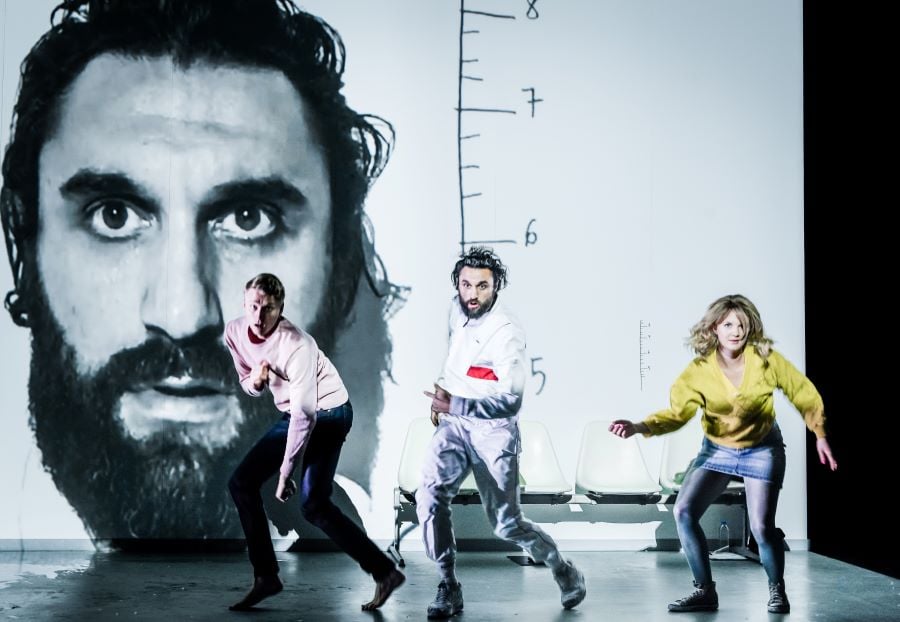
Simultaneously, the production also sees his story mediated – splintered – through the lens of a small camera phone that the actors carried precisely around the stage, accompanied by a carefully controlled live score played by percussionist and keyboard player Thomas Witte.
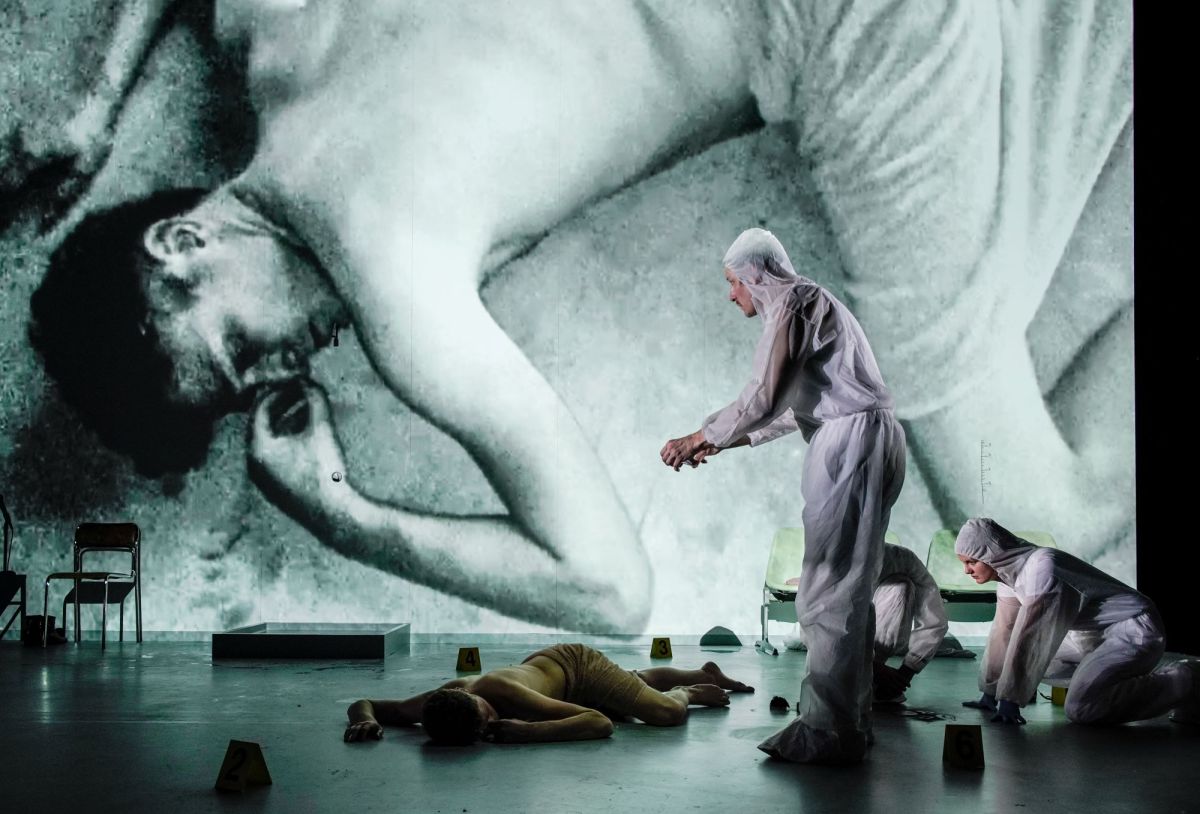
The camera captured and projected, in stark black and white, small details in real time on a screen at the rear of the stage, like a fingerprint identified and transferred to evidence tape, and Reda’s mugshots.
Pre-recorded video was seamlessly spliced into the footage, further adding to the sense of multiple perspectives on stage and the many truths and distortions of Édouard’s life-altering experience.
Confronting and exquisitely constructed theatre
Louis helped adapt his own novel for Ostermeier’s production of History of Violence, which premiered in Berlin in June 2018 and marked the first dramatisation of one of his books. (An adaptation of Louis’ first novel, En finir avec Eddy Bellegueule [The End of Eddy], by British theatre-makers Pamela Carter and Stewart Laing, was staged two months later in August 2018, and programmed at Melbourne Festival the following year; Ostermeier went on to direct a Schaubühne Berlin adaptation of Louis’ third book, Qui a tué mon père [Who Killed My Father] in 2021, in which the author performed his own text.)
Superbly structured and controlled theatre-making, Ostermeier’s History of Violence was a fascinating meditation on class, culture and the act and art of storytelling. The fracturing of self caused by violent events was skilfully captured on stage through both script and stagecraft. Short dance breaks reflected the way we endlessly replay memories. Laufenberg’s nuanced performance also brought Édouard’s deeply mixed feelings about his rapist – including his personal and political distaste for the carceral system – to convincing and complex life.
The production was also unflinchingly graphic at a pivotal moment, with Édouard’s rape played out in real time at the play’s gruelling emotional climax. The scene left this writer shaken but simultaneously awed by the stagecraft on display, given that Laufenberg and Schuch had to remember not only the relevant choreography and blocking while imbuing the scene with emotional authenticity – they also had to judiciously apply stage blood to hands and clothing in the short space of time available to them.
History of Violence was a highlight of Adelaide Festival’s opening weekend, a compelling, lingering and powerful theatrical exploration of a shocking and life-changing event.
History of Violence played the Dunstan Playhouse, Adelaide Festival Centre from 27 February to 2 March as part of Adelaide Festival. Browse all Adelaide Festival reviews.
The writer visited Adelaide as a guest of Adelaide Festival.