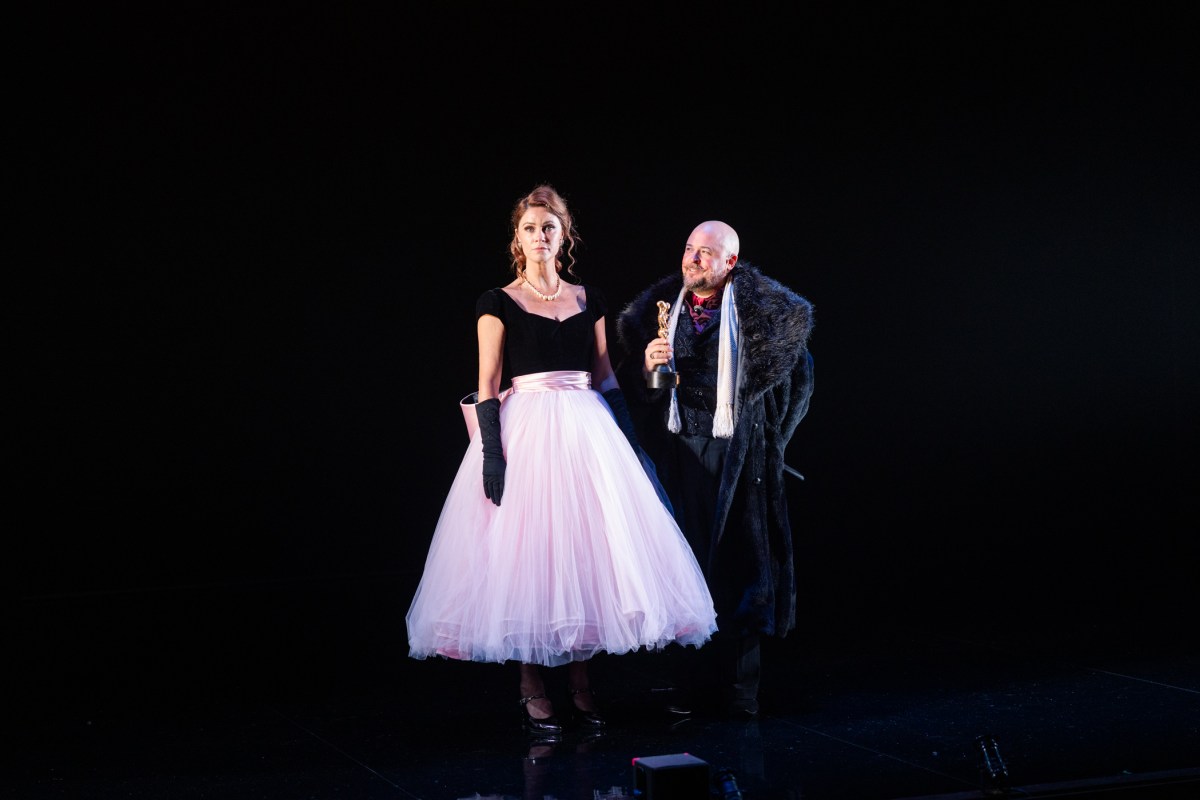
Here’s a nicety to ponder: what’s the difference between a theatrical device and a theatrical gimmick?
Few people today may be aware of Mary Orr’s short story about a larger-than-life Broadway star and the young sycophant whose fawning attentions initially conceal a rapacious ambition. It was titled The Wisdom of Eve and published in Cosmopolitan in 1946.
There are surely, however, even fewer who are unaware of Joseph L Mankiewicz’s film adaptation, All About Eve, which was produced by 20th Century Fox in 1950 and picked up six Oscars, including two for Mankiewicz as writer and director, a Best Supporting Actor statue for George Sanders (as Addison DeWitt) and another for Best Picture. It was nominated for a further eight, including for the four main female actors.
Malthouse’s All About Eve review – quick links
From Mankiewicz to the Malthouse
That Bette Davis didn’t win for her performance as Margo Channing in Mankiewicz’s All About Eve would seem to be one of the great injustices of the age. But she was in good company. Her co-star Anne Baxter, as the titular Eve, also missed out, as did, incidentally, Gloria Swanson, would you believe, in Sunset Boulevard. That year they all took a back seat to the redoubtable Judy Holliday for Born Yesterday.
Apologies, I digress. Suffice to say, the film version of All About Eve is one of the gold standards – a cracking screenplay, sensational performances and brilliant direction. For goodness sake, it even had Marilyn Monroe, luminescent in an early scene-stealing supporting role as Miss Caswell.
All of this is likely why we don’t see too many versions of it. It’s hard to compete with perfection and not many people would be game to attempt it.
Well, apart from Ivo van Hove, who adapted and directed the story at the West End’s Noël Coward Theatre in 2019. You may have seen that production here, thanks to that wonderful and now long-running initiative National Theatre Live, which distributed the filmed version. It had Gillian Anderson as Margo and Lily James as Eve, both acquitting themselves well.
And it’s van Hove’s adaptation that has now been staged for Melbourne’s Malthouse Theatre, with Dean Bryant in the director’s seat.
Taking on a beloved story
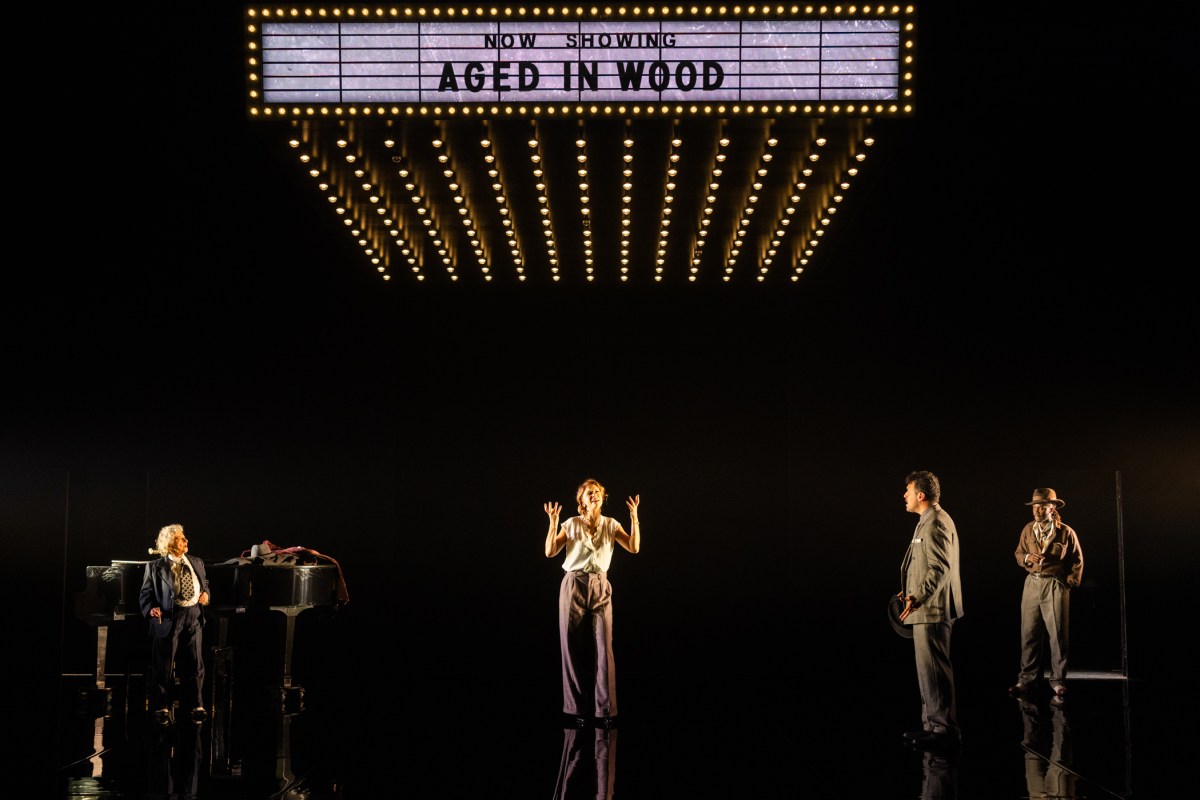
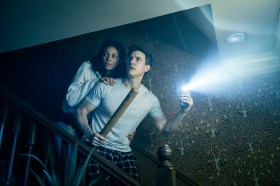
This is a terrific production – crisply directed and smoothly executed across the board. Dann Barber sets the scene with a simply multi-bulbed cinema ‘NOW SHOWING’ sign. Later, it becomes a thin, surtitle-like screen, replacing the words with the odd close-up of lips, but mostly ominous eyes – presumably Eve’s. They glower over the action, Big Brother-like, and only come into full colour as Eve’s ulterior motives reveal themselves completely.
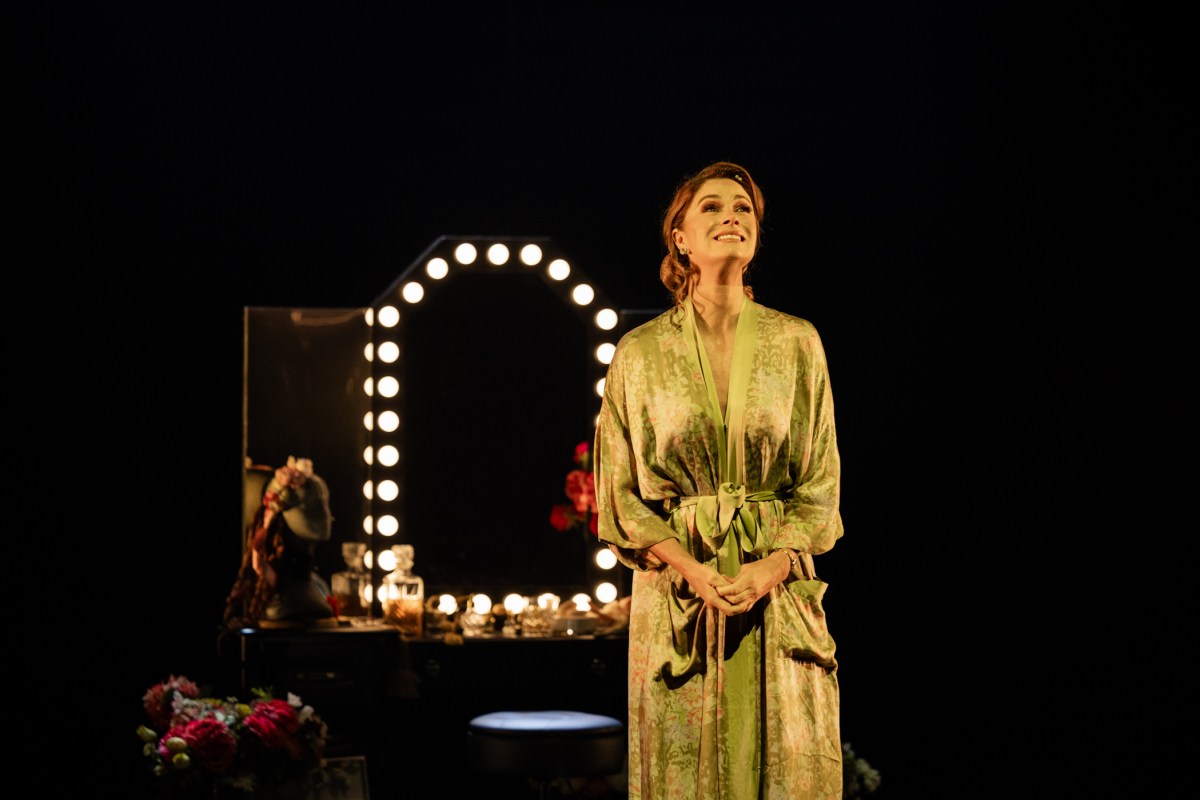
As the action commences, there are a handful of set pieces – a glamorous double bed, a piano, a restaurant banquette, a sweeping staircase bedecked with a couple of spherical Art Deco lamps, and a dressing room make-up mirror (of course).
These glide in and out of place so seamlessly, it’s a joy to watch. Sometimes the stagehands are in view, sometimes objects appear as if by magic – there’s a beautiful little touch when a calling card suddenly appears in the outstretched hand of Karen Walker (Christina O’Neill).
Christie Whelan Brown’s many costume changes – the reason for which we’ll get to shortly – follow the same convention, often swiftly performed centre stage in view of the audience, but now and again happening in the blink of an eye while attention is elsewhere.
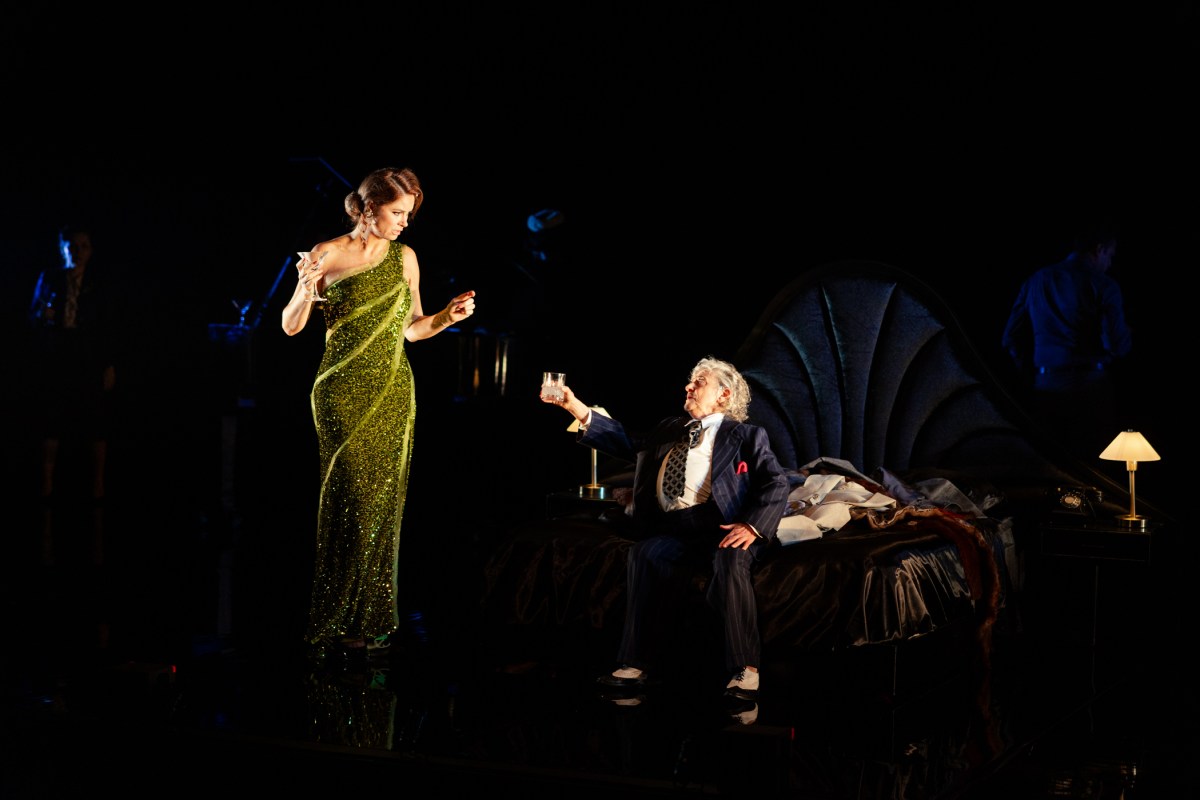
Said costumes, cleverly designed by Dann Barber, speak to mid-century glamour but without any fussy bells and whistles. They’re beautifully effective.
The costume and hair design also offer a smattering of Easter eggs – there are the ringlets that are also reminiscent of Bette Davis in Whatever Happened to Baby Jane, and especially the black wig worn by Evelyn Krape as Birdie, which is much more Edith Head (the 1950 film’s Oscar winning costume designer, with Charles Le Maire) than Thelma Ritter, who played the role originally.
Bolder is the soundscape. Rainbow Chan’s striking chords punctuate the action and are full of foreboding, making quite the impact when juxtaposed with the generally light touch applied to the text.
Actors acting
It’s a play about the theatre and the actors who live in it and love it, so it’s appropriate that the performances are strong across the board, even if it may be apparent that smoking isn’t a comfortable pursuit for some of the cast. (We live in a very different world to that of the 1950s.)
O’Neill is particularly notable as Karen Walker. She doesn’t play the role with quite the arch waspishness of a Celeste Holm, but she offers real heart and clearly conveys the agonies of being stuck between a rock and a hard place when her loyalties are tested and divided.
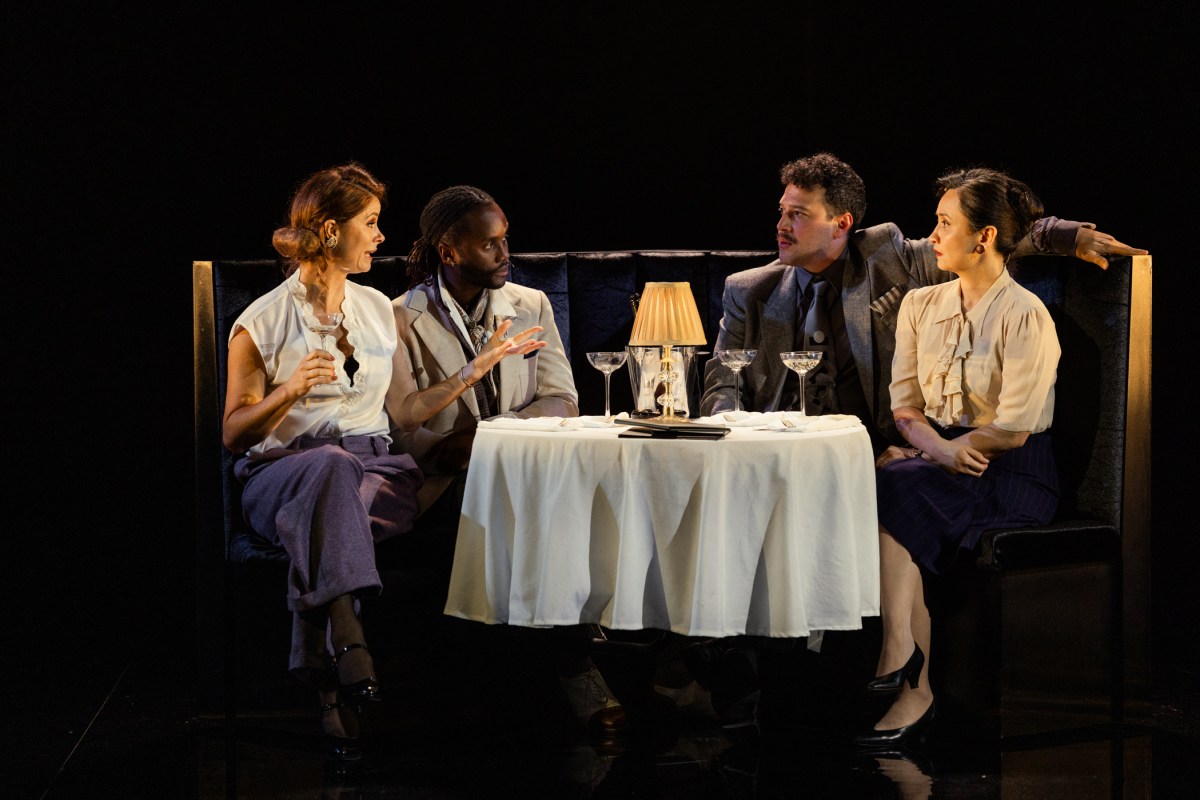
Brent Hill is also clearly aware that Addison DeWitt is one of the world’s greatest gifts of a role. He takes that gift and runs with it.
So many lines sparkle, but you’d be hard pressed to beat his delivery of, ‘You’re maudlin and full of self-pity – you’re magnificent!’
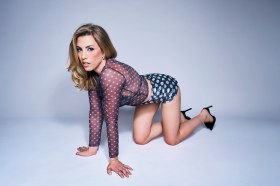
And then we come to Whelan Brown and this production’s USP, if you like, which is that she is playing both roles: Margo Channing and Eve Harrington.
If you’re wondering how this works logistically, as Margo and Eve often share scenes, Bryant has elected to lean into the theatricality. With a toss of the head, a perceptible change in physicality and, especially, a dramatic shift between vocal characteristics, Whelan Brown always makes it absolutely clear who she is at any given moment.
Sometimes the character change is marked with an audible swish on the soundtrack and other times not. Whichever way, the two characters are always distinct and carefully delineated. But the greater question is why?
Playing with convention
It’s completely understandable that, in taking on such a landmark show, you’d want to differentiate it from what’s come before. And here’s where the difference between a gimmick and a considered theatrical device comes into play.
When watching Suzie/Eddie Izzard play all the characters in Hamlet, Cynthia Erivo pull off the same with Dracula or Eryn Jean Norvill play 26 parts in The Picture of Dorian Gray, there’s a clear theatrical choice at work. And I doubt anyone sat in the audience thinking, ‘Another performer is missing out on an opportunity to shine here.’
In All About Eve, it could be argued that what was certainly a bright and even inspired idea isn’t actually carried through or reflective of the text.
If the concept is that fame-hungry actors are all alike – and whoever is in the ascendancy will always have the next one snapping at their heels and Eve actually is Margo, just 20 years younger – then Whelan Brown should logically also play Phoebe at the end of the play.
As it is, the only other actors playing more than one role are doubling up because their characters don’t appear in scenes at the same time, so they’re continuing a fine and time-honoured tradition.
And, also, the logic of the dual roles isn’t really supported by the text. There’s nothing that tells us Margo was just like Eve when she was younger. She’s blowsy and often overbearing, but do we get the sense that she was ever conniving, insincere and, indeed, downright Machiavellian? They are very different characters.
The script may tell us over and over again that Eve is younger (and apparently therefore prettier) than Margo, but we need to have it hammered home, because we certainly can’t see that difference when it’s the same actor playing both roles. It’s a point that was made abundantly clear in the National Theatre Live version, when the gorgeous and glamorous but undeniably mature Gillian Anderson faced off against the dewy-eyed Lily James.
Christie Whelan Brown is a tremendous talent and she certainly can play both roles with alacrity. But is this perhaps a case of just because you can, doesn’t mean you should?