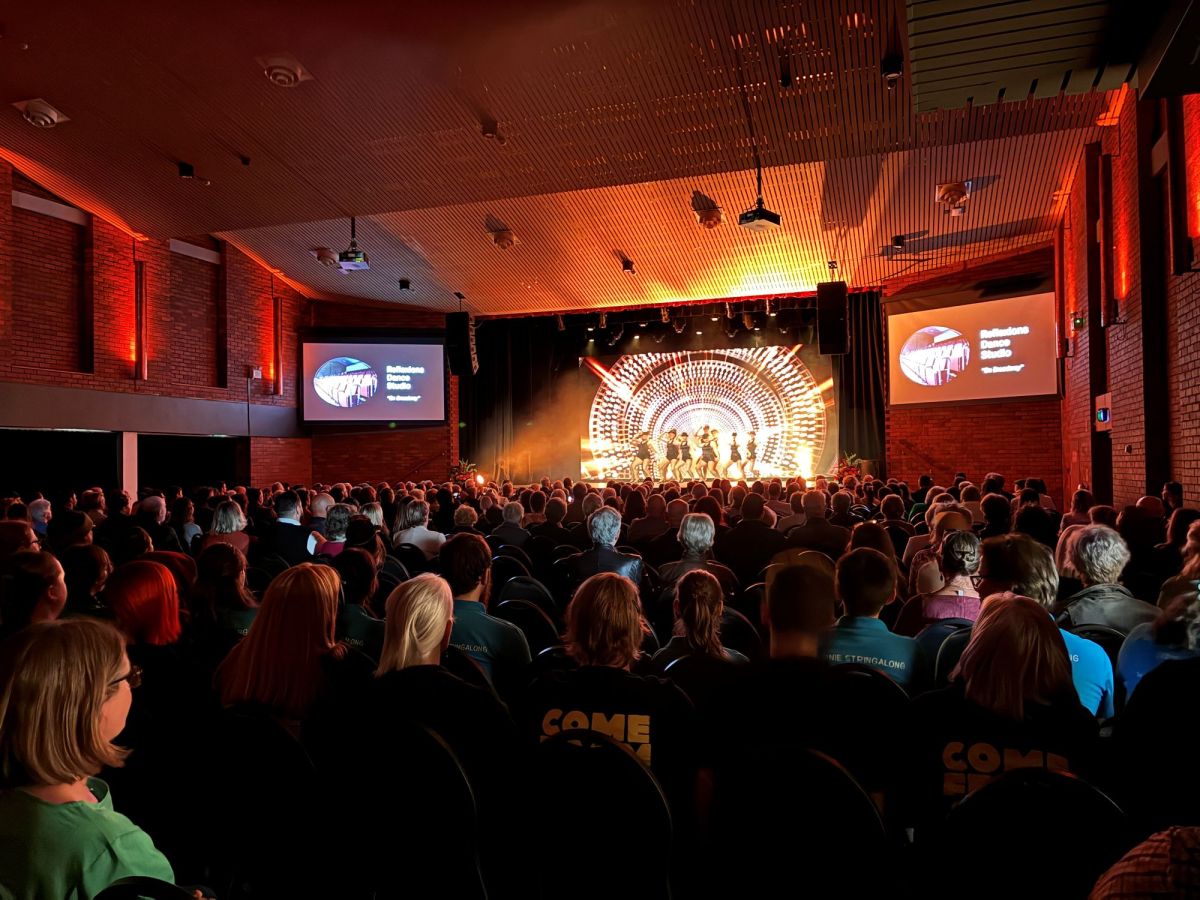
The $20.5 million redevelopment of ‘a tired 1970s performing arts centre’ into a cultural space in Burnie, north-west Tasmania/Lutruwita, saw the new Burnie Arts building opened last week.
The vision for the new centre was straightforward but ambitious: to create a cultural hub for the wider Burnie community and unite Burnie City Council’s fine art and museum collections, while simultaneously creating a multi-purpose venue for the performing arts, in a building that could also host functions, workshops and events.
Importantly, the revitalised and redevelopment building also needed to feel welcoming in order to break down cultural barriers and ensure that everyone felt welcome in the venue.
Burnie Arts: quick links
Burnie Arts: from modest to major redevelopment
Initially, with $5 million funding provided by the then-Coalition-led Federal Government, the project’s scope was modest. During the 2022 Federal election campaign, however, the Labor Party promised a further $13 million. Once the Albanese Government was elected, the Burnie Arts redevelopment became the only Tasmanian cultural infrastructure project listed in 2023’s national cultural policy, Revive.
Burnie City Council Mayor Teeny Brumby said the redevelopment project was important for the entire community.
‘This centre belongs to the people of Burnie. It’s where our stories, our talent, and our imagination come together under one roof. We recognised that the original building had excellent bones, and with a clever design we could stretch a $20 million budget to deliver something extraordinary,’ Brumby said in a media statement.
‘It’s a bold statement that Burnie backs itself, our city, our people, and our future. We’ve created something that doesn’t just showcase the arts but celebrates the heart and spirit of this community,’ she added.
Mark Viner, Director, Burnie Arts, tells ArtsHub that the redevelopment of the original civic centre, constructed in 1976, was ‘a total transformation of a tired 1970s performing arts centre that has served Burnie so well but was in desperate need of a makeover’.
He continues: ‘Fortunately, we received enough funding from the Federal Government to do more than a makeover – it is effectively a new building that, for the first time, merges our art, museum, performance and event operations with a café, casual meeting spaces and workshop facilities all in the one building.
‘The whole building features displays and stories and interpretations drawn from our collections and commissioned works that weave through all the public spaces. The vision was to create a cultural hub and social meeting place for our community, as well as continue to deliver all the functions that the building has carried out for so many years such as weddings, funerals, birthdays, formals, dinners, expos, meetings, etc.
‘In addition, the work includes full technical upgrades of both performance venues and enhanced mobility access throughout the building,’ Viner explains.
Burnie Arts: arts events continued despite reconstruction
Ensuring that Burnie Arts’ programs and operations could continue despite the ongoing redevelopment was an additional challenge. Several years of construction, during which Burnie Arts staff and builders all worked together on the site, with daily visitors also passing through, was ‘extremely challenging,’ Viner says, but has had clear benefits for Burnie Arts.
‘[It was] hugely important to take our community with us on the journey. As a result, audiences for performances have actually increased over the construction period, people are spending more time at the venue and arriving earlier to socialise [and] grab a drink,’ he explains.
Read: Tasmanian Live Performance Exchange to develop statewide strategic plan by and for the sector
‘We have been building our program and audiences consistently for the past four years and taking major steps to showcase Tasmanian work – we work with the other Tasmanian Performing Arts Centres and collectively established the Strategic Touring Fund with support from Arts Tasmania to support the touring of Tasmanian work – and we have also worked hard to bring back companies like Bell Shakespeare, Opera Australia etc, after an absence in Burnie of almost a decade.
‘The new venue will make all of this even better and will allow us to attract and deliver audiences for a broader range of performances as well as exhibitions,’ Viner says.
Burnie Arts: 2026 and beyond
Viner believes the new Burnie Arts centre is one of the best arts facilities in Tasmania. Its 2025 program included performances by the nationally significant Bell Shakespeare, the Launceston circus company Rooke and community arts representatives Burnie Musical Society, while exhibitions ranged from works supported through the Sharing the National Collection initiative through to the locally focused permanent exhibition, Early Burnie.
Viner said: ‘We have great plans to bring more creative opportunities to Burnie [in 2026] as well as be the champion for home grown activities by supporting our community’.
Burnie Arts’ 2026 program will be launched on 7 December, with highlights including the presentation of The Other Side of Me by Gary Lang NT Dance Company (‘a tough story, powerfully told’ according to ArtsHub’s 2023 Darwin Festival review of the production’s premiere season), produced by BlakDance, and the ‘Taiko percussion meets dance’ work Water Mirror, by Sydney-based company Danza del Arte.
‘Both of these will be stunning productions and yes, we were the first venue to gain support under the Sharing the National Collection initiative so individual loaned works and special exhibitions will feature prominently in our [2026] program,’ Viner says.
Some 100,000 visitors are expected to visit the upgraded arts precinct each year, according to Burnie City Council, whose Mayor Teeny Brumby said: ‘Burnie has always punched above its weight, but this takes it to another level. The new Burnie Arts Centre is proof that when we dream big and work together, remarkable things happen.’