Emerging in the 1960s, two collectives of paper architects responded to the pop-art, space-age zeitgeist. Archigram and Superstudio imagined speculative futures for architecture typified by high-tech megastructures. They disseminated their ideas through proposals, exhibitions, publications, and films.
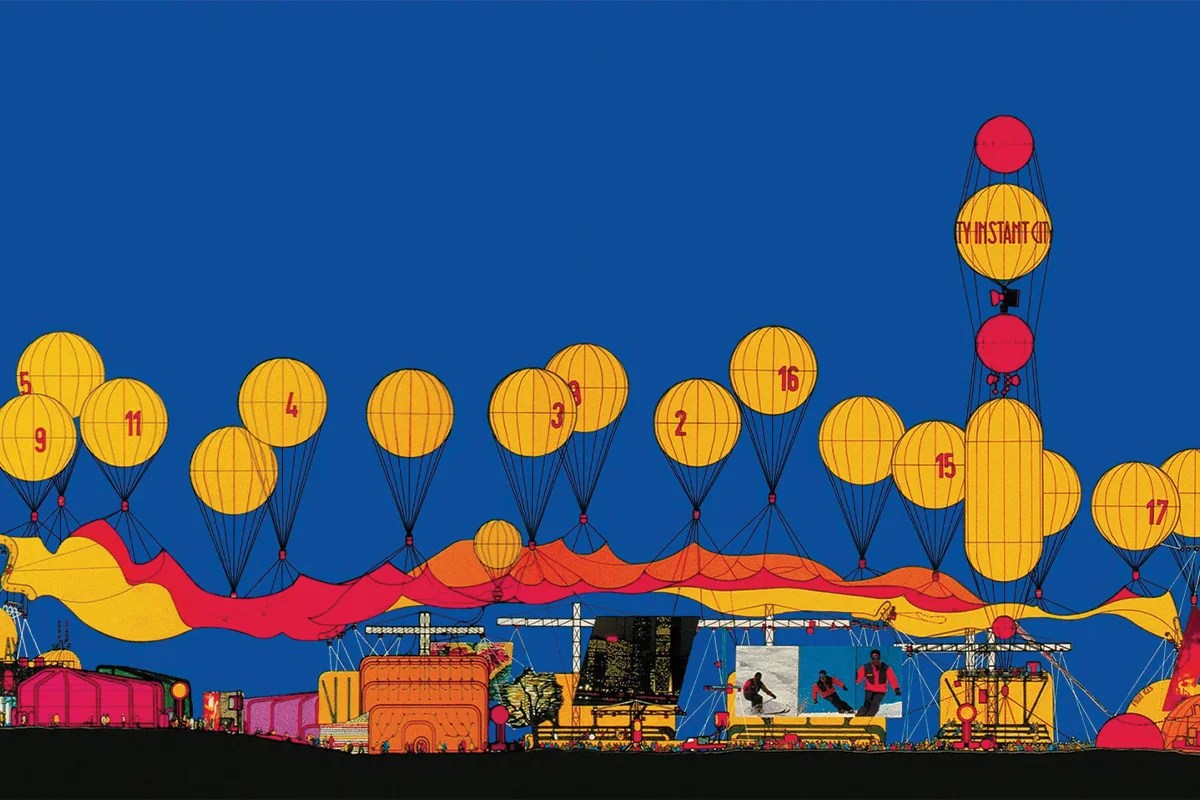
Founded in 1961 in London, Archigram (Peter Cook, Warren Chalk, Ron Herron, Dennis Crompton, Michael Webb, and David Greene) embraced media culture and disposability, technology and science fiction. In dowdy England, they proposed walking cities (moving on legs) and plug-in cities (consisting of masts into which standardised pods—dwellings, shops, classrooms, etcetera—could be provisionally slotted).
Founded in 1966 in Florence, Superstudio (Adolfo Natalini and Cristiano Toraldo di Francia, and later Gian Piero Frassinelli, Alessandro Magris, Roberto Magris, and Alessandro Poli) offered a critique of Archigram’s optimistic techno-futurism. They satirised it in Continuous Monument: An Architectural Model for Total Urbanization, an absurd proposal to cover the planet with a grid, a tiled expanse, where mobile citizens could rent coordinates and connect for periods of time. This ‘negative utopia’ represented a critique of the urban planning of the day.
Here we present a television program from 1967 outlining Archigram’s philosophy and two manifesto films by Superstudio: Supersurface: An Alternative Model of Life on Earth (1972) and Ceremony (1973).
For more information click here